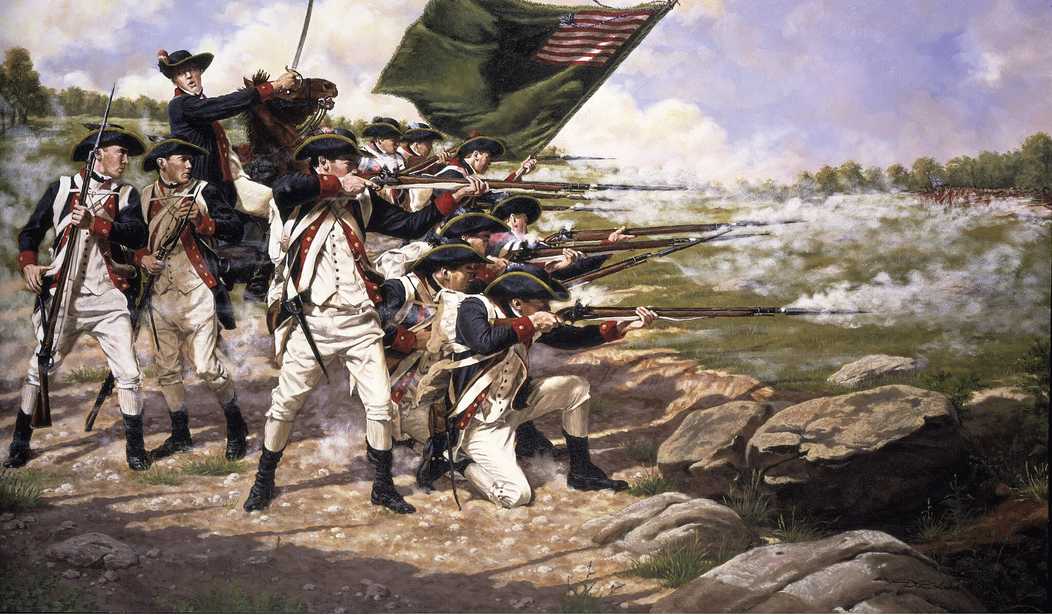
The Battle of Brooklyn, fought in the late summer of 1776, was the first major battle after America’s founding fathers signed the Declaration of Independence on July 4. The battle, which is also known as the Battle of Long Island, took place in what is now Brooklyn, N.Y., pitting the Continental Army under the leadership of Gen. George Washington against the global superpower, the British Empire.
Washington’s army lost the battle but it proved its resilience, and that helped shape the future of the war.
At the outset of the war, it was clear to Washington that control of New York was critical to success. New York had a deep harbor and central location, which made it more accessible to the other states. The British understood the strategic value of New York as well. They assumed that if they could crush the Continental Army in New York, they could bring about a quick resolution to the rebellion.
British Gen. William Howe assembled one of the largest expeditionary forces Britain had ever sent overseas, which consisted of over 30,000 troops that included Hessian mercenaries. British warships clogged New York Harbor.
Washington countered by moving his troops into defensive positions around New York City and over to Long Island. His goal was to block a British landing, but his army was largely inexperienced, poorly supplied, and outnumbered.
According to historians, Washington said that the coming events would determine “whether the liberties of America shall stand or fall.”
Digging in
The American troops dug in, forming defensive lines across the hills near Brooklyn, along Gowanus Heights and through wooded ridges. Washington’s strategy was to defend the narrow roads that cut through the hills, known as passes, and slow the British advance.
American commanders included Israel Putnam, John Sullivan, William Alexander, and Lord Stirling, who took charge of forward positions. A young officer by the name of Alexander Hamilton, then just a teenage artillery captain, was part of this force.
You’ve heard of Murphy’s Law: If anything can go wrong, it will. Well, that happened to Washington when, right before the battle, his best general, Nathanael Greene, fell ill. This affected the coordination of the American defensive lines. It also left holes in the line, such as at Jamaica Pass, which was poorly guarded.
The British Land on Long Island
General Howe began to move in August. His British troops landed at Gravesend Bay, south of Brooklyn, facing very little resistance because Washington was expecting the main attack to hit Manhattan.
British officer Henry Clinton had studied the topography and knew the terrain. He daringly decided not to hit the Americans head-on, but rather, to try to flank them through a secret march around the American left flank through Jamaica Pass.
Afterward, Clinton would write that the Americans were “completely surprised” by the tactic, which he credited to British reconnaissance and American misjudgement.
Before sun-up on Aug. 27, 1776, thousands of British troops moved silently under the cover of darkness through Jamaica Pass. Local loyalists guided them as they looped around behind the American lines. At the same time, Hessian and British units attacked from the front, pinning American forces down.
By the time the morning fog lifted, the British closed the trap.
American Gen. Sullivan’s troops were among the first to realize they were surrounded. Fighting broke out in the fields and the woods. As fierce as the fighting was, the Americans were overwhelmed by the disciplined, trained, and well-stocked British army.
One British officer described it: “The rebels ran with great precipitation, throwing away arms and accoutrements.” Yet many American units resisted stubbornly, buying valuable time.
The most famous stand of the battle came from Lord Stirling’s force on the American right. Facing superior British troops near the Old Stone House, Stirling ordered repeated charges to hold the enemy back while the rest of the army retreated.
A group of heroes in the battle may have saved the lives of hundreds of others who were able to escape to Brooklyn Heights. They were members of the “Maryland 400,” a group of young soldiers who attacked again and again, taking significant casualties, despite overwhelming odds.
Stirling himself was captured after refusing to abandon his men. Historical accounts say that Washington watched from Brooklyn Heights and was moved to tears by the sacrifice.
A battle is lost, but not the war
By the afternoon, American forces were forced to retreat to fortified lines near Brooklyn Heights. Around 1,000 Americans were killed, wounded, or captured. British losses were much lower.
Gen. Howe was known to be cautious, and so he chose not to launch an immediate assault on the American defenses. Rather, he began digging siege lines. He was confident that the Continental Army was trapped between his army and the East River and had nowhere to go.
Howe would later say that he preferred a more methodical approach, thinking that maybe the rebels might surrender or seek to negotiate to avoid a brutal frontal attack.
Escape across the East River
Washington did not surrender or negotiate. What he did is described as one of the boldest retreats in military history.
On the evening of Aug. 29, under a night sky, the American troops quietly began to cross the East River to Manhattan. They used small boats and were organized by fishermen from Massachusetts. Col. John Glover and his Marblehead sailors organized the operation.
To fool the British, fires were kept burning. Wagon wheels were muffled to reduce noise, while a dense fog descended on the river at dawn, hiding the final evacuees.
The British didn’t realize what was happening until after the Americans were gone.
Washington later wrote that the escape was “little short of a miracle.” Howe later admitted he was caught by surprise.
After this battle, Washington realized that facing the British through conventional, large-scale battles was too risky. He determined that going forward, the Continental Army would have to be more nimble, more mobile, and sharp at strategic retreats to preserve his fighting force.
The loss also hardened American resolve to win the war. Troops who survived the battle carried new determination into later battles. They quickly became battle-hardened.
After the Battle of Brooklyn, the British took control of New York City, which remained a Loyalist stronghold for most of the war. Historians often say that it was Howe’s caution that allowed the Revolutionary War to continue. Had he attacked aggressively after the main battle, the Continental Army might have been annihilated.
Washington later reflected that it was perseverance that mattered more than any one battle. As long as the Continental Army survived, Washington believed independence from Great Britain was attainable.
Related: ‘America 250’ Tuesday: The Battle of the Chesapeake