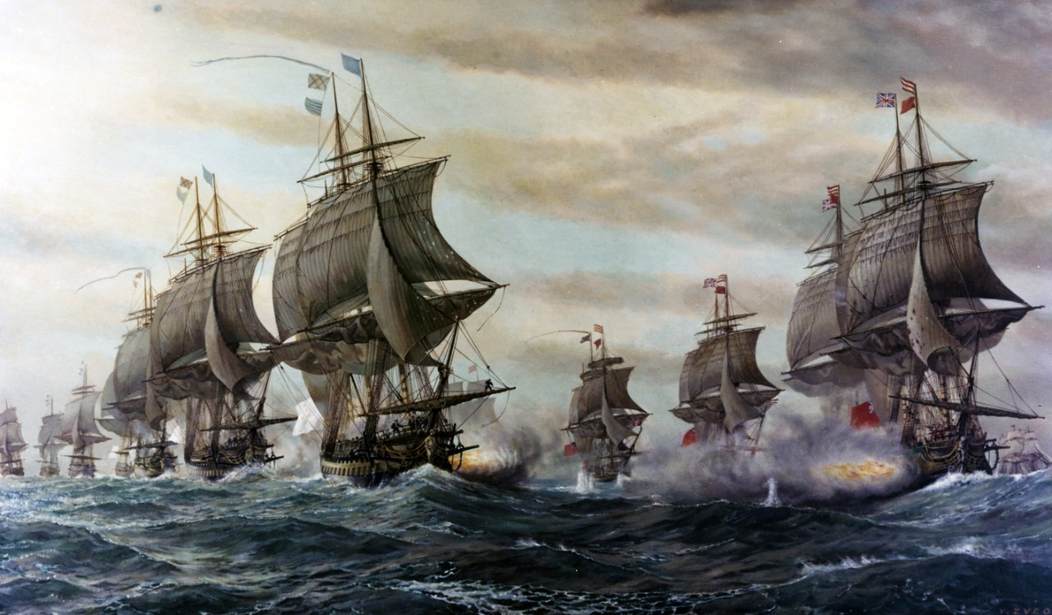

Of all the naval battles that occurred during the Revolutionary War, the Battle of the Chesapeake is the one that historians believe was the turning point for the patriot cause during the war. It was fought on Sept. 5, 1781, and it took place near the entrance to the Chesapeake Bay. A British fleet under the leadership of Adm. Thomas Graves faced off against a French Fleet commanded by Adm. François Joseph Paul, comte de Grasse.
The clash was also known as the Battle of the Capes. It may not have been the largest battle on water during the war, but what it accomplished was incalculable. The French victory prevented British naval relief from reaching Gen. Charles Cornwallis at Yorktown. It ensured that the British army would be trapped and ultimately forced to surrender.
By 1781, the American Revolution had evolved into a global conflict involving France, Spain, and the Dutch Republic, all fighting against Great Britain. The British strategy shifted toward the southern colonies, where they hoped loyalist support would allow them to regain control.
Gen. Cornwallis led British forces through the Carolinas and into Virginia. He established a base at Yorktown along the Chesapeake Bay. The key to his position was its reliance on the British navy’s ability to maintain supply lines and evacuate or reinforce his army. Meanwhile, Gen. George Washington and his French ally, the Comte de Rochambeau, saw this as a ripe opportunity to strike. They realized that through naval superiority, they could isolate Cornwallis.
Grasse’s arrival in American waters was critical. He sailed in from the Caribbean with a full fleet, coordinating with Washington, who was working to concentrate patriot and allied forces in Virginia.
British leadership saw the danger and dispatched Graves from New York to intercept the French. On Sept. 5, the two fleets sighted each other near the Virginia Capes, and a classic line-of-battle engagement began. Ships formed long parallel lines, exchanging broadsides of cannon fire, typical for naval warfare of the time.
Neither side won a decisive victory in terms of ships captured or sunk. Still, it was a strategic victory for the French fleet and the patriot cause. The British had trouble with communication. Constantly shifting winds created problems for the British formation on the water. Graves was never able to mount a concentrated attack. The French fleet was able to maintain better cohesion. In the end, it forced the British to withdraw.
Neither fleet lost many vessels outright. The French held control of the bay, while the British fleet was forced to retreat to New York for repairs and to regroup. With this, Cornwallis’s army on land in Virginia was effectively cut off from rescue.
Over the next few weeks, French naval forces blocked Chesapeake Bay while Washington and Rochambeau marched their combined American and French armies south. This led to the Siege of Yorktown. It put Cornwallis in a no-win position. Without naval support, he had no practical escape route. On Oct. 19, 1781, Cornwallis surrendered. This marked the end of the last major land battle of the war and forced the British government to enter peace negotiations. The Battle of the Chesapeake proved that control of the sea could help determine victory on land, something that helped shape the American military thinking from its earliest days.
Another important aspect of the Battle of the Chesapeake was its international makeup. While American forces played a crucial role in the Yorktown campaign, the naval victory itself was credited to the French. This reinforces that the Revolution depended on global diplomacy and international relations as much as local resistance. France’s contribution of ships, sailors, and its naval expertise turned a colonial rebellion into a global war, one for which Great Britain was not prepared.
The Battle of the Chesapeake exposed the limits of British naval dominance. History books frame the battle as a strategic masterpiece in terms of timing and ship-to-ship warfare. What it accomplished is what it prevented: British reinforcement and evacuation.
Without this victory, Yorktown might never have happened, and the Revolutionary War could have lasted years longer. Ultimately, the battle illustrated how naval warfare shaped America’s destiny.
Related: ‘America 250’ Tuesday: Alexis de Tocqueville on Democratic Sovereignty