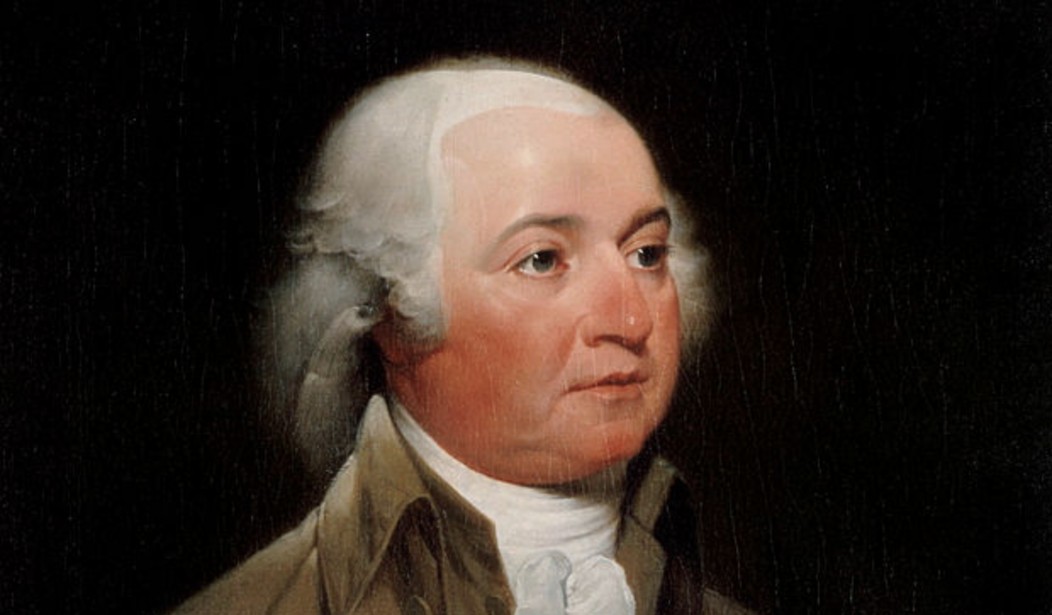

One of my favorite biographies of a founding father is David McCullough’s 651-page masterpiece on John Adams, fittingly called John Adams. There are biographies, and then there are stories. Some stories are powerful and interesting enough to make into Hollywood productions, and this is one. In 2008, actor Paul Giamatti played Adams in a highly recommended TV miniseries. He was joined by Laura Linney, who played Abigail Adams, John’s wife, and it is that dynamic that makes the whole John Adams story so compelling.
Since there isn’t enough space here to tell the whole story of John Adams, I’ll try to capture the essence of that unique and now legendary partnership that helped forge a young nation.
Winston Churchill said, “History is written by the victors.” While that is true, it is also written by those who could write and did write while history was unfolding. I think that was part of the legacy John and Abigail Adams left us. The correspondence between John and Abigail was so prolific and well written that it provided a priceless historical record of their time—not only in terms of the facts, or even the personal feelings that come through, but, even more importantly, in terms of their narration and commentary on historical events.
If you read any of those letters, you’ll come away amazed by how intelligent and insightful John Adams was. And you’ll notice that Abigail was every bit as smart as her husband. They complemented each other, each seeing things the other did not or could not.
John was a Harvard-educated lawyer before he became a revolutionary patriot. He was drawn to Abigail’s mind, and he wasn’t just saying that. You can see it in his letters. To him, she was woman whose sharp mind and moral clarity matched his.
For her part, Abigail was self-taught and extremely well-read. She was highly versed in history, literature, and biblical scripture.
Historians have studied their correspondence, almost 1,200 letters in all, which is a dialogue that will hold your attention even if you hate love stories or “chick flicks.” All you need is a love of history.
You get to see how they were each other’s confidants, advisors, mentors, and counselors.
John Adams spent a great deal of time away, tending to the affairs of the revolution and the birth of a nation. During the revolution he was away from home for years at a time. He went abroad for long periods, and when he left there was never the assumption he would return home safely. Meanwhile, Abigail managed their farm in Massachusetts. She raised their kids, and she provided her own version of leadership to the people around her who looked to her as her husband’s proxy.
John often referred to her as “my dearest friend” and “the rock upon which I lean.” At a time when spousal roles followed a hierarchy, their partnership was one of two equals characterized by immense mutual respect.
Each handled their separation and John’s absence from family life through the knowledge that some things are bigger than ourselves, and sacrifice to achieve those things is more important than personal wants or needs.
In her letters to John, Abigail often talked about liberty and justice. John had a notorious temper and drive, and she grounded him. He was often tough to get along with, and she was often there to remind him to be more patient and tolerant, not only because it was the right thing to do, but because it might help him actually accomplish what he wanted in the end.
In addition to their contributions to the country during the Revolutionary War and the forming of a government, they also gave the world their children, one of whom, John Quincy Adams, would become president himself.
Here are some gems from their letters to each other, the first ones being from Abigail to John:
- "Learning is not attained by chance, it must be sought for with ardor and attended to with diligence."
- “If we mean to have Heroes, Statesmen and Philosophers, we should have learned women. The world perhaps would laugh at me, and accuse me of vanity, but you I know have a mind too enlarged and liberal to disregard the Sentiment. If much depends as is allowed upon the early Education of youth and the first principals which are instill'd take the deepest root, great benefit must arise from literary accomplishments in women.”
- "The habits of a vigorous mind are born in contending with difficulties."
- “Arbitrary power is like most other things which are very hard, very liable to be broken”
Now, let’s hear from John’s letters to Abigail:
- “I must study politics and war that my sons may have liberty to study mathematics and philosophy.”
- “The longer I live, the more I read, the more patiently I think, and the more anxiously I inquire, the less I seem to know...Do justly. Love mercy. Walk humbly. This is enough.”
- “[Independence Day] will be the most memorable Epocha, in the History of America. I am apt to believe that it will be celebrated, by succeeding Generations, as the great anniversary Festival. It ought to be commemorated, as the Day of Deliverance by solemn Acts of Devotion to God Almighty. It ought to be solemnized with Pomp and Parade, with Shews, Games, Sports, Guns, Bells, Bonfires and Illuminations from one End of this Continent to the other from this Time forward forever more. You will think me transported with Enthusiasm but I am not. I am well aware of the Toil and Blood and Treasure, that it will cost Us to maintain this Declaration, and support and defend these States. Yet through all the Gloom I can see the Rays of ravishing Light and Glory. I can see that the End is more than worth all the Means. And that Posterity will tryumph in that Days Transaction, even altho We should rue it, which I trust in God We shall not.”
John wrote these last words in a letter to Abigail that was dated July 3, 1776, the day before the Revolutionary War started. The day before the very first victory and defeat in that war. A time when all he could possibly have was hope and conviction. Not only was nothing settled on that day, but nothing had even begun. And yet here we are, almost 250 years later, after Adams and a few people like him willed this nation into being. A nation that would change all of world history in ways that even John Adams could not imagine.