





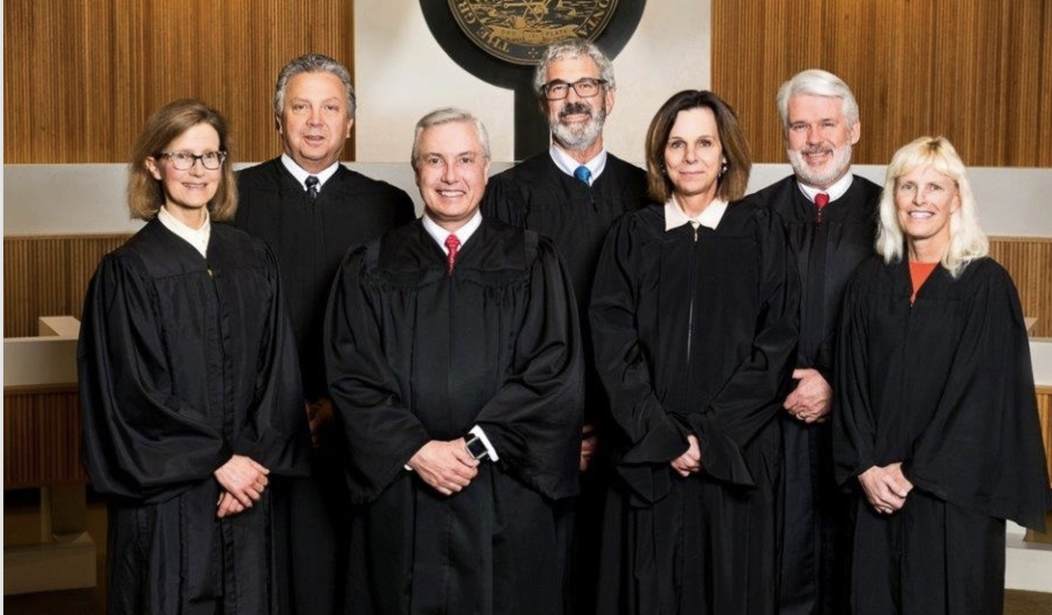
Some judges can’t seem to grasp what comes easily for ordinary folk. Like knowing what a woman is. U.S. Supreme Court Justice Ketanji Brown Jackson didn’t seem to know the answer at her confirmation. Now, five members of the Montana Supreme Court — Laurie McKinnon, James Shea, Ingrid Gustafson, Katherine Bidegaray, and Beth Baker — seem equally baffled, earning them our June Dishonorable Judicial Conduct Award.
Every month, we pick the worst judicial decision we have run across, based on a judge or judges issuing a decision so outrageous, so outside of the law, so defiant of reality, that it qualifies for being an embarrassing, and often shameful, miscarriage of justice. Since last month’s winner was Justice Jackson, it seems appropriate that these five judges have followed her down the rabbit hole into the equivalent of the fantasy world of Alice in Wonderland.
In 2023, the Montana legislature enacted a law defining “sex,” wherever it appears in state law, the way everyone did until recently, as “determined by the biological and genetic indications of male and female, including sex chromosomes.” The Montana Department of Public Health and Human Services, therefore, issued a rule that “sex” on birth certificates could be changed only to correct an error, that is, only if a person’s sex was misidentified on the original, and the same rule applies to driver’s licenses.
Two men who identify as “women” sued, claiming that this policy violated the state constitution. The district court issued a preliminary injunction against enforcing the policy, holding that it “likely” violated the Montana Constitution’s Equal Protection Clause. That clause provides that “[n]either the state nor any person, firm, corporation, or institution shall discriminate against any person in the exercise of his civil or political rights on account of…sex.” In a 5-2 decision, Kalarchik v. Montana, the Montana Supreme Court agreed.
Judges are supposed to settle legal disputes by interpreting and applying the law to the facts of cases. The law that applied to this case was a state constitutional provision and a state statute. Interpreting such written laws requires judges to determine what those who enacted the text intended it to mean. Not always easy, but pretty straightforward.
The key question is this: Did those who placed the key term “sex” in the Equal Protection Clause intend it to mean biological sex or to also include so-called gender identity? The plaintiffs’ expert witnesses defined “sex” to be “a person’s inner sense of belonging to a particular sex.” If “sex” means biological sex, the statute does not discriminate because neither males nor females may change that designation on a birth certificate. The plaintiffs’ case, therefore, required redefining “sex” to include “gender identity."
Writing for the majority, Justice Laurie McKinnon made clear from the get-go that the majority intended to deliver what the plaintiffs needed. The majority completely ignored whatever the people intended “sex” to mean in their constitution and instead opted for whatever reading would produce the outcome the judges wanted.
The majority, for example, repeatedly used gender-activist rhetoric—words such as “cisgender” and phrases such as “assigned at birth” — without attempting to connect it to the constitutional provision they were supposed to be interpreting. The entire opinion is saturated in transgender ideology and fake science.
Related: May’s Dishonorable Judicial Conduct Award Reaches the Highest Court in the Land
But the court did not stop at imposing upon the state constitution’s Equal Protection Clause a meaning of “sex” that those who put it there in 1972 could not have intended or even imagined. They went on to state, without any legal authority whatsoever, their key claim that “[t]ransgender discrimination is, by its very nature, sex discrimination” and “[b]eing transgender is a suspect class under the Equal Protection Clause.”
The plaintiffs had no case law or legislative history at all to support those claims, and so, wanting the plaintiffs to win, the court created them, steadfastly refusing to recognize that your sex is a matter of biological reality.
As Justice Jim Rice says in his dissent, which was joined by Justice Cory Swanson, this holding compels the state government “to issue falsified legal documents.”
Lots of things are changing in society, culture, and — if judges like these had their way — law. But our liberty requires that government, including the courts, exercise only the power they are given so that “we the people” can govern ourselves. If the people of Montana want to cater to the delusion that each of us is whatever we feel like we are (at least at the moment), then the people and their elected representatives can do so.
But if there’s to be any difference between law and politics, if the phrase “rule of law” is to mean anything, judges have to be either kept in their proper place or kept off the bench altogether.
Related: April’s Dishonorable Judicial Conduct Award in the Swinging Body Parts Case
In his separate dissent, Swanson explained not only why the majority was wrong in this case, but also the damage that this kind of political judging does to the public’s perception of the judiciary and the very concept of the “rule of law.” Swanson closed his dissent this way:
The more activist the court, the more its uncured decisions fuel the misunderstanding of the judiciary’s role and undermine the moral heft of its reason…The Majority’s sweeping and manifestly wrong decision based upon undeveloped constitutional logic and expressed policy preferences has produced more grist for the political mill.
For abandoning their judicial role and using “undeveloped constitutional” illogic to impose ideological “policy preferences” rather than follow the law, these five members of the Montana Supreme Court have earned the June Dishonorable Judicial Conduct Award.



Join the Conversation
VIP members get the ability to comment on articles.