





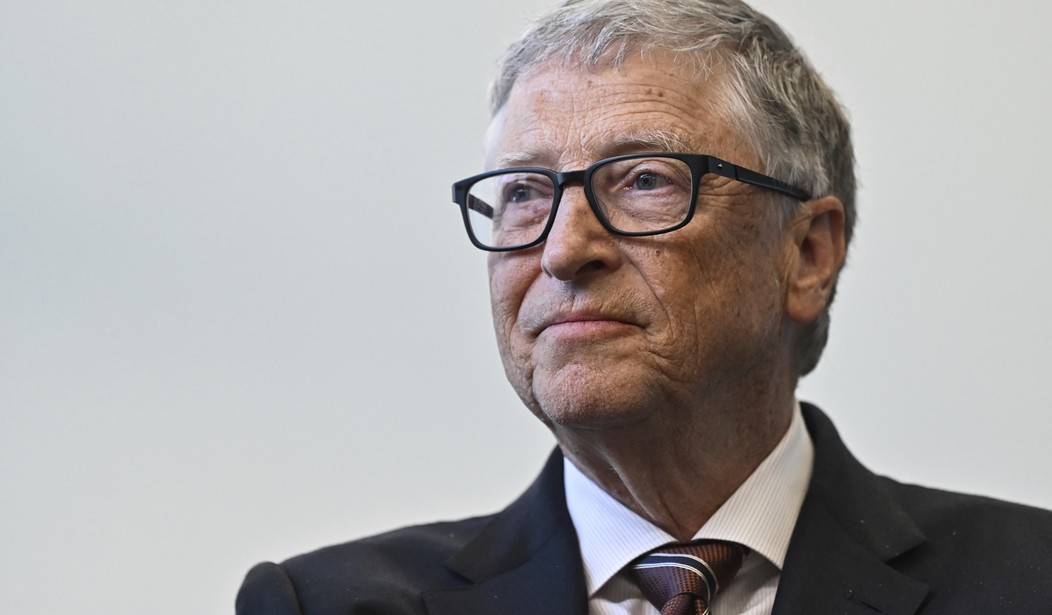
For 13 straight years — and 18 years overall — he was the world’s richest man. But that wasn’t the title he cared most about.
It was this one: the most admired man on the entire planet.
And for a while, he had it, too. For five straight years, he topped the polls.
Nobody was more admired than Bill Gates!
Even though he wasn’t a politician, actor, leader, or a sports star. Heck, he wasn’t even an active businessman anymore, but a rich retiree!
Of course, it didn’t happen by accident. Gates had to “pay to play” — and he paid through the nose: To date, the Gates Foundation has distributed over $110 billion globally.
That’ll buy you an awful lot of publicity, won’t it?
If you want to argue that Gates was purely motivated by altruism, I’ll simply point out that the Gates Foundation has a dedicated 24/7 online media center to field journalists’ inquiries, book interviews, quote its “experts,” plus a steady stream of press releases (1,519 of ‘em so far!). The website was clearly optimized to enhance media coverage, and obviously, people who prioritize media coverage are desirous of publicity. It’s what they value.
C’mon, folks: He named it the “Gates” Foundation for a reason.
And it worked, too. In 2006, NPR gushed over his character:
The image of Bill Gates this week has been of a warm, smiling man holding one of the millions of children that his billions of dollars of philanthropy have helped inoculate against a killing disease.
Do you remember when serious people referred to Bill Gates as the antichrist, evil, ruthless and greedy?
[…]
His change from monster to benefactor raises utterly human questions. Was Mr. Gates ever the greedy bossy miser depicted by his critics? Has his vast wealth made him feel more responsible for the world?
Sure, he might’ve been an evil capitalist billionaire — but somehow, he was one of the good guys. (Unlike that jerk, Elon Musk.)
For decades, Bill Gates has crafted the public persona of a nerdy but pleasant philanthropist. In contrast with the likes of Tesla's Elon Musk and Twitter's Jack Dorsey, Gates was likable, relatable, nonthreatening.
Gates continued to cultivate this personality — pledging to give away half his wealth through The Giving Pledge and investing heavily in healthcare and addressing the climate crisis through the Bill & Melinda Gates Foundation — as his money multiplied.
But today, his reputation is in the toilet. Gates is a public pariah.
There was his high-profile divorce from his wife of 27 years. Reports of (repeated) infidelity. Anger over his foundation’s COVID response. Allegations of sexual harassment in the workplace.
And most of all, there was the looming specter of Jeffrey Epstein.
Bill Gates planned to give his wife antibiotics without her knowledge fearing he had caught a sexually transmitted infection from “Russian girls”, Jeffrey Epstein claimed in an email that was released by the US Department of Justice on Friday.
Epstein, the late paedophile financier, alleged that the Microsoft billionaire had asked him to procure the medication in what appeared to be draft emails he sent to himself, addressed to “Bill”, on July 18, 2013.
Naturally, Gates denied the Epstein email. (As well as any wrongdoing with Epstein.)
Naturally, it didn’t matter: The accusation was so vile, it stuck in the public’s mind.
Instead of being “nerdy but pleasant,” Gates now seemed creepy and perverted.
Throughout the Epstein controversy, Gates assumed a low profile. For over a year, he deliberately stayed out of the limelight, canceling keynote speeches before world leaders, patiently waiting for the PR firestorm to pass.
And this week, he finally made his move:
New York Times: Bill Gates Is Warning That AI Is More Dangerous Than Big Tech Will Admit
The Verge: Bill Gates Is Deeply Worried About AI, and He’s No Longer Staying Quiet
Axios: Bill Gates Sounds the Alarm on an AI Transition
CNN: Bill Gates: AI Debate ‘1,000% Bigger’ Than Nuclear Debate
CBS News: Bill Gates Issues Stark Warning About AI’s Impact on American Jobs
NBC News: Bill Gates Is Sounding the Alarm About Growing Risks Posed by AI
HuffPost: Bill Gates Issues Stunning Warning About Even a ‘Best Case’ AI Scenario
CNN: Bill Gates Says There Needs to Be Limits on AI
CNBC: Bill Gates Warns ‘There Is No Plan’ for the ‘Upheaval’ AI Will Cause
Washington Post: Bill Gates Was an AI Optimist. Now He’s Scared of What Could Go Wrong.
But of all the headlines, MarketWatch’s was closest to the truth: Bill Gates Issues a Stark Warning About AI — and Americans Increasingly Share His Concerns
An August poll from the Pew Research Center found that 52% of Americans say they are “more concerned than excited about the increased use of AI in daily life.” That’s up from 37% in 2021. Just 9% say that they are more excited than concerned, and about a third of Americans are equally excited and concerned about the technology.
Fearing AI is now a bipartisan issue. (Which is notable, ‘cause there aren’t too many bipartisan issues left.)
Three-quarters of Americans think AI should be more regulated, according to YouGov, a pollster, with Republicans nearly as keen as Democrats. Almost two-thirds of Americans think the technology is advancing too quickly, versus only 2% who say “too slowly”, according to the Pew Research Centre. Policy is struggling to keep up with the pace of change.
Americans of both parties fear that AI will disrupt people’s lives, their jobs and even their children’s future romantic attachments. A whopping 45% say they are very or somewhat concerned that AI might cause human extinction, according to YouGov. Fully 65% think it will reduce the number of jobs available in America (74% of Democrats and 56% of Republicans). More than 70% fret about the exacerbation of mental-health problems and the concentration of power in tech firms.
The intensity of Americans’ anxiety sets them apart. A poll by Pew last year found that Americans were more pessimistic about AI than people in any of 24 other countries surveyed. [emphasis added]
Which is why politicians in both parties are pandering to anti-data center hysteria.
Seven in 10 Americans oppose constructing data centers for artificial intelligence in their local area, including nearly half, 48%, who are strongly opposed. Barely a quarter favor these projects, with 7% strongly in favor.
[…]
The data center question parallels the wording Gallup uses to ask about local nuclear power plant construction. In the same March survey, 53% of Americans say they oppose building a nuclear energy plant in their area, far less than the 71% opposed to data center construction. Since Gallup first asked the nuclear power plant question in 2001, the high point in opposition has been 63%.
Gallup’s numbers are overwhelming: 75% of Democrats, 74% of independents, and 63% of Republicans oppose data centers.
If you’re a “tech expert” looking for a tech issue to exploit, AI and data centers are the motherlode.
Which is why fearmongering AI is the lynchpin of Gates’ campaign to resuscitate his PR image. This was 100% a deliberate rollout.
Gates, after all, released his anti-AI screed on his own media outlet. He controlled both the content and the timing. He then made sure he was available to discuss it on-air with CNN. And in print with GeekWire’s editor and co-founder. As well as with the journalists at Axios.
I guarantee you, there’ll be more interviews, more feature stories, and more grim warnings about the coming AI catastrophe. This is just the beginning of his PR campaign — not the end — because that’s how PR campaigns are designed.
And we know he’s thinking of PR because Gates explicitly brought it up to GeekWire. Only in Gates’ retelling, it’s the pro-AI crowd that’s cynically playing the PR game, not him:
[Gates] said the public argument among AI companies over whether the risks are real is beside the point, because privately the people running them already agree. “I know they’re all worried,” he said, “or all of them that I know, which is basically everybody but Elon.”
People inside AI companies who acknowledge the downsides, Gates said, get told: “Hey, you’re hurting our PR while we’re trying to raise trillions of dollars.”
Methinks the lady doth protest too much: If anyone is hypersensitive to “hurting” his PR, it’s Gates, circa 2026. More often than not, the opposite is true: The leading AI companies tend to overplay how dangerous their models are, because it implies they’re ultra-powerful and cutting-edge.
Well, it’s 2026, and we’re up to GPT-5.6. Guess it wasn’t too dangerous after all.
But even though the sky (still) hasn’t fallen, public opinion is increasingly hostile towards AI. Americans of all stripes hate it. You can’t open X or TikTok without being inundated with anti-AI and data center hysteria.
Turns out there’s an excellent reason why:
The X Safety team conducted an investigation into suspected Chinese inauthentic accounts involved in influence operations:
— Global Government Affairs (@GlobalAffairs) August 28, 2026
We identified a bot farm of approximately 200,000 accounts. Within this farm, we found 200 accounts posting in a manner that could manipulate a legitimate… pic.twitter.com/Mj0SqerdlH
Fun fact: 84% of Chinese people are excited about AI, compared to just 38% of Americans. And that’s despite American companies and American researchers advancing faster than their Chinese competitors.
The Chinese people consume different AI propaganda than Americans — and it shows.
The race for AI supremacy will define the 21st century. At stake is nothing less than global dominance in every field, industry, and professional sector.
Including the military.
For his own reasons, Gates is incentivized to demonize AI. Of all the tech issues in the public sphere, it’s his best bet to regain what he values so damn much; he already spent $110 billion to achieve it.
And that’s worldwide respect and admiration.
The wildcard is China: Gates and the Chi-Coms now have the exact same PR goals. And just like Gates, they have oodles of money, bots, and resources to throw at the problem, too.
Oh, by the way, Gates is hoping to land a meeting with Chinese President Xi Jinping to discuss AI.
Unofficially or not, a PR alliance between China and Gates is now probably inevitable.
One Last Thing: 2026 will reach a crescendo with the midterm elections. Nothing less than the future of our country teeters in the balance.
Never before have the political battle lines been so clearly defined. Blue wave or red wall, one way or another the 2026 midterms will transform our country.
We need your help to win the media war!
As a PJ Media VIP member, you’ll receive exclusive access to our behind-the-paywall content, commenting privileges, and an ad-free experience. VIP Gold gets you the same level of “insider access” across our entire family of sites (PJ Media, Townhall, RedState, twitchy, Hot Air, and Bearing Arms). That means: More stories, more videos, more content, more fun, more conservatism, more EVERYTHING!
And if you CLICK HERE and use the promo code FIGHT you’ll receive a Trumpian 60% discount!
Thank you for your consideration.
Join the Conversation
VIP members get the ability to comment on articles.