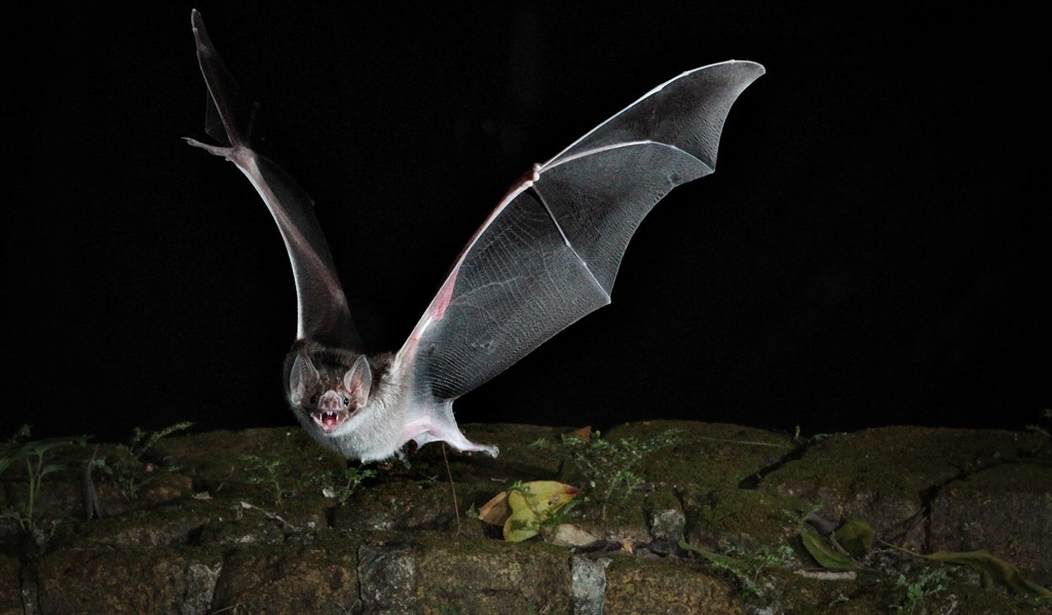

As we saw in a story featured in the previous "Predator Watch" column — about a Kentucky woman who remained asleep in bed while a bear entered her home and ate her leftover KFC — a wild animal encounter can occur even in the safety of one’s home. Yet after a year of covering these stories, this one shocks even me.
Krista Edelman, a gastroenterologist, was asleep in her Richmond, Va., home, which is almost 100 years old. As she explains in an Instagram video she shared on August 21, she thought she was dreaming that morning about a mouse trying to get into her mouth. But it was no dream, and — although some people may refer to the animal in question as a “flying mouse” — this was no mouse.
Edelman soon correctly identified the animal using only her sense of touch: “I’m half-asleep. I reached up to my mouth, again, still thinking this is a dream, and then I touched something that is kind of slimy, and a little hairy and cool, and I immediately somehow knew it was a bat.” Her choice of verb perfectly conveys the horror of this nightmarish incident (emphasis mine): “This bat was legitimately trying to burrow between my lips into my mouth."
While her instinct initially kicked in, prompting her to grab the bat and throw it across the room, she drew on her medical background for her next step. “As a physician, I knew we were supposed to try to catch this bat so that it can actually be tested and see if there are rabies are in its brain, because rabies is relatively prevalent in bats,” she says in the video. She pulled a comforter over her head and screamed while her husband tried to catch the bat, eventually succeeding with a plastic net and a bucket.
Edelman did not go to the ER right away, perhaps because she had no visible bite marks, although bats’ teeth are so small that a person cannot necessarily tell whether they have been bitten. Instead, she went to work and saw patients. Local news station 12 On Your Side reports what she did next:
She said she later called Dr. Nate Warner, an infectious disease doctor at VCU, who told her that exposure closer to the brain — such as in the mouth — could carry a more accelerated rate of transmission than an exposure on arms or legs. Edelman said that information, along with learning that Richmond Animal Control had recorded at least five rabies-positive bats in Richmond and Henrico so far this year, led her to go to St. Mary’s Hospital after her workday.She received two vaccine doses before the test results from the bat came back negative and she was able to stop treatment. However, one of the doctors who treated her, Adam Landsee, described how unusual and worrisome the incident was: "To actually have a bat in the mouth, assuming that’s a mucous membrane and a bat is crawling in with its head or its mucous membranes, its saliva, it’s a pretty concerning exposure."
Related: Predator Watch: Bear Attacks Hit Historic Levels in This State
While this story had a happy ending for Edelman, a similar incident from 2024 ended tragically. An 11-year-old boy from Canada woke up to find a bat lying on his nose and mouth. Like Edelman did, he swatted the bat away, and his father caught it and released it outside. Because his parents didn't see any scratches or bites on his face and he was not acting oddly, they didn't consider rabies or take him to a hospital. CBC recounts what happened next: "Almost three weeks later, the boy developed tingling, numbness and swelling on the right side of his face. His neurological condition deteriorated in the following days, following trips to an urgent care clinic and emergency department, where he was eventually taken off life support and 'died peacefully with his family at his bedside,' the case report said."
After reading such a devastating story, Edelman's video is harder to dismiss as just a viral sensation. She called it a bat PSA and offered this message: "Get your exterminator to come out to check your attic and your chimneys, especially if you live in an old house in Richmond like I do."