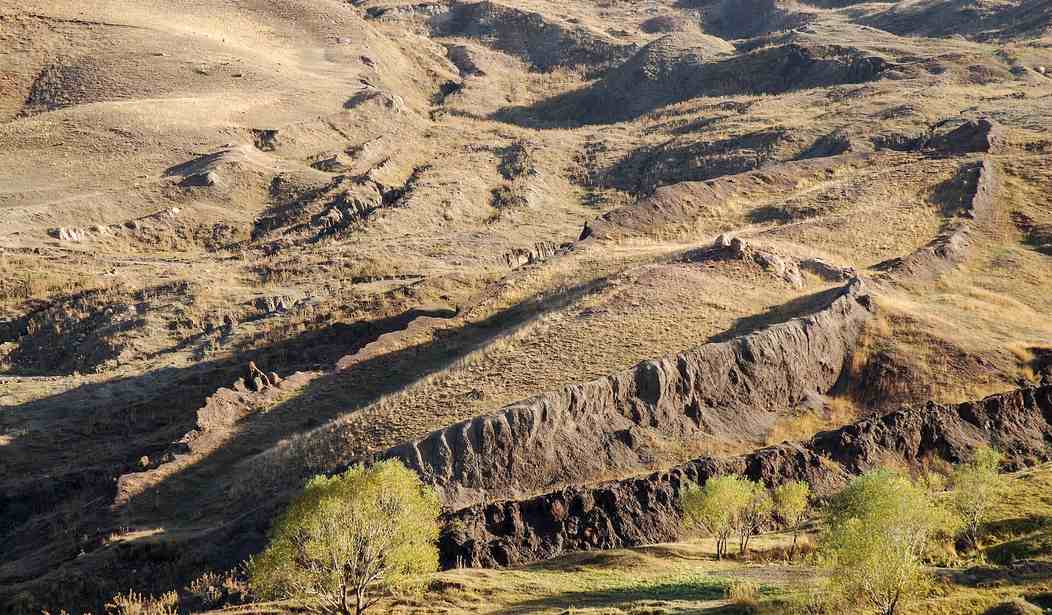

In 1959, Turkish Army Captain İlhan Durupınar was flying over Mount Tendürek, a volcanic mountain in eastern Turkey about 18 miles south of Mount Ararat, when he saw what looked like a boat 2,000 feet above the ground. Later surveys discovered it was 538 feet long. According to the Book of Genesis, Noah's Ark was built to a length of 300 cubits. Depending on the specific cubit measurement used (such as the Royal Egyptian cubit of roughly 20.6 inches), 300 cubits translates to about 515 feet, making the formation's length remarkably close to the traditional biblical dimensions.
This is what piqued amateur archaeologists' interest in the first place. Durupınar's photo was leaked to the media and raced around the world.
Geologists classify the site as a natural syncline (a rock fold) composed of limonite and weathered volcanic minerals rather than a man-made vessel. Nevertheless, the two anti-creationist scientists who made the initial survey nominated the site as an International Geological Heritage site.
Why does it matter whether this turns out to be Noah's Ark? Because we are in a narrow window. We still have the stories, and we finally have the tools to test them. Both of those are temporary. Sites erode, records are lost, and in 10,000 years nothing about this argument will have survived. Whatever the cores come back with, millions of people are now paying attention to the question of where we came from. What else should we be testing while we still can?
— Megalithic Mysteries (@Megalithic12000) September 24, 2026
After Captain İlhan Durupınar’s initial 1959 aerial discovery, small groups made early investigative visits, most notably including American researcher Dr. Arthur Brandenberger and a team that included early ark hunter George Hagopian in the 1960s.
Then, in the 1980s, amateur archaeologist Ron Wyatt and former merchant marine officer David Fasold led multiple high-profile expeditions starting in the mid-1980s. They used early metal detectors and ground-penetrating radar (GPR), and partnered with Turkish geologists (such as Dr. Salih Bayraktutan) to conduct early core drilling and subsurface tests.
Beginning in the early 21st century, independent geologists, documentary teams, and university researchers periodically returned to the site to sample the soil and test the geological syncline hypothesis, publishing papers that refuted its artificial nature.
By 2020, the technology allowed better surveys than ever before. Sophisticated ground-penetrating radar, deep core drilling, soil surveys, and electrical resistivity tomography (ERT) have given a 3-D picture below the surface and have raised almost as many questions as they have answered.
"With hundreds of soil samples from both inside and outside the formation, some reaching 60 feet in depth, experts said analysis will show if man-made activity or decaying wood sit in the soil," writes Tim Newcomb of Popular Mechanics.
“When we drilled into the formation this year for the first time, we did not encounter any solid block of rock, of limestone [or] of any type of rock,” said Andrew Jones, Noah’s Ark Research Project vice president, according to Fox News. “We were hitting mainly soil. We’re still studying our results, but we believe that this should give [skeptics] pause when they say this is a rock formation.”
Three years ago, preliminary soil samples from near the surface exposed human activity and marine life. This time, researchers wanted to go deeper.
The researchers believe the carbon levels from samples within the formation were roughly 40 percent higher than those outside the formation, possibly due to a high concentration of wood. Even with the field work wrapped up for 2026, nothing’s certain until the laboratory analysis finishes over the winter.
Jones said the pottery finds could tie to two ancient settlements that once existed near the formation. “You can connect the dots,” he said. “If this is Noah’s Ark, we have people living right beside it early on.”
A "rock formation" not made rock? “What excites me most is that questions debated for decades can now be investigated using physical samples from documented locations and depths,” Jones told Newsweek. “We have taken a substantial step forward in our ability to test the site, not completed the investigation.”
Jones knows skeptics are waiting to tear apart any conclusion that Noah's ark could have rested in that spot. Indeed, tying whatever the researchers find to Noah, his family, and every animal "two-by-two" on the ark is an impossibility.
But evidence gathered in this last expedition could certainly support the story. For many, that's enough proof to satisfy the believers.
Also for our VIPs: What If a Solar Flare With the Power of a Trillion H-Bombs Hit Earth? It Would Be a Very Bad Day.