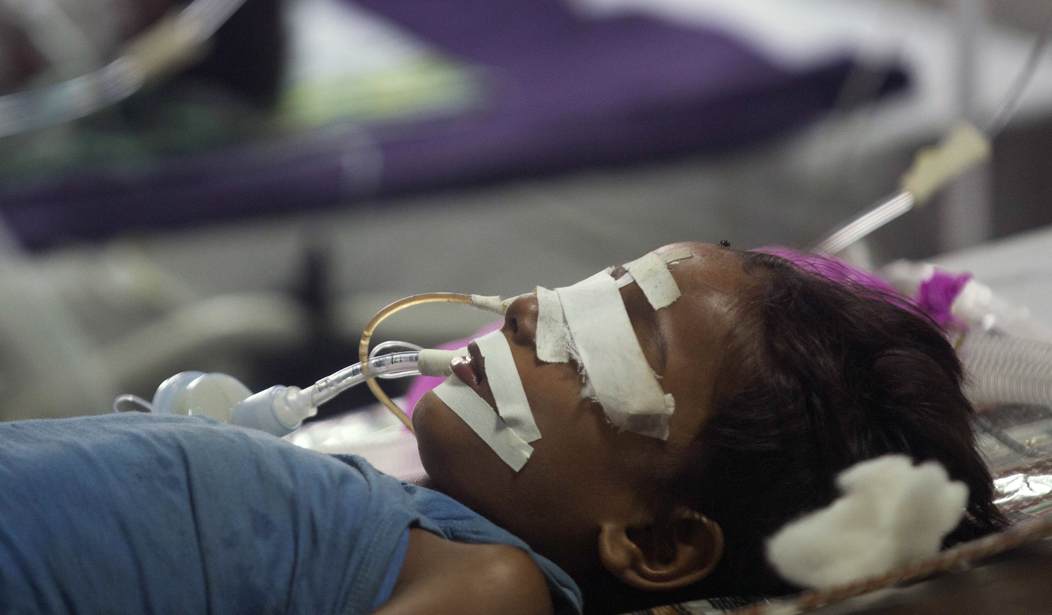

Darwin Daniel Sotolongo Cedres was just 10 months old when he died on Wednesday. The baby boy suffered from "grade 4 tracheal stenosis, a severe congenital malformation that causes critical narrowing of the trachea and seriously compromises breathing." He spent about half of his life in a hospital, in critical condition, hooked to a machine that helped him breathe, but it was not enough.
The problem wasn't necessarily that nothing could be done — while the issue is severe, it is also treatable. He could have had surgery. He could have potentially lived a long and happy life.
The problem was that little Darwin was born in a place where the citizens are treated no better than the piles of garbage that line the streets because the regime that cosplays as their government is only interested in what it can do for itself. He never had a chance.
"Sadly, the little angel didn't make it. He couldn't withstand the neglect, the mismanagement of the Cuban healthcare system, or the ineptitude of those who should have guaranteed him the care he needed in Camagüey. An innocent life that had barely begun is gone, a child who deserved to grow up, laugh, and live," journalist Jose Luis Tan Estrada posted on social media.
Darwin's mother said that doctors told her that the surgery the baby needed couldn't be performed in their home country due to the lack of resources. She was in the process of trying to help her baby have surgery abroad, but he died before she could get everything in order.
Cuba.
The problem in Cuba is that Darwin's story isn't unique. A two-month-old baby in Caibarién recently died because there was not enough medication or even general care available at the hospital. The recent dengue and chikungunya epidemics left 33 dead, most of whom were young children. Of course, those are just the regime's statistics. Some human rights groups say those numbers are much, much higher, and even those numbers could be higher due to lack of testing or lack of death reporting.
Poor sanitation and lack of running water that forced families to store water where mosquitoes could breed in it were largely to blame for the outbreaks. Many of the children who died only did so because they needed access to things such as IVs to prevent dehydration, or there was a lack of functioning medical machinery due to blackouts.
The overall infant mortality rate in Cuba is higher than it has been in decades. For every 1,000 births, 14 infants die. That's nearly triple the infant mortality rate in the United States, and seven times the rate in Japan.
I've read stories just this week of dead infants found in the garbage piles and of babies abandoned at a hospital. I've read stories of hopeless mothers who don't even have diapers for their little ones, so they're having to use gauze.
Almost all of this is preventable. And while the regime is, as always, currently blaming the United States, the reality is that this has been going on for a long time. Cuba's healthcare system collapsed for numerous reasons that had nothing to do with the United States quite some time ago, and it has taken its youngest residents with it.
On Friday, Donald Trump said that Cuba will fall soon. He says Marco Rubio is in talks with various people, that the regime is begging to make a deal, and that he will be sending Rubio over there soon. For these babies, the change can't come soon enough.