I have been kept by cats for more than 50 years, and the more I observe them, the more mystified I am by their otherworldliness. They do not seem to be of this Earth, or perhaps of this universe. Their mysteriousness is a large part of their charm.
I love dogs, too. But dogs are an open book: loving, loyal, and protective. Dogs want you to know them, to love them. They crave it. Cats? Not so much. They may want you to love them, but always on their terms, not yours.
I know there are cat haters out there reading this. Cats and I don't mind. We know we are more intelligent than dog lovers.
Don't believe me? Researchers at Carroll University in Wisconsin surveyed college students to assess personality traits and cognitive abilities alongside pet preferences. Self-identified cat lovers scored higher on measures of general intelligence, reasoning, and abstract thinking compared to dog lovers. Also, broader population surveys in the UK found that cat owners are statistically more likely to hold university degrees or higher education qualifications than dog owners.
Cats rule. Dogs drool.
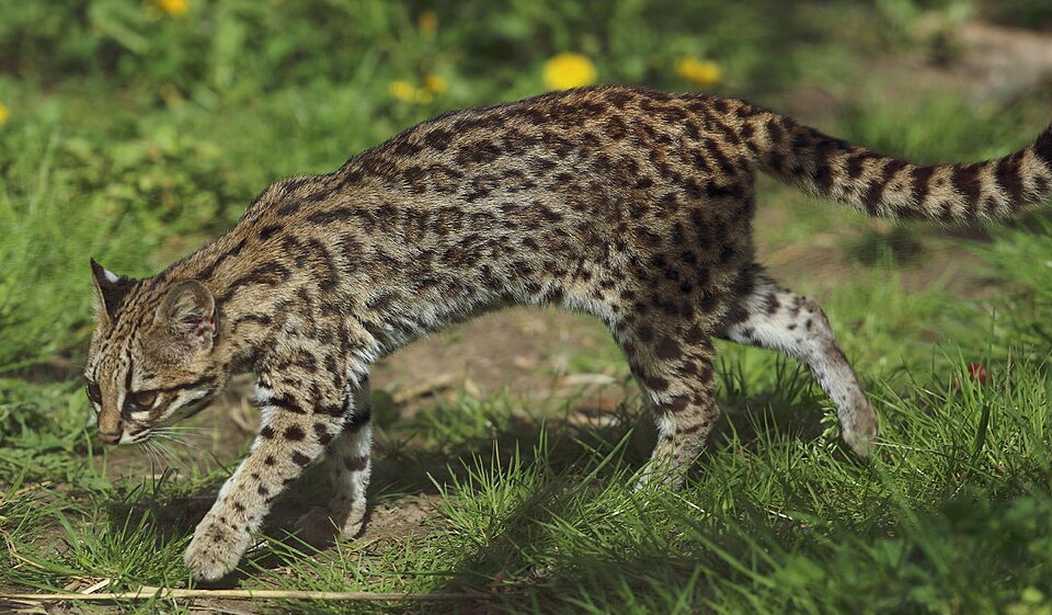
That said, a new species of cat has been discovered in the wilds of South America. It's a species of tiger cat that can only be identified by examining its genetics. It's the first new species of cat discovered in 100 years.
The minute I saw this little guy, I fell in love with him. I want one.
It's unbelievable that in the first quarter of the 21st century, we're still finding previously unknown species on Planet Earth. Over half of newly identified species every year are insects and spiders. About 2,000 new plant species are identified, and hundreds of new reptiles, fish, and amphibians are identified and cataloged.
Finding a new mammal is rare. But many of these discoveries are not necessarily encounters with completely unfamiliar creatures trekking through deep jungles; a large portion comes from genetic sequencing that reveals two identical-looking organisms are actually distinct species, or from museum scientists reclassifying older specimen collections.
That's the case with the South American tiger cat.
An international team of researchers genetically analyzed dozens of samples from small felines native to South America known as tiger cats. They found evidence that at least five distinct species of tiger cat live in the region, including a previously undocumented species now called the tilcayo. The team’s work sheds light on an elusive group of wild cats and should help better inform conservation efforts in the area, the researchers say.
“The tilcayo is the first living cat species to be discovered and newly named in over a century,” lead study author Jonas Lescroart, an evolutionary ecologist at the University of Antwerp in Belgium, told Gizmodo.
Unlike their big cat namesake, tiger cats are tiny, typically measuring between one and two feet long and weighing between four and six pounds. They’re also not closely related to the tiger, instead belonging to the same broad genus as ocelots (Leopardus). They do have distinct spotted or striped fur coat patterns that help them camouflage in their environment, similar to a tiger. They are also known as oncillas.
Tiger cats, even different species, look pretty much the same until you sequence their genetic code. The research team that Lescroart led was able to gather samples from the extremely remote Guianas region, "an area in northeastern South America that includes the countries Guyana and Suriname, as well as French Guiana (a region of France)," according to Gizmodo.
“Our current study presents the most complete genetic study yet, including that key missing element: DNA from tiger cats in the Guianas, which is the location where the original tiger cat L. tigrinus had been described in 1775,” Lescroart told Gizmodo.
“We also analyzed specimens preserved in natural history museums, showing how these collections can provide valuable genetic information and help answer questions that would otherwise be difficult or even impossible to investigate," study co-author Paola Nogales-Ascarrunz, a scientist with the National Geographic Society and wild cat conservation expert in Bolivia, told Gizmodo.
The team’s work shows how much scientists still have to learn about the world, even when it comes to heavily studied animals like wild cats. It’s also practically important to understanding and overcoming the challenges that these animals are facing.
Lescroart notes that the two currently accepted species of tiger cat (L. tigrinus and L. guttulus) are classified as vulnerable under the IUCN Red List of Threatened Species. Yet it’s possible that the other cats detailed by these researchers are in even greater peril. So the team is calling for a reevaluation of all of these species’ population health.
The team's work will continue, as scientists and geneticists seek to unravel the mystery of the tiger cat's evolution. When and how did the other tiger cat species branch off into so many other genetically distinct species?
That, and other questions, will probably be left for future generations of researchers to answer.