







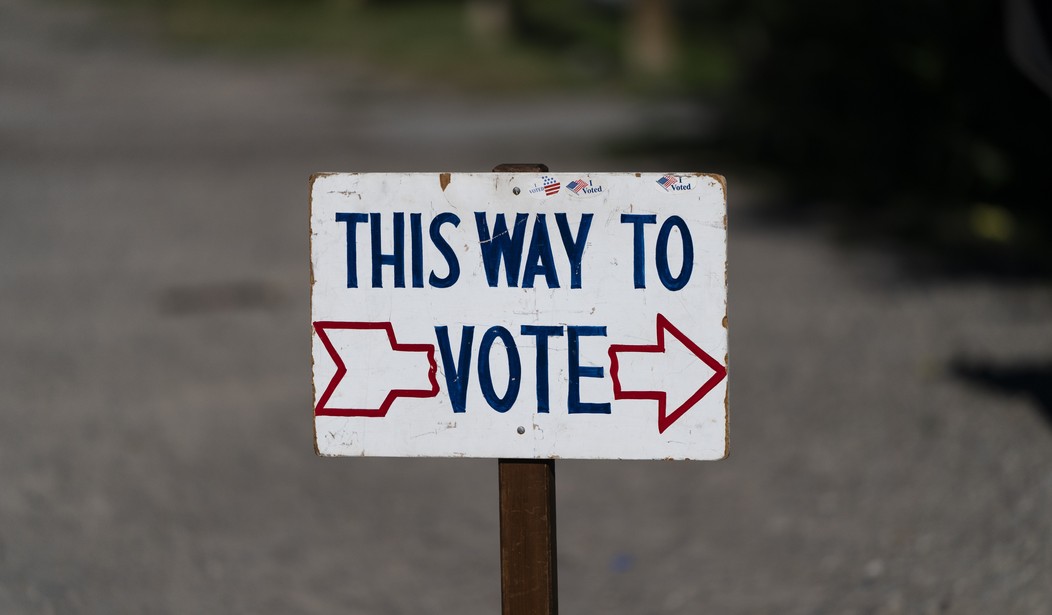
Political experts, including those who make a living predicting election outcomes, have had a rough couple of election cycles.
The 2022 midterm election was supposed to be a GOP wave election, with Republicans gaining 25-30 seats in the House and up to three seats in the Senate. The actual results were GOP +9 in the House, while Democrats gained a seat in the Senate.
In 2024, many polls showed the Democrats regaining control of the House and maintaining control of the Senate. Instead, the GOP hung on in the House as the Democrats gained only one seat and the GOP won four seats in the Senate.
The presidential race was a joke, polling-wise. Donald Trump won all seven battleground states. Long-standing conservative polling firm Trafalgar Group frequently showed Trump ahead across all or nearly all swing states in their final surveys prior to Election Day. But not one single pollster predicted the sweep, and few predicted Trump's win in the popular vote.
While mainstream polling averages showed Vice President Kamala Harris with small leads in upper-Midwest states like Michigan and Wisconsin leading into Election Day, a select group of non-polling predictive models accurately anticipated Trump's eventual victory in all seven key battlegrounds.
The inaccuracy is not due to ideological bias. These are not "push polls" that seek a predetermined result. These are honest-to-God statistical models, based on solid science and history. What happened?
In fact, most polls were within the statistical margin of error, but with the country so closely divided, a 3-4% error is magnified because a predicted winner ends up a loser. Pre-election polls in 2024 showed that Trump could have won most or all swing states if the turnout, GOP enthusiasm, and questions about Harris had all swung in Trump's favor. They did, and Trump won.
The nation is still closely divided. Even with Trump's approval rating underwater, the Democrats' craziness, their flirtation with socialism, and their continued emphasis on "Trump is Hitler" as a campaign tactic have turned off vast swaths of heartland voters and independents across the country.
This doesn't show up in polls for one reason: reluctant responders.
The ongoing struggle to survey enough people to create a viable sample size represents one of the single biggest operational challenges in modern political science. With response rates for traditional telephone and digital surveys hovering in the single digits (often below 2-5%), the core issue facing pollsters is no longer just sample size, but nonresponse bias — the risk that the few people willing to answer a survey are fundamentally different from those who refuse.
Automated call-blocking apps, call-screening ("silence unknown callers"), and relentless text-message fundraising have conditioned voters to ignore outreach from unknown sources. People who take 10 minutes to complete a survey tend to be highly politically engaged, hyper-informed, or civically involved. This makes it difficult to reach lower-propensity or disaffected voters who show up on Election Day but tune out political chatter the rest of the year.
Desperate pollsters are trying several ways to overcome reluctant responders. "Multi-mode outreach" includes not only traditional landlines, but text-to-web invitations, online panels, and other less conventional means. There's recall-vote weighting where, in low-response demographics (conservatives), they ask, "Who did you vote for in the last election?" and weight the model accordingly.
Instead of just balancing age, race, and gender, advanced models attempt to weight for political engagement, voter registration history, and geographic density to avoid over-representing hyper-passionate partisans. This is "modeling beyond demographics."
Despite these innovations, nonresponse bias remains notoriously difficult to cure. Weighting can easily balance a sample for known demographic targets, but it assumes that the few hard-to-reach voters who do respond think exactly like the hard-to-reach voters who don't.
So the obvious question becomes: why are the same "experts" who got burned in 2022 and 2024 by inaccurate polling so trusting of polls showing a "blue wave" on the way in 2026?
Redistricting has helped House Republicans build a seawall that can withstand a roughly 5-point Democratic wave.
Why it matters: Early readings are pointing to something twice that size — enough to wash away the GOP House majority.
Democrats have been running roughly 10 points ahead of their 2024 presidential performance in special elections this year.
A swing of that magnitude would produce a comfortable 230-205 Democratic majority, according to an Axios analysis of how the battle for the House would play out under different electoral scenarios.
In another time, on another planet, "Democrats have been running roughly 10 points ahead of their 2024 presidential performance in special elections this year," might actually have some relevance. Not on planet Earth in the 21st century. A 10-point difference between an election where only a fraction of the electorate turned out compared to the Democrats' performance in a national election where Donald Trump was on the ballot is statistical noise, in my opinion.
Between the lines: Gerrymandering since the presidential election has given Republicans more breathing room, with GOP-drawn maps creating a net advantage of roughly nine seats.
But some of those newly redrawn GOP seats rest on a potentially shaky assumption: that the 2026 electorate will look much like 2024's.
A national swing toward Democrats like the one in Trump's first midterm would overwhelm the GOP's redistricting defenses.
The New York Times reports that, "In recent weeks, a tide of anxiety has risen among Democrats in the Granite State who are concerned that a party with big dreams of expanding its map could let the seat left open by the pending retirement of Senator Jeanne Shaheen, a Democrat, slip from its grasp."
The leading Democratic candidate in Tuesday's New Hampshire primary is Rep. Chris Pappas, 46, a four-term congressman from the First District. He will face off with former Sen. John E. Sununu. Pappas is sounding the alarm about retaining the seat that retiring Democratic Sen. Jeanne Shaheen currently holds. He put it bluntly in a fundraising email on Friday morning: “We’re losing.”
“If we’re going to be able to take back four seats and flip the Senate majority, we can’t afford to take one step backward in any seat that’s currently held by a Democrat,” Pappas said in an interview this week.
Does that sound like a "blue wave" to you?
The reality on the ground is so different than the rarefied air inhabited by most pollsters that it seems futile to take much comfort or get too alarmed about the polls. The cross-tabs will still be valuable to gauge the mood of the electorate, but individual candidate polls and party polls are, in my opinion, next to useless.
Buckle up, people. It's going to be a wild ride to Election Day.
Editor's Note: President Trump is leading America into the "Golden Age" as Democrats desperately try to stop it.
Help us continue to report on President Trump's successes and combat Democrats' lies. Join PJ Media VIP and use promo code FIGHT to receive 60% off your membership.
Join the Conversation
VIP members get the ability to comment on articles.