





Ronald Reagan's words about the government at all levels still resonate.
"The most terrifying words in the English language are: I'm from the government, and I'm here to help."
"Government's view of the economy could be summed up in a few short phrases: If it moves, tax it. If it keeps moving, regulate it. And if it stops moving, subsidize it."
During the Reagan administration, the FTC under Chairman James C. Miller III began examining state-level professional restrictions and occupational licensing boards (such as restrictions on advertising for opticians, dentists, and lawyers), arguing that overregulation harmed consumers by driving up costs and restricting market entry.
While modern free-market advocacy groups frequently cite Reagan's economic principles to advocate against occupational licensing barriers, Reagan himself targeted federal bureaucratic oversight rather than state-level occupational permits. But the drive to deregulate continued under most Republican presidential administrations, saving Americans billions of dollars.
One state-level regulatory regime cries out for serious and substantial reform: occupational licensing. "While licensing advocates claim that getting government permission is necessary to protect health and safety, that argument becomes less credible when many occupations are licensed in some states and not others," writes Reason.com's JD Tuccille.
"Are Arizona and Nevada suffering because they don't require electricians to navigate California-style credentialing?" Tuccille asks.
Indeed, that's only one problem with occupational credentialing. The Archbridge Institute's 2026 State Occupational Licensing Index shows which states have the most restrictive credentialing requirements.
"Too often, the occupational licensure laws on the books do not reflect the world we actually live in," Alanna Wilson cautioned in Governing. "American workers wishing to launch a career, build their own business or re-enter the workforce in one of 102 lower-income occupations must on average give up nearly a year to education and on-the-job training, pass at least one exam and pay nearly $300 in fees."
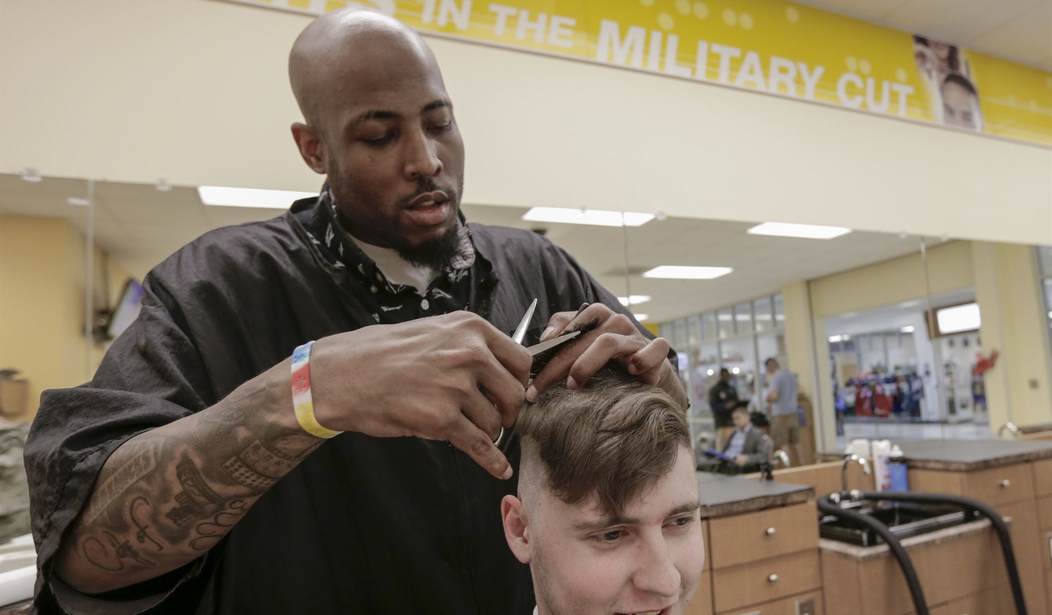
While total licensing fees for Illinois residents who wish to be cosmetologists cost between $225 and $240, cosmetology school costs anywhere from $10,000 to $18,000 in tuition and supplies. At least 1,500 hours of instruction are required before you can take a licensing exam.
A December 2025 Federal Reserve Bank of Minneapolis report found that "in recent years, 22 percent of the employed have reported holding a government-issued license, in professions ranging from physical therapy to cosmetology to public school teaching." Many of these jobs are entry-level or considered low-skilled. Occupational licensing and the educational requirements to earn the credential are preventing uncounted numbers of lower-income Americans from finding gainful employment.
Some states may have eased requirements but added burdensome rules to occupational licensing.
"In the state of Alabama, all acupuncturists are required to be licensed physicians; thus while the occupational title of 'acupuncturist' is not licensed, that occupation is barred by a license in some way," Archbridge notes. "In several states, shampooers must obtain cosmetology licenses to work."
According to Archbridge's report, the five most burdensome states in the union are Oregon, Texas, Tennessee, Arkansas, and New Jersey. The five states that put the fewest bureaucratic hurdles in the way of work are Missouri, Kansas, New York, Indiana, and Colorado.
As the report points out, medical doctors are licensed in every state. Nail technicians, for unclear reasons, also need licenses in every state. Most regulated jobs, like the electricians and nutritionists mentioned above, are licensed in some states but not others. Master gas fitters face barriers of some kind in 44 states, including licensing requirements in 11. Dental radiographers face similar burdens in 33 states. Security guards are licensed in half of states, as are fuel piping contractors. Medical assistants and animal breeders are licensed in 10 states. Mold remediation workers need licenses only in Texas.
In other words, while some heavily regulated jobs arguably pose safety concerns, others that might raise similar issues are intermittently licensed. That offers an opportunity to assess whether licensing offers benefits.
"A broad ideological spectrum of analysts and economists mostly agrees—occupational licensing does not improve public health in any scientifically rigorous or statistically significant manner," Spence Purnell, then of the Reason Foundation, which publishes Reason.com, wrote in 2018.
Then why require it? Special interests aplenty have their reasons. The professional associations protect their members by discouraging competition. Trade schools also benefit from license requirements by forcing students to attend in order to get their credential.
Exclusively for our VIPs: Trump Goes 'All-In' on Americans Being First to Set Foot on Mars
These licensing requirements raise costs to consumers by severely limiting competition.
While, as the Minneapolis Fed cautioned, eliminating licensing requirements is very rare, states have moved to recognize other states' licenses. "As of 2026, 28 states have adopted some form of universal licensing recognition—the same as last year," according to Archbridge. "Universal" recognition isn't always universal—some states specify that the licenses they recognize be subject to "substantially similar" rules as those issued locally, while others recognize only the licenses of state residents. But 11 states earn Archbridge's gold medal for universally recognizing occupational licenses without restrictions.
This seems like a sensible solution given the difficulty of repealing licensing laws. Politicians are loath to admit the laws they passed to "protect the public" are adding substantially to consumer costs. By passing universal license recognition, a state can unchain a worker and allow them to go to another state where financial opportunities may be better.
Editor's Note: President Trump is leading America into the "Golden Age" as Democrats desperately try to stop it.
Help us continue to report on President Trump's successes and combat Democrats' lies. Join PJ Media VIP and use promo code FIGHT to receive 60% off your membership.
![[UPDATE] Audio Appears to Confirm Talarico’s Stay at Mental Health Facility; Campaign Denies It](https://media.townhall.com/cdn/hodl/2026/257/05654322-cebe-4479-a0f1-67bd873ecc9f-536x311.jpg)

Join the Conversation
VIP members get the ability to comment on articles.