





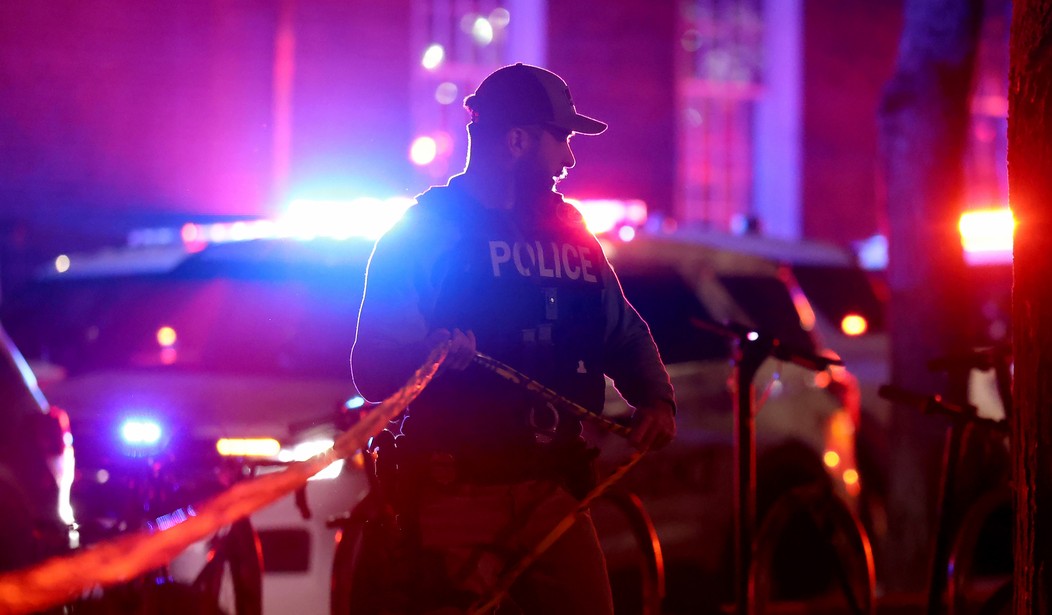
For those who might look askance at the headline to this article, I can only point out the obvious: Donald Trump would have been blamed if the big cities' crime rate rose, so that must mean that he gets the credit (or blame) when the rate of violent crime reaches historic lows.
In truth, the post-COVID drop in the violent crime rate has been happening since 2022. At that time, the rate of murders, rapes, and other violent crimes could only go down. In 2020, murders were up 29% from the previous year, increasing another 4.3% in 2021. Aggravated assaults increased by more than 12%.
Violent crime began to level off in 2022, but it certainly wasn't the result of radical left "defund the police" policies. In fact, most big cities were desperately looking to hire police officers after the lockdowns ended.
Today, the crime rate in big cities is at or near historic lows. The Council on Criminal Justice (CCJ) and the Regional Justice Information Service (RJIS) publish biannual crime statistics for major cities based on FBI data and local police reports.
"Following the historic 30% increase in homicide from 2019 to 2020, CCJ’s last report estimated that the 2025 national homicide rate will likely be at its lowest level since at least 1900," the joint report says. "Trends through the first half of 2026 show that the decline, which began in the second half of 2022, has continued, advancing well beyond the “return to normal” phase seen after the spike in 2020."
How did this happen? "Researchers and practitioners have pointed to a range of possible influences, including changes in criminal justice operations and strategies, technological advances, and broad shifts in society and culture," the report notes.
The homicide drop has sparked a political fight over who deserves credit, with each side offering a clean and politically convenient story. But oversimplifying what is happening risks misunderstanding the forces behind it and the steps needed to sustain progress. In this op-ed for USA Today, CCJ President and CEO Adam Gelb focuses on three big forces moving at once: criminal justice operations and strategies, technological advances, and broad shifts in society and culture.
While the downward trajectory of crime is clear, it’s extremely difficult to disentangle and pinpoint what’s actually driving the drop. In this op-ed for the Fulcrum, Senior Research Specialist Ernesto Lopez dives into the data and highlights several explanations, ranging from community prevention to broader behavioral trends.
"Community prevention?" "Broader behavioral trends?" I guess the learned folks are claiming the gang bangers' behavior is improving?
The last paragraph in the analysis makes the grudging admission that maybe, just maybe, an additional 100 million guns in the hands of private citizens, sold between 2020 and 2025, might have had an impact on the violent crime rate. Research indicates roughly 30 million Americans acquired guns between 2021 and 2024, including over 11 million first-time gun owners.
Private gun ownership in America has surged in the past several years. Meanwhile, violent crime, particularly homicide, saw a historic rise followed by a historic decline. In this webinar, experts discussed how gun policies, enforcement strategies, and market dynamics are shaping gun violence trends today.
The report also touches on the simple fact that the police are back to doing their jobs and arresting violent criminals. Despite some high-profile failures of the "no bail" policy, the theory that taking violent criminals off the streets leads to less crime has been proved again.
- Courts slowed by COVID-19 disruptions have largely resumed normal function.
- Police departments, on their heels after the protests of 2020, have reemphasized targeted enforcement strategies.
- Communities have scaled up violence prevention efforts and prisoner reentry programs to unprecedented levels, aided in part by federal recovery funds.
- Immigration enforcement has removed dangerous offenders while also sweeping in many people who pose little or no public safety risk.
Exclusively for our VIPs: 'AI Psychosis,' or Excessive Trust in AI, Is Becoming a Big Problem
Remember the shooting gallery that Washington, D.C. had turned into? Look again.
Combined, Washington, D.C., recorded 424 homicides across the 2020–2021 period, marking a significant multi-year rise that peaked in 2023 (274 homicides) before declining.
In the first half of 2026, the Nation's capital reported 46 homicides, down 43.9% from 82 in the first half of 2025. Even before the National Guard was deployed, the murder rate was declining. It cratered after the Guard came to town, as did other violent-crime indices.
As the CCJ makes clear, it wasn't a single factor that led to the decline. But some factors contributed more to the drop in violent crime than others. I would say more guns in the hands of citizens and the increase in incarceration for violent criminals had significantly more impact than "violence prevention" efforts and "prisoner re-entry programs" did.
However you look at it, and for whatever reason, this is good news. The violent crime rate is still far higher than it should be, and removing impediments to bringing it down further should be the work of Congress.
Editor’s Note: The American people overwhelmingly support President Trump’s law and order agenda.
Help us fight back against the Democrats and Soros-backed DAs that refuse to enforce our laws to hold criminals accountable. Join PJ Media VIP and use promo code FIGHT to receive 60% off your membership.

Join the Conversation
VIP members get the ability to comment on articles.