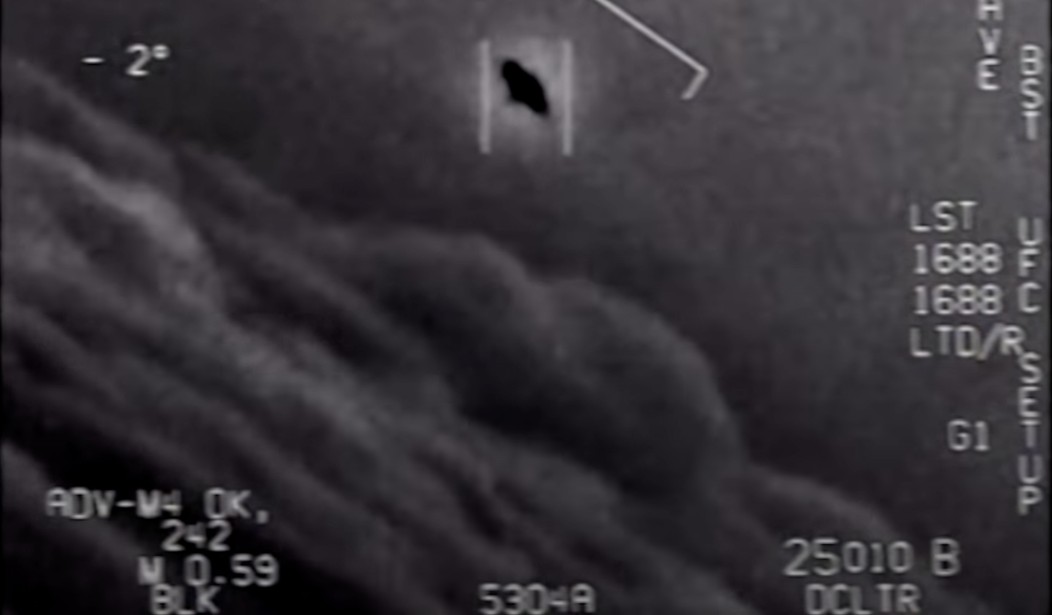
On Friday, June 12, the Pentagon released another tranche of formerly classified documents about the phenomenon once known as Unidentified Flying Objects (UFOs), now referred to by the government as "Unidentified Anomalous Phenomena" (UAP). As the U.S. military has known for decades, not all UFOs are "flying objects."
The UAPs include objects sighted both in and out of bodies of water. Unidentified Submerged Objects (USOs) have become a subject of growing interest and concern at the Pentagon, as reports of strange craft moving at incredible speeds underwater and performing radical maneuvers have skyrocketed.
Many reports describe objects that can move freely through the air, hover above water, and dive beneath the surface—often without leaving a splash or radar trail. Navies worldwide frequently log mysterious sonar and radar targets that move at speeds far exceeding conventional submarine capabilities, often referring to them as "fast movers."
Many presumed USOs are later identified as natural phenomena (whales, bioluminescence), misidentified human vessels (submarines, ships), or divers. Also, unusual weather conditions or sonar anomalies can create echoes and visual mirages that mimic solid, fast-moving objects.
Reporting platforms like the Enigma app gather crowdsourced reports from coastlines, tracking thousands of unusual aerial and water-based sightings annually. It's available on the iOS App Store and Google Play Beta and captured significant mainstream attention following a spike in East Coast drone sightings in 2024.
"These files, hidden behind classifications, have long fueled justified speculation — and it's time the American people see it for themselves," Defense Secretary Pete Hegseth said in a statement when the files were released.
Retired Rear Admiral Tim Gallaudet, former chief meteorologist of the Navy, testified in 2023 in the first Oversight Committee hearing on UAPs. “We are pretty convinced these craft are operated by higher-order intelligence that is not human,” Gallaudet said. “I don’t believe they’re of the natural world as we know it. They may come from Earth, but I don’t believe they belong to the plant and animal kingdoms as we know them.”
Indeed, the notion that we share this planet with another form of intelligent life is not completely batty. The oceans cover 70% of the surface of our planet, and we've explored only a tiny fraction of it. Eighty percent of the oceans remain unmapped, unobserved, and unexplored, while less than 30% of the ocean floor has been charted. It's wild speculation, to be sure, but the idea can't entirely be dismissed.
In one recently released iPhone video, called “Orbs Over the Pond,” the Pentagon describes “a light source below the horizon, hovering above a pond at an estimated distance of 2,700 feet.” This object appeared as “a ‘plasma-like sphere’ intermittently changing shape and luminosity. At times, the primary light source appeared to separate into smaller luminous points,” the Pentagon said. The object disappeared after about 45 minutes.
An analysis attributed the sighting to “sunlight backscattering” from reflected snow illuminating the underside of low-altitude clouds. However, this description came with “low confidence,” and the case is considered unresolved.
Most of the thousands of USO sightings people have reported on the Enigma app come from California and Florida, according to the nonpartisan organization’s website.
"What is really interesting to me is the reports that we receive about [United States] underwater vessels detecting craft moving at exceptionally high speeds underwater," Kent Heckenlively, author of Catastrophic Disclosure: Aliens, The Deep State and The Truth, told Fox News Digital. "Now that's one of two things: That's something we don't understand, or that means our technology is picking up ghosts underwater."
Ultimately, whether these USOs turn out to be atmospheric illusions, revolutionary foreign tech, or something entirely outside our current understanding of the natural world, they represent a glaring blind spot in maritime awareness. In a world where national security depends on knowing exactly what is moving through our waters, ignoring "fast movers" is no longer an option. The Pentagon’s willingness to open these files is a start, but until we fully commit to exploring our own oceans, the threat of the unknown will continue to lurk just beneath the surface.