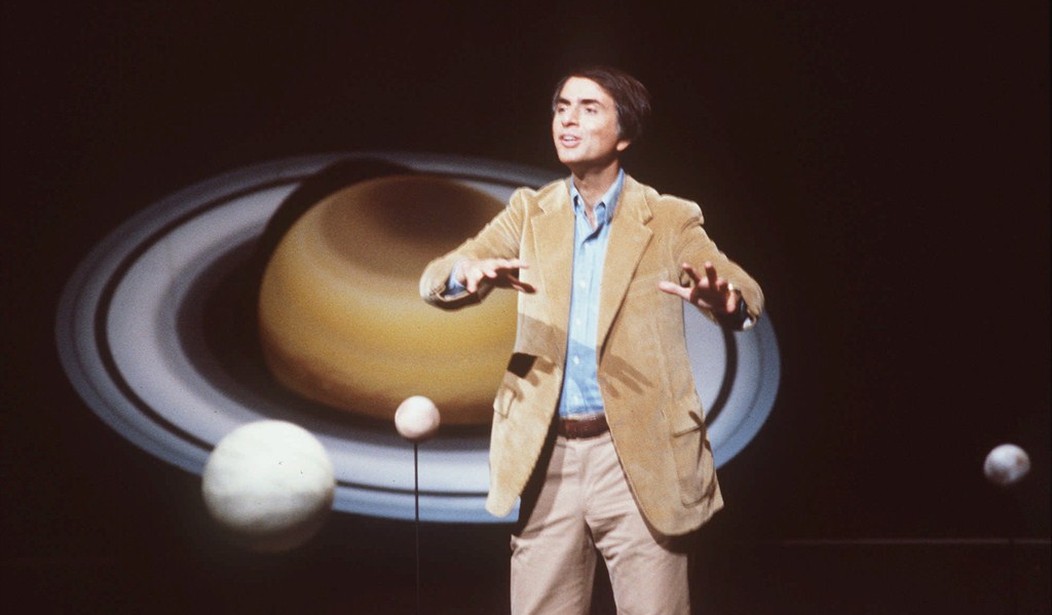
Carl Sagan had the marvelous gift of being able to take cosmically difficult concepts and explain them in a way that everyone (almost!) understood.
When it came to searching for extraterrestrial life, he was a true visionary. In 1970, Sagan thought that scientists were trying to define "life" too narrowly. Why limit a definition to defining life as we know it? Sagan believed that a single example of alien life could change everything and begin a more inclusive search for life.
"For many years, a physiological definition of life was popular. Life was defined as any system capable of performing a number of such functions as eating, metabolizing, excreting, breathing, moving, growing, reproducing, and being responsive to external stimuli," Sagan wrote in a collection of essays on The Nature of Life. "But many such properties are either present in machines that nobody is willing to call alive, or absent from organisms that everybody is willing to call alive."
Sagan used the ridiculous example of the automobile to get his point across. "An automobile, for example, can be said to eat, metabolize, excrete, breathe, move, and be responsive to external stimuli."
Taking the automobile example, its logical extreme, what would an alien visiting Earth think of automobiles and the infrastructure that supports them?
"And a visitor from another planet, judging from the enormous numbers of automobiles on the Earth and the way in which cities and landscapes have been designed for the special benefit of motorcars, might well believe that automobiles are not only alive, but are the dominant life form on the planet," he wrote.
Science writer Connor Feehly, writing in Nautilus, warns, "If we don’t have a broad, robust definition of what life is, we may miss it when searching for extraterrestrial life in the cosmos."
In a white paper submitted to the Planetary Science and Astrobiology Decadal Survey 2023-2032, of the National Academies, a group of scientists, affiliated with NASA, SETI, and universities around the world, outlined a way forward in astrobiological research. They wrote “the probability that life in the universe would share a biochemical ancestry with life on Earth quickly diminishes the further away from Earth we explore.” It’s imperative, the scientists continued, “that we build foundational knowledge for life detection strategies that target universal biosignatures.”
Aaron Goldman, a biologist from Oberlin College, has been working on problems about how life evolved on Earth. “The most successful definitions of life fall into two general categories: entropic definitions, which describe life through its ability to increase internal order at the expense of increasing disorder in the surrounding environment; and evolutionary definitions, which describe life through its ability to evolve by natural selection,” Goldman says.
Entropic definitions simply explain the ability of a lifeform to use sources of energy, like the sun, that feed metabolic functions. "The set of objects we call “life” are highly ordered and are low in entropy, according to this view.," writes Feehly.
But an entropic view of life has its own set of problems. You might take an entropic approach and come to the conclusion that stars meet that definition of life. According to Feehly, "Nuclear fusion and fission in the star’s core maintain the structures and processes that are necessary to its stable physiology and anatomy—a type of stellar metabolism that mirrors the metabolic processes of biological organisms."
The trouble with qualitative descriptions of life, like the entropic and evolutionary approaches, is they often present numerous gray areas and strange counter examples. In such cases we are left with a set of life’s features that serve as a litmus test for whether one set of phenomena qualifies as life or not. Are viruses alive? Being unable to replicate without infecting a host, and their lack of energy needs, might suggest they aren’t under both the entropic and evolutionary views. What about digital or synthetic lifeforms? A lot of people might say no because they don’t share the biological features with the entities that we do call living, and are composed of an entirely different substrate. Under one such set of criteria, our answers might say no, and under another they might say yes, while our intuition might tell us something else altogether.
Clearly, a revolutionary approach to defining life was needed. Life on Earth is based on carbon. But silicon is far more common in the universe. How can a definition of life encompass all possible molecular combinations?
Astrobiologist Sara Walker from Arizona State University and chemist Lee Cronin from the University of Glasgow thought up a process they call the "assembly theory." “Basically, the idea is that what underlies life is the physics that builds complexity in the universe,” Walker says.
In a rudimentary way, for an atom to form a bond to create a molecule, an energy barrier has to be crossed, so as a molecule gets more complex, it gets increasingly unlikely that it was created by chance; or as Walker puts it, “the universe doesn’t make complex things for free.” Life, though, is able to bypass these energy barriers, opening up an extremely vast chemical space where a mind-boggling number of complex molecular structures can be realized. The goal of assembly theory, says Walker, is to “understand the circumstances when selection emerges and when you start building up complexity.”
"Assembly theory describes complex molecules with something called the molecular assembly index," writes Freehly. "The molecular assembly value of a molecule is determined by the shortest number of steps that are needed to create that molecule through its elementary building blocks (atoms and their bonds), and this number can be derived for a given molecule through analysis in mass spectrometers."
It's the "intrinsic complexity of an object which determines whether it was the product of living processes," Feehly notes.
Our search for extraterrestrial life has been underway, scientifically speaking, for more than 65 years. In April 1960, astronomer Frank Drake used the radiotelescope dish at the National Radio Astronomy Observatory in Green Bank, W.Va., to launch Project Ozma, the first modern Search for Extraterrestrial Intelligence (SETI). As our instruments have gotten more sensitive and our telescopes find dozens more planetary candidates that could harbor life, we are still only looking for places that could harbor life as we know it.
Soon, we won't have to limit ourselves to that narrow definition.