



At first blush, Sen. Bernie Sanders' (D-Vt.) plan to impose a one-time 50% tax on AI companies' profits can be seen as just typical socialist blather.
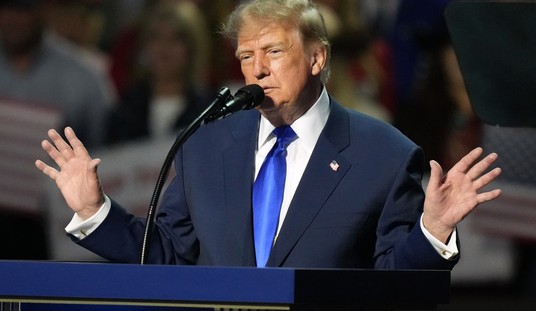
It may be that, but on the other hand, Donald Trump seems to agree with the premise of a "Sovereign Wealth Fund." He issued an executive order in February directing the secretaries of the Treasury and Commerce departments, as well as the assistant to the president for economic policy, to "develop a plan" for a sovereign wealth fund and submit it to him within 90 days.
Sanders will introduce the "American A.I. Sovereign Wealth Fund Act" in the coming weeks, claiming that the bill will "give the public a direct role in determining the future" of AI, rather than its use being "dictated by a handful of Big Tech oligarchs."
"Who will own and control that future?" Sanders asks in a New York Times editorial on Monday. "Who will benefit from it, and who will be hurt by it?"
Those are very good questions. Considering that AI has the potential to be the most disruptive and civilization-altering technology in history, those questions demand answers.
The answers are not to be found in the socialists' ideas of confiscation. To realize the full potential of AI, wealth-grabbing by the government is the last thing that's needed. Besides, does anyone seriously believe that the government will use a sovereign wealth fund to benefit society? We only need to look at other sovereign wealth funds around the world to see what governments do with all that "sovereign" cash.
In Russia, President Vladimir Putin is draining the country's National Wealth Fund for his war in Ukraine, against the advice of the nation's financial monitors. Iran uses its National Development Fund to finance terrorist groups such as Hezbollah, Hamas, and its shadow police force, while Saudi Arabia's wealth fund is regularly used to facilitate human rights abuses, according to a 2024 report from Human Rights Watch. While it's unlikely that an American wealth fund would be used this nefariously, recent cases of fraud show it's not unreasonable to assume that an unappropriated pot of hundreds of billions of dollars could tempt officials.
According to the White House Fact Sheet on the president's plan for a sovereign wealth fund, the primary policy goal of the fund is to leverage investment returns to benefit the general public and bolster the nation's geopolitical standing. The administration explicitly outlined four core purposes, including lessening the tax burden, promoting fiscal sustainability, funding "Great National Endeavors," which could include investing heavily in domestic infrastructure, manufacturing, and development projects to spur economic growth, and financing projects that advance U.S. economic interests and counter foreign adversaries globally.
Trump, more than any other president, has been aggressive in grabbing significant stakes in several companies. "The Cato Institute estimates that the White House already has ownership stakes in 20 private companies, in the form of equity stakes, warrants, and golden shares," says Fortune Magazine. "These range from mineral companies like MP Materials, Trilogy Metals and Lithium Americas, to semiconductor firms like Intel and xLight, to quantum powers IBM and GlobalFoundries."
It's obvious that Donald Trump and Bernie Sanders have radically different ideas about what a "sovereign wealth fund" should do. But Sanders has history on his side.
"Coursera cofounder and Google Brain lead Andrew Ng told a Stanford audience in 2017 that AI would transform the world the way electricity did a century ago—touching every industry, reshaping every economy, becoming as fundamental as the grid itself," according to Fortune. In fact, electricity, which was extremely disruptive to business and society, can be something of a guide for our move into an AI future.
In the 1930s, as Ng argued nearly a decade ago, only about 10% of rural Americans had electricity, while cities enjoyed near-universal access, largely because private utility companies refused to serve communities that weren’t profitable enough. When the federal government stepped in through the Tennessee Valley Authority, the power companies called it unconstitutional, filed lawsuit after lawsuit, and installed “spite lines,” or power lines run purely to block cooperatives from forming because they didn’t want anyone else to have them.
When the Norris Dam was built in East Tennessee, more than 15,000 people were displaced from 125,000 acres condemned by eminent domain. Those who owned property received some compensation while sharecroppers and tenant farmers received nothing.
Eventually, electricity became a public utility, with private companies usually subject to a public commission that set rates. Looking at our vulnerable, outdated electrical grid, one has to question the wisdom of that.
Other major disruptive technologies, like the telegraph and telephone, were also seen as threats, and there was a clamor to nationalize them.
Like the electrification of the grid, fears of how the public’s consent is exercised when infrastructure or technology is put into place are just as prominent in the age of AI, and has a historical backing to leave people feeling weary. Think of the telegraph, which arrived in the 1840s and policymakers debated public ownership from its earliest days (in fact, the Labor Reform Party’s 1872 platform demanded the government prevent telegraph corporations from exacting rates that bore unduly on producers and consumers). Soon after came the telephone, which was eventually nationalized during World War I, when President Wilson put telephone and telegraph lines under the U.S. Post Office from June 1918 to July 1919, all before it was returned to private hands and rebuilt as a monopoly. It was regulated for fifty years, and finally broken apart in 1984.
Every transformative communications technology in American history has cycled through the same arc: private consolidation at a public cost, and a political reckoning at a delayed intervention.
Sanders wants a sovereign wealth fund to play into his scheme to solve the income inequality problem. Eventually, he wants the fund to make direct payments to the American people. Elon Musk is on board with this idea. Anthropic CEO Dario Amodei and OpenAI's Sam Altman have also expressed support for some kind of wealth transfer.
The tech billionaires are running scared. They know that unless they get out in front of this issue, the peasants with pitchforks led by Bernie Sanders and the radical left will impose a "solution" on them far worse than a sovereign wealth fund.
AI as a political issue is tailor-made for demagoguery. And in an age of demagoguery, the full potential of AI is not likely to be realized unless the demagogues can be sidelined and a rough consensus achieved through a realization of shared interests.
Related: 63% of Workers Admit to Exaggerating Their AI Skills. 69% Think AI Will Take Their Jobs.
Editor's Note: The Democrat Party has never been less popular as voters reject its globalist agenda.
Help us continue exposing Democrats' plans to lead America down a dangerous path. Join PJ Media VIP and use promo code FIGHT to receive 60% off your membership.






Join the conversation as a VIP Member