
No one is sure when or how dogs were domesticated. There are several leading theories, each with its own timeline. They may all be wrong.
I prefer to believe something magical happened between dogs and humans in our distant, prehistoric past. That domesticated dogs were once closely related to wolves is supported by DNA evidence, but how did the fearsome, savage wolf get trusted enough that we allowed them to lie down and sleep with our children?
Dogs and wolves parted company, genetically speaking, 20,000 to 40,000 years ago. A common misconception is that dogs evolved directly from the modern gray wolves we see today. Instead, genetic evidence shows that dogs and modern wolves are sister branches on an evolutionary tree. They both diverged from a common, ancient wolf ancestor that is now entirely extinct.
While the genetic split began much earlier, the actual process of domestication — when these ancestral dogs began living closely alongside human hunter-gatherers — is generally estimated to have occurred between 15,000 and 23,000 years ago.
By the time the last Ice Age ended around 11,700 years ago, dogs had already diversified into multiple distinct genetic lineages across the globe, fully cementing their status as humanity's first domesticated companion.
"Dogs whose faces moved quickly were easier to read, and over tens of thousands of years, those were the dogs that humans kept around," says Popular Science. Wolves signal to wolves. Dogs signal to us.
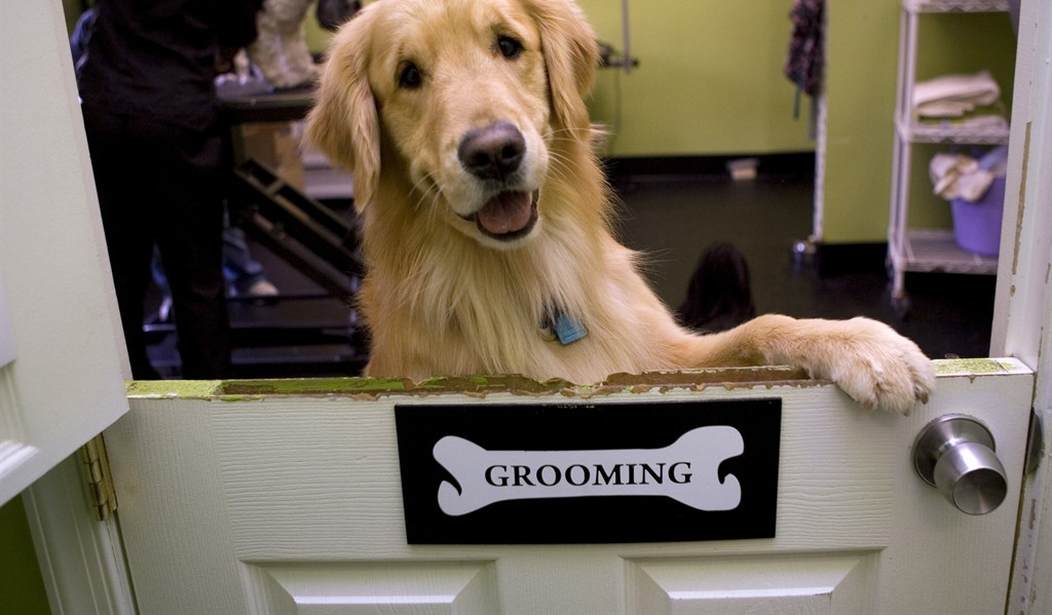
But can we read those signals? Most people who have dogs never stop to learn how to read a dog's face and body language. Instead, we anthropomorphize the expression on a dog's face. We see the tail wagging, the open mouth, and claim our dog is smiling at us. He may very well be doing that. Or, he could be tense or uneasy.
“We want to assume that dogs love us and are happy. So, we’ll look at a dog running around with other dogs and think, ‘If I were them, I’d be happy. So, they must be smiling.’” Sometimes, Burrows says, that's misreading what the dog is actually feeling. The dog may not actually be having a good time.
The classic example is the “guilty look.” A dog cowers when its owner discovers a chewed shoe, and we read shame on its face. But experiments suggest the look isn’t really about guilt. It’s what Jesch calls an “appeasement signal” triggered by the owner’s body language—the dog’s way of trying to defuse the situation before it gets worse.
“They’re more likely just doing an appeasement signal to say, please don’t be mad at me,” Jesch says.
Context matters. A “smiling” dog curled up on the couch next to you is probably content, Burrows says. The same expression in a loud, chaotic environment, paired with a tucked tail, might mean the dog wants to leave.
Also for our VIPs: Our Early Ancestors Were Experts at Getting Food 'To Go'
Karen Jesch, a PhD student at Boston College’s Canine Cognition Center, says that breeds like Pugs, with their flattened faces, are challenging to read. Their subtle expressions are harder to interpret than they would be on a Labrador or Setter.
“If everybody who loves dogs were to spend a little bit of time learning how to interpret their signals, I think we could help them live much happier lives," says Jesch.
Dogs are far better at reading us — our posture, our facial expressions — than we are at reading them. Thousands of years of evolving together, hunting together, sleeping together, playing together, and protecting each other have created a bond that exists nowhere else in the animal kingdom.
Till the day he died, my dad said he was convinced that our Golden Retriever, Sherry, would talk to him someday. They are talking to us, Dad. We just have to learn how to listen.