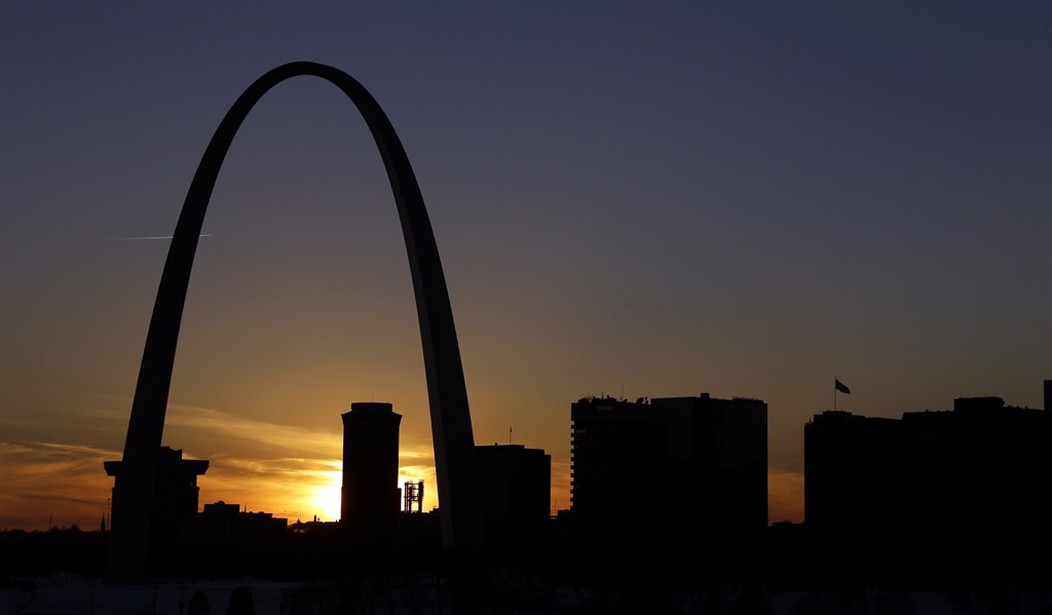
I lived in St. Louis from 1985 to 1990. At that time, the city was already falling into the pits of hell.
Just the skeleton of a once-vibrant hub of industry, commerce, and culture remains today. In the 1980s, the city's population had fallen by more than half from its 1950 high of more than a million. You can track the fall of St. Louis by tracing the collapse of river traffic that was once the primary means of moving goods across a large section of the country.
The Mississippi and Missouri rivers converge just north of St. Louis, near Hartford, Ill., forming a crucial ecological and economic junction. This confluence makes St. Louis the "Gateway to the West," where the continent's longest river (the Missouri) meets the major transportation artery (the Mississippi). Its central location in the United States attracted Fortune 500 companies such as McDonnell-Douglas, Monsanto, and Ralston-Purina.
The city's glory days are distant memories. But the one constant throughout the late-19th, 20th, and 21st centuries has been the St. Louis Cardinals of Major League Baseball.
The St. Louis Cardinals are one of the "elite franchises across American sport," as UnHerd's Jeff Bloodworth notes. In St. Louis, the Cardinals are more than a baseball team. They are a uniting expedient that used to make immigrants into Americans overnight, when baseball was king and the players, royalty.
Now, for many Cardinal fans, their city's glory is just a distant memory, and baseball is the window through which so many people glimpse the past.
There is no other game seen through the prism of remembrance quite like baseball. Whether sitting on the back porch in 1950’s and 60’s suburbia listening to the hissing, static filled play-by-play on radio while the fireflies blinked to announce their presence and the sweet smell of Jasmine filled the nostrils with the scent of summer, of family, of a shared passion.
Or perhaps in the city, you sat on the front stoop with every other house on the block blaring out the call of the game, a broadcast legend conducting a city-wide symphony of sound, mothers with babies, fathers with sons, and the young, the old, laughing, talking, arguing, loving. A neighborhood, a community united around a passion so intense that enmities were temporarily forgotten as “the boys” or “the bums” performed extraordinary feats of effortless athleticism with both the workmanlike attitude of the blue collar hero and the pizazz of a circus performer.
While the Cardinals are one of the few franchises with a multi-state fan base due to the reach of the 50,000-watt KMOX radio station, life in the city itself still grinds to a halt on game day. Win or lose, the energy of Cardinal fans is one of the few signs of life in a city where high crime rates, miserable schools, a dwindling population, and crumbling infrastructure are strangling the spirit of a once proud city.
Yet amid the joys of Opening Day, you don’t really get the sense that St. Louis’s communal spirit survives the rest of the year. “That’s part of our problem as a region,” says Tony Messenger, a veteran local journalist. “We aren’t literally invested in the success of downtown St. Louis. And if we were, Opening Day would be more meaningful.” Separated by city and county, middle-class suburbanites adore the St. Louis Cardinals. But their tax dollars do not pay for the streets abutting the team’s stadium, nor for derelict city schools. United on Opening Day, St. Louis is divided on most others.
Indeed, many once-thriving neighborhoods are now ghost towns. The entire city is depressed and depressing. People and businesses continue to exit.
But, like opening day for the Cardinals, there is hope. After being vacant for over a decade, the Millennium Hotel site near the Gateway Arch is slated for a $670 million transformation. Led by The Cordish Companies, the project will reconnect downtown to the riverfront with a large-scale mixed-use district featuring residential units, a new hotel, office space, and entertainment venues.
There's also the $1.7 billion National Geospatial-Intelligence Agency headquarters being built in North St. Louis. It's a massive federal project slated to bring thousands of employees to a new campus in North St. Louis by 2026, acting as a major catalyst for further commercial growth in the surrounding area.
In addition, a $232 million mixed-use development is planned near the soccer stadium. It is expected to include more than 450 apartments, retail space, and a 29-story massive timber tower, which would be a landmark architectural addition to the city.
All told, more than $3 billion in industrial and commercial development is being poured into the city and surrounding suburbs. The money won't magically transform the city into a bustling metropolis. But it offers it a chance to begin an upward path toward redemption.
I can guarantee that the Cardinals will be a big part of the city's revival, at least in the minds of citizens.
Recommended: It's a MMIWG2SLGBTQQIA+ World and We're Just Living In It