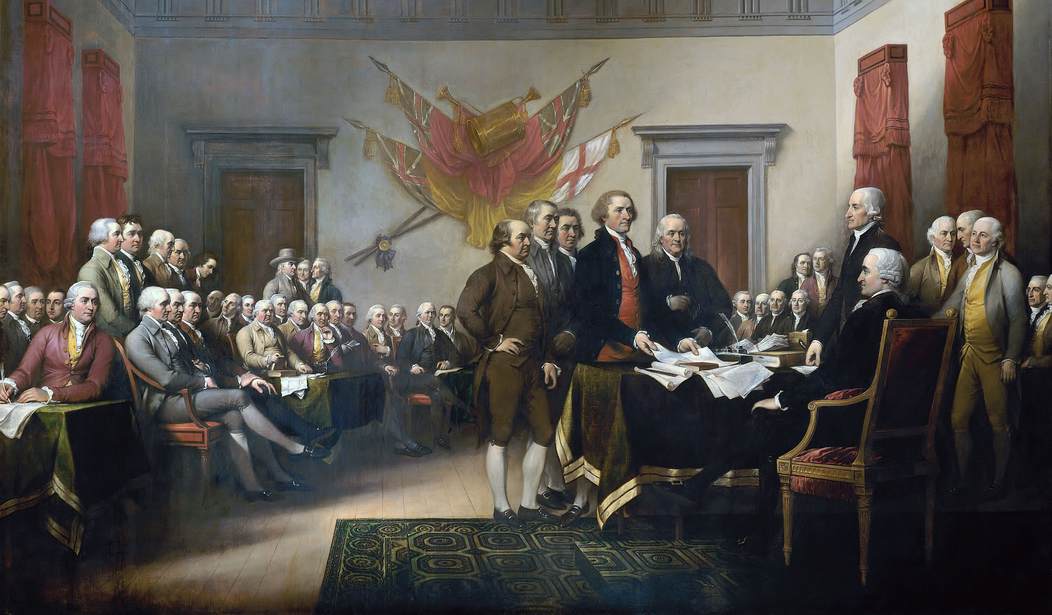
My senior year in college was 1976, the bicentennial year. I hadn't taken an American history course since high school and, feeling very patriotic, decided to take a course on the American Revolution.
I would have been better off staying in bed.
The radical left professor glossed over many of the astonishing ideas that were given life before, during, and after the Revolution in favor of portraying our nation's founding as a backlash against mercantile interests being stifled by Great Britain and the system of slavery being threatened by anti-slavery forces in England.
Slavery continued in colonies under British control until 1834 and the passage of the Slavery Abolition Act. So, the idea that colonists were particularly worried in 1776 about the abolition of slavery was absurd.
As far as being a backlash against mercantile restrictions on the colonies, that was definitely true, but it wasn't the primary reason for the revolt, or even one of the top five reasons for the revolt. The American Revolution was cultural. It was economic. It was social. And what the addle-brained communist teaching the course never mentioned was the simple fact that Americans recognized they were a different, separate people from the British and needed their own, separate country. By 1775, a majority of Americans felt a sense of "otherness" toward Great Britain and made independence a popular political position.
Some analysts, such as those at the American Enterprise Institute, argue that left-leaning historians like Gordon Wood find support for a "communitarian" view of the past that may overemphasize collective identity over individual liberty. Indeed, leaders like George Washington, trained in the European military tradition, commented that American soldiers who volunteered for the Continental Army were singularly incapable of taking orders unless the orders were explained to them. They had to lose their individualism before they could function as a unit. Eventually, they did, but it took until the Battle of Brandywine in 1777 for America to have a professional army proving they could go toe-to-toe with the Redcoats on the field of battle.
The left has abandoned the idea that the American Revolution was anything except a power grab by colonial elites rather than a true democratic uprising, with some arguing it was specifically intended to block the abolition of slavery. While elites were important to the Revolution, the mercantile class largely remained loyal to the king until 1775. Patriot leaders argued that it made no sense for a distant king to rule America, and pamphlets like Thomas Paine’s Common Sense attacked monarchy itself. This helped move many elites from wanting better treatment under the king to supporting full independence from him.
Daniel McCarthy of Modern Age highlights the left's skewed view of our revolution.
They have basically been taught something in primary school and in their universities and the mass media that the American Revolution was really about overthrowing a conservative government, overthrowing any kind of established authority: that it was a revolution in the name of anarchy, in the name of fighting against the police, fighting against the redcoats, the authorities, the military, and that this was simply a sort of grassroots people-power uprising against any kind of law and order.
Therefore anytime a mob decides that it doesn’t like the way that law is being enforced (or maybe it doesn’t like the existence of laws at all) it can do what the American revolutionaries did and and get out there into the streets, interfere with law enforcement, create a situation in which there may in fact even be violence, perhaps even fatalities, and that this would all reflect badly on law enforcement.
The left took to heart what the "rabble" was doing in the lead-up to the Revolution. The street gangs in Boston and other cities may have seen the revolutionary spirit as an excuse to riot, rob, and burn, but the vast majority of citizens abhorred the street action by the Sons of Liberty. The patriot elites, such as the Adamses, Paul Revere, and others, saw the mob as a useful tool but wouldn't have dreamed of enacting most of their radical proposals.
It's true the elites feared "the mob" governing them, having seen the Sons of Liberty in action in Boston at the Tea Party. But by 1776, a majority of the mercantile class and other people of property were on board with the Revolution.
Rather than being a rejection of the rule of law as the left claims, McCarthy suggests the Revolution was not intended to be a revolt against law and order itself, despite its violent nature. Modern leftist views often conflate the concept of the American Revolution with social revolutions, whereas historically, the American left has been rooted in liberal and democratic presuppositions rather than purely radical or Marxist ones.
The fact that the left of the 1960s and '70s abandoned their rationalist roots and became unhinged about, well, everything demonstrates a lack of intellectual rigor. According to Vox, some argue that the "activist left" is turning its back on the Revolution entirely, failing to celebrate it as a significant victory for equality and democratic progress.
The work of the Declaration of Independence, the Revolution, and the Constitution is not complete. Those documents have created the template for liberty and equality. It's up to us to finish the work.