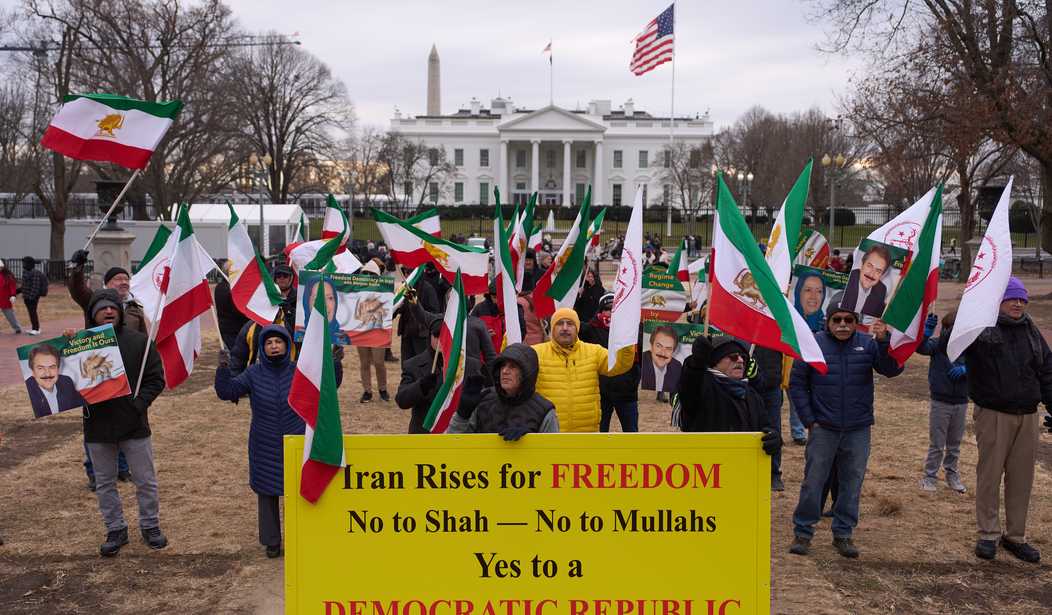

Iran's clerical-fascist regime appears to be on the ropes. Despite the best efforts of the nation's cyber police, internal intelligence operatives, and the cadres of morality police, protests in every major and minor city in Iran have exploded.
Most of them aren't very large. The government's efficient cyber-tracking system, which monitors social media, allows police to descend on budding protests before they can attract a combustible number of demonstrators.
Iranian journalist Masih Alinejad, who has been targeted for death by the regime several times, reports that despite the regime's best efforts, people are pouring into the streets.
But there are just too many. The streets no longer belong to the government.
Message from Iran:
— Masih Alinejad 🏳️ (@AlinejadMasih) January 2, 2026
This is Marvdasht. People are in the streets. The Islamic Republic is brutally cracking down.
With every young person the Islamic Republic kills, our anger grows stronger.
We must win, otherwise Khamenei will slaughter us all and hang us.
Let the world hear our… pic.twitter.com/7zEAPKNAst
Reuters reports that Iranian human rights groups say that 16 protesters have been killed since the unrest began the last week in December, including Saghar Etemadi, 22.
Saghar Etemadi, a 22-year-old Iranian protester, was shot in the face with pellet bullets by security forces and later died in hospital.
— Masih Alinejad 🏳️ (@AlinejadMasih) January 4, 2026
She stood up for a free Iran.
The regime killed her.
Her last Instagram message before protesting:
“I’m afraid we’ll lose many more of us,… pic.twitter.com/Z7L4YKUcIE
We've seen all of this before. Protesters pour into the streets in the thousands, tens of thousands, and hundreds of thousands, and then the crackdown comes. The fanatically loyal Revolutionary Guards and hired thugs who serve as adjuncts to the police begin arresting and sometimes killing protest leaders. Once they're off the streets, the protests die down, and an uneasy peace is established.
Numerous commentators observing the protests say that this time it may be different. This time, the people may actually have a chance.
Wishful thinking? Middle East Forum's Michael Rubin doesn't think so.
While previous protests involved elites or smaller segments of society, the current unrest is spreading across Iranian society, including traditionally supportive elements.
Even Islamic Revolutionary Guard Corps veterans suffer the consequence of runaway inflation and the Iranian rial’s hemorrhaging value.
The closure of the Tehran Bazaar is often the harbinger of government collapse if not revolution.
It is increasingly likely that Supreme Leader Ali Khamenei’s legacy will be the collapse of the Islamic Republic.
If the Iranian public has its say, his son Mojtaba will also hang.
That's the key: "the Iranian public" will probably not have much of a say in a future Iran after the clerical fascists are gone. Even if the long-shot revolution leads to the government fleeing or being lined up against a wall, what follows may actually be worse.
"There is no centralized leadership to the current protest movement, and as the collapse of the Georgetown conference demonstrated, the diaspora opposition leaders and groups are more polarized than ever," writes Rubin.
The 2023 Georgetown conference, hosted by the Georgetown Institute for Women, Peace, and Security, brought together all the major Iranian opposition groups in one place: monarchists supporting the Shah’s son, Crown Prince Reza Pahlavi; communists; socialists; human rights and civil society activists; prominent actors; and Ali Karimi, "one of Iran’s best-known soccer legends, now an anti-regime activist based in Germany," according to The Atlantic Council.
The group promised to publish a charter of demands. Within a month, the factions were at each other's throats, hurling accusations and making it clear that there was no such thing as "unity" among anti-regime activists.
Within hours of the charter’s publication, many supporters of Pahlavi went on social media to attack the coalition, christened the Alliance for Freedom and Democracy in Iran (AFDI), and its new charter. Much of their complaints ranged from vague to conspiratorial. Some complained that the phrase “the Iranian nation” had not been used even though the text spoke of “the people of Iran” and committed itself to the country’s territorial integrity. Some complained about the clenched fist logo used by ADFI, claiming it signaled a hidden leftist agenda.
That does not bode well for the future. The people are in the streets because the currency, and the economy along with it, is collapsing. The shops are closed because the shopkeepers are in the same boat as their customers. The people are angry, desperate, and want change.
Iran's police chief, Ahmad-Reza Radan, told Reuters that security forces had been targeting protest leaders for arrest over the previous two days, saying "a big number of leaders on the virtual space have been detained."
That tactic has worked in the past, as has shooting a few protesters to remind Iranians who has the guns and who doesn't, but will it be enough?
Rubin believes the prospect of a civil war that could roil the entire region is in the offing.
Should civil war erupt in Iran—and its likelihood is high—then the Arab Gulf states must also be prepared for hundreds of thousands, if not millions, of Iranian refugees. The first wave will be upper- and middle-class Iranians who can afford apartments in Sharjah, if not posh hotels in Dubai. With time, however, more working-class and rural Iranians will begin to flee by dhow and speed boat across the Persian Gulf, perhaps overwhelming the Emirates and its Gulf neighbors.
Oman is typical: Rather than plan for Iran’s fall, Muscat prefers wishful thinking that diplomacy can resolve any internal disputes before violence erupts.
Within Washington, there may be too much optimism that the Islamic Republic’s collapse will resolve the Houthis’ fight. Such a belief misunderstands the Houthis: while the Islamic Revolutionary Guard Corps co-opted the group, it did not create it. Indeed, the Houthis have intellectual and political roots in Yemen’s Imamate that predate Iran’s 1979 Islamic Revolution. While southern Yemen rejects the Houthis, they do have a constituency in northern Yemen, which is one reason why the U.S.-backed Presidential Leadership Council has failed to end the Houthi scourge.
There is likely to be no happy ending for the Iranian people if the regime collapses, nor will the unstable Sunni monarchies in the Gulf benefit from the end of the Shi'ite Iranian regime.
The streets of Tehran are proving that the regime’s days are numbered, but the infighting of the opposition suggests that what comes next could be just as fractured. Until a "New Iran" can find a voice that speaks for all its people, the cycle of revolution and repression is likely to continue, regardless of who holds the title of Supreme Leader.