Once upon a time (about 2 million years ago), there were a few thousand animals that walked upright, with big brains but puny muscles and teeth suited to chewing, not biting.
They weren't swift, nor could they escape the numerous large predators that roamed the African savannah at the time. Cave lions, bears, dire wolves, saber-toothed cats, and leopards saw these small, slow creatures as an easy meal.
They were hanging on to existence by sheer dint of their ability to cooperate, to work together, and perhaps to communicate in some small way when danger threatened, or where food and water could be found.
How did this Australopithecus africanus, an early tool-making human ancestor, manage to survive to pass its genes to the next generation? How did it survive to evolve into what modern homo sapiens have become?
How did we evolve from prey to predator?
Until recently, we saw Australopithecus as a murderous, war-prone prehistoric proto-human, practicing cannibalism and killing off other hominids of the time. However, that view was colored by a wrong-headed cultural bias that saw primitive man as evil and unredeemed.
The perspective of our ancestors being vicious predators was embraced, in part, because it was consistent with “a basic Judeo-Christian ideology of man being inherently evil, aggressive, and a natural killer," according to Washington University anthropologist Robert Sussman.
"Of late, however, the scientific balance has been shifting, partly inspired by the 2005 book, Man the Hunted," writes evolutionary biologist David Barash in Nautilus. The book details anthropologists Sussman and Donna Hart's view "that most primates are prey rather than predators, a pattern seen in A. africanus like 'Lucy' and her descendants," says Barash.
Sussman and Hart noted that A. afarensis was an “edge species,” inhabiting borderlines between trees and savanna, likely reverting to the former to sleep and to escape from huge ground-dwelling predators, which were roughly 10 times more abundant than they are today. These included cave lions, dire wolves, hyenas as big as bears, and bears as enormous as North American short-faced bears, which stood 11 feet tall on their hind legs. Tree-climbing ability would likely have been key to survival in such a tough neighborhood.
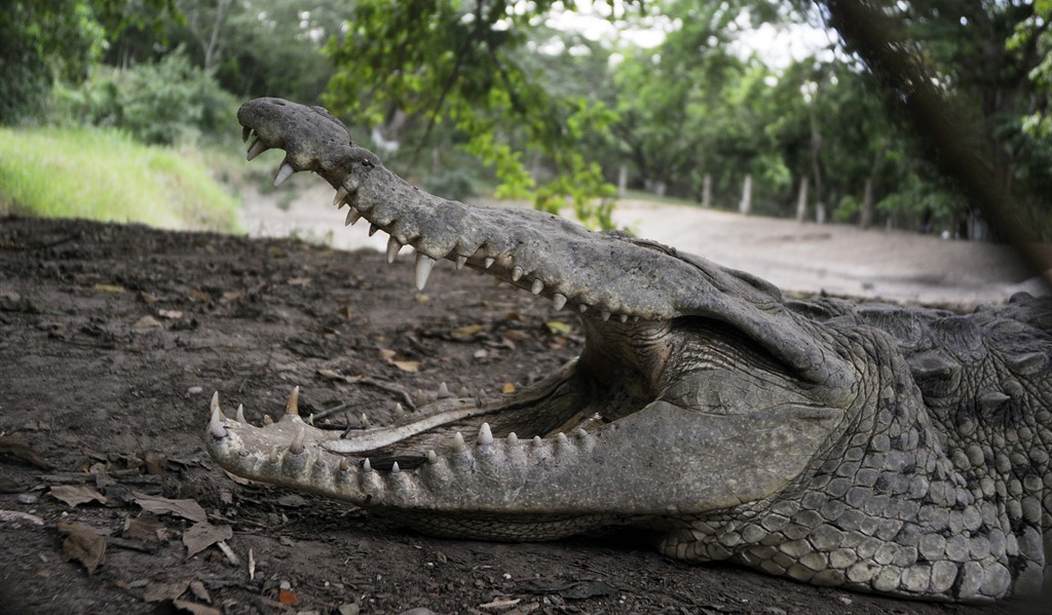
Moreover, recent fossils have been suggestive that our ancestors were on the menu for animals, although as with nearly all such data, the sample sizes are small. There’s OH-8, a Homo habilis specimen dated at 1.8 million years old, discovered by the Leakeys in Olduvai Gorge, Tanzania, and whose left foot and detached leg show extensive tooth marks from a crocodile. Plumwood’s experience, it appears, wasn’t unique. Ditto for another victim—labelled OH-35—who was evidently dismembered by one or more crocs, and whose other skeletal parts had been chewed by a leopard-sized carnivore. (It’s also possible, of course, that these early meals involved scavenging on carrion rather than killing live prey.)
We're just beginning to understand why some of our evolutionary changes were driven by the fact that we were easy prey for the expert hunters that inhabited the savannah when we were a young species trying to survive.
Why, relatively suddenly, 3.5 million years ago, did our ancestors become bipedal? What in our environment made it advantageous for "Lucy" to walk around on two legs rather than four?
The simple answer is that we were able to spot danger from farther away, thus giving us more time to escape. Those hominids who were able to escape because they glimpsed danger from an upright posture lived long enough to pass their genes to the next generation. It's probable that not all A. africanus possessed the ability to stand upright. Those who couldn't lost the evolutionary race and their lineage was lost.
Once we consider the likely impact of being preyed upon by other creatures no less than preying upon them, many other fundamental human traits take on new meaning. Early communication by gesture and words? Quite likely helpful when it came to group cohesion, sharing information as to food sources along with water holes during drought, achieving social dominance, and the like.
Oxford University’s Robin Dunbar has made the case that speech originated as cohesion-generating social gossip. But don’t ignore the payoff of being able to broadcast a prompt heads-up when a predator appears.
That we are no longer prey (except for a few unlucky folks who are dumb enough to swim in crocodile-infested waters or poke a grizzly bear) has accelerated our intellectual abilities and created our ability to create civilizations. Agriculture, industry, cities, and states all followed our transformation from prey to predator.
How we got from there to here is a story still being written.