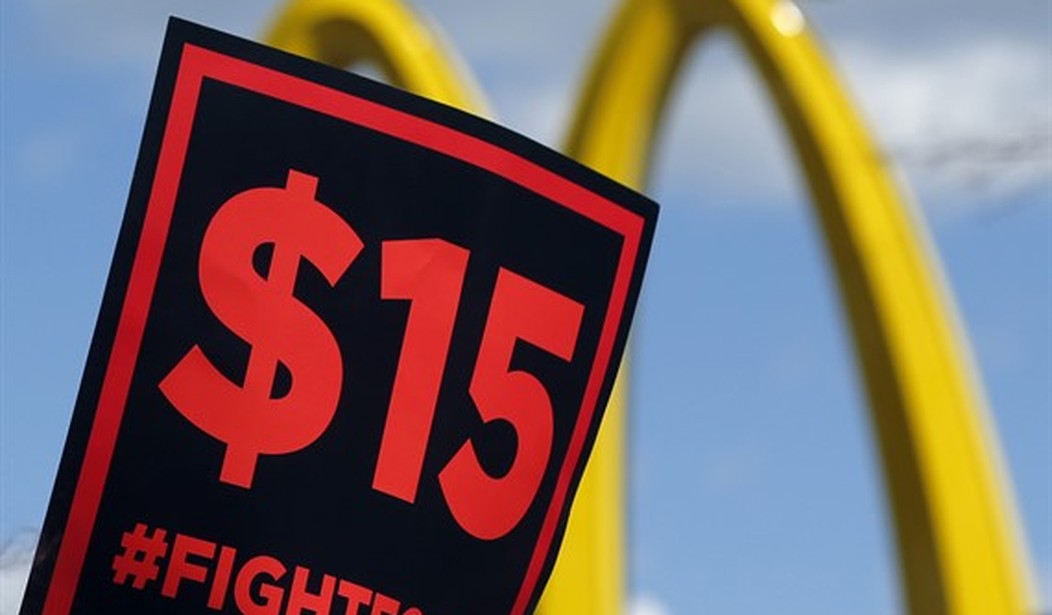

In 2023, California passed a law that increased the minimum wage from $16 per hour to $20 per hour. The lawmakers also empowered a Fast Food Council to meet every six months and increase wages without the input of the state legislature.
The law affects "fast-food workers employed at chains with more than 60 locations nationwide," Jeffrey Clemens, Olivia Edwards, and Jonathan Meer write in a National Bureau of Economic Research (NBER) working paper. Since the increase went into effect all at once, the increase gave an "approximate 8 percent wage increase in California’s fast-food sector relative to the fast-food sector elsewhere in the country."
I'm sure the fast food workers in California will be eternally grateful to the state legislature for the huge increase, at least those who still have jobs will be grateful. The law went into effect on April 1, 2024, and already the NBER says that 18,000 jobs have been lost as some store locations closed, while the revolution in AI and robotics accounted for the rest.
The authors note that "employment in California's fast-food sector declined by 2.7 percent between September 2023 and September 2024 relative to fast-food employment elsewhere in the United States." They point out that prior to the passage of the huge increase in minimum wages, fast-food employment was rising faster in the state than elsewhere in the country. When you figure in potential jobs eliminated, the percentage of jobs lost spikes at 3.7%.
In September, the Employment Policies Institute (EPI) drew on U.S. Bureau of Labor Statistics data to estimate "15,988 fast food jobs lost since the law went into effect in April 2024." The group added, "California's fast food job loss rate (-3.3% of jobs lost) more than doubled the losses in fast food restaurants nationally (-1.6% of jobs lost) since September 2023."
That EPI memo built on a November 2024 study that found "more than 4,400 California fast food jobs have been lost since January," based on federal data. That study also found "10.1 percent menu price increases by April 2024 since the law's passage in 2023."
A February 2025 paper from the Berkeley Research Group (BRG) found the fast-food sector "lost 10,700 jobs (-1.9%) between June 2023 and June 2024." The researchers added, "this decline sharply contrasts with the sector's historically compounded annual growth rate of 2.5% and marks the only December year-over-year decline in fast food employment this century–excluding the Great Recession (2009) and the COVID-19 pandemic (2020)." That report also found that "menu prices at California's fast food restaurants increased by 14.5% between September 2023 (the month AB 1228 was signed into law) and October 2024, nearly double the national average (8.2%)."
"California fast food restaurants also increased automation and technology adoption to offset rising labor costs," the BRG paper also found. "Therefore it should not be surprising that the number of employees per restaurant is declining."
The first thing one California businessman who owned 180 fast-food outlets across the state did after the law came into effect was to begin "capping workers' hours to avoid overtime pay." Harshraj Ghai and his family have also started to invest heavily in AI and robotics. If nothing else, the massive increase in the minimum wage in California has spurred the revolution in those technology sectors.
Unexpected consequences will get you every time.
In addition to wages, California fast-food stores are seeing a significant increase in the prices of menu items. The BRG report also found that "menu prices at California's fast food restaurants increased by 14.5% between September 2023 (the month AB 1228 was signed into law) and October 2024, nearly double the national average (8.2%)."
The economically uninformed California lawmakers, who believed they could create prosperity by raising wages in a vacuum, are being given an immediate lesson in the law of supply and demand. Increasing wages leads to higher prices for an industry built on the concept of serving cheap, delicious food quickly. Any visit to a fast food restaurant recently, especially in California, would disabuse the average American that most of that criteria wasn't being met.