


One might call it a Fall “cleaning” of sorts. Not so much in the Russian sense of a chistka, or purge. More like changing summer clothes for winter clothes. As the temperature drops in Russia, the gas that fuels Russian politics is being turned up. With State Duma elections scheduled for 2 December and Presidential Elections slated for early March 2008, there is no doubt that by the time everything is said and done, Russian politics will be burning white hot. And there is no doubt that Clan Putin will be monitoring the controls.
Today’s Russian political news is just one example. Putin dismissed Russian Prime Minister Mikhail Fradkov. Many have rightly interpreted the move as a clearing of the political deck for the upcoming elections. Putin himself confirmed this. “The country is nearing parliamentary elections to be followed by presidential elections… We all need to think together about building the power and governing structure so that they can better meet the needs of the pre-election period, and prepare the country for the time after parliamentary and presidential elections in March 2008,” he explained. Fradkov concurred. He told reporters that Putin should be given a “free hand” in making a government suitable for the upcoming elections. “I think it would be right on my part to take the initiative to vacate the position of the chairman of the government so you don’t have any constraints in making decisions about building the configuration of power with respect to the upcoming political events.”
The move fully complies with the Russian Constitution. Articles 83 and 117 give the President of Russia the right to dismiss and appoint the Russian Government.
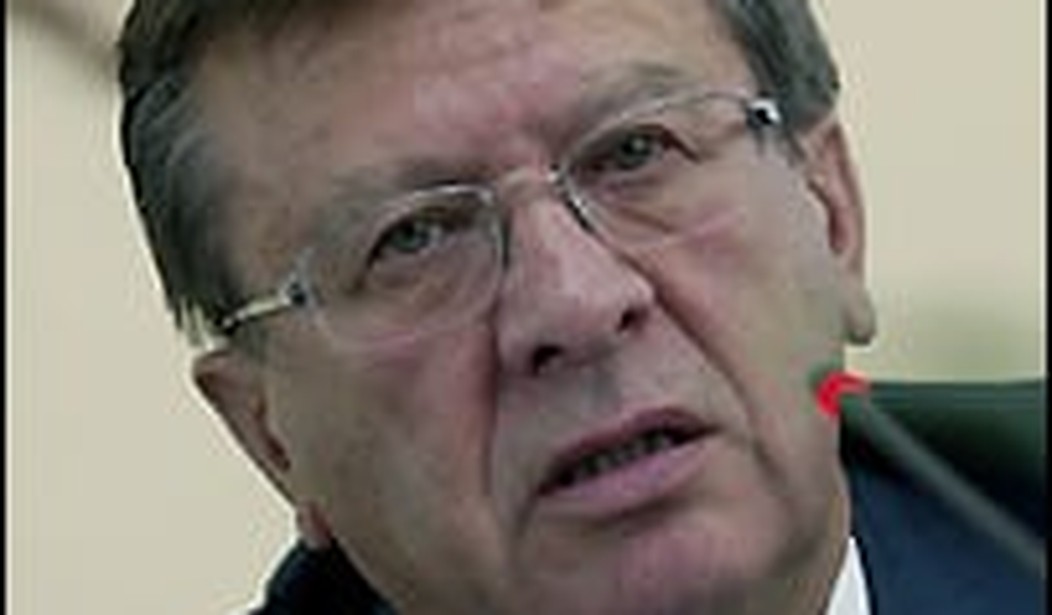
Initially, reports assumed that Fradkov’s dismissal would pave the way for Deputy Prime Minister Sergei Ivanov, who is also a presidential favorite, to be named Prime Minister. But always keeping analysts on their toes, Putin defied expectations and named Viktor Zubkov, head of the Russian Financial Monitoring Service, for the post. Zubkov is little known even inside of Russia. As Aleksandr Ryklin writes in Ezhednevnyi Zhurnal, “The Prime Minster of Russia is to become a person who half a year ago no one wrote, talked, or thought anything about.” Zubkov’s political career has been intimately tied with Putin. He’s served in Soviet/Russian administration for over 30 years and hails from Putin’s St. Petersburg bailiwick. Zubkov worked under Putin in the early 1990s in St. Petersburg’s city administration.
The question now becomes what the government shake up really signifies. Vladimir Katrenko, Deputy Chairman of the State Duma, told Kommersant that “the dismissal of the government is not a sign of political crisis or any other crisis in the country.” The move merely “ensures the continuity of the Putin’s political course after the upcoming elections,” the daily stated. Communist Party Presidential candidate Gennady Ziuganov also doesn’t see anything dramatic in the move. “I declared in spring that there would be a significant change in the government, in so far as the Prime Minister is necessary and a new team is necessary to ensure the carrying out of elections,” he said.
Nor is the move all that strange by Russian political standards. Putin is simply repeating what his predecessor, Boris Yeltsin, did in 1999. Some will remember that on 9 August 1999, Yeltsin suddenly fired then Prime Minister Sergei Stepashin. Yeltsin appointed the then virtually unknown Vladimir Putin in Stepashin’s place. At the time, Yeltsin’s move was also to “ensure the continuity” of his political course. In an interview with Paul Klebnikov, former KGB head General Oleg Kalugin said, “Yelstin was convinced that Putin was a completely reliable, loyal member of the family [Yeltsin’s clan]. Putin was a man of Prussian-style obedience: Once the president orders something, Putin will do it. This made him irreplaceable for President Yeltsin.” How naive Kalugin’s statement sounds eight years later. Putin’s appointment paved the way for his becoming President, a position that gave him the power to smash Yeltsin’s clan and drive the oligarchs that ran it into exile. Could Zubkov’s appointment be the harbinger of something similar to come?
As Marx once wrote, following Hegel, history occurs twice: “the first time as tragedy, the second as farce.” Therefore, while Putin’s move has precedent, it shouldn’t be taken as too significant. For while some might immediately think that Zubkov, like Putin before him, might serve as a “dark-horse” candidate, the former is hardly the outsider that the latter was. The Putin clan is far too entrenched and, unlike Yeltsin’s government in 1999, politically solvent. No, Zubkov’s appointment should be seen as a shoring up of that power, rather than any kind of shake up. As Yevgeny Volk of the Heritage Foundation told RFE/RL, “I think that whoever it is, this is a signal that the president is making his choice. There is just half a year left until the presidential election, and that’s long enough on the one hand to make the new candidate popular, to show him to people, to demonstrate how well he works. And on the other hand in that amount of time, if the economic climate remains good, it is unlikely he will make mistakes big enough to sully his reputation.” I have a tendency to agree.
Sean Guillory is a PhD candidate in Russian and European History at UCLA. You can read his thoughts on Russia at Sean’s Russia Blog.




Join the conversation as a VIP Member