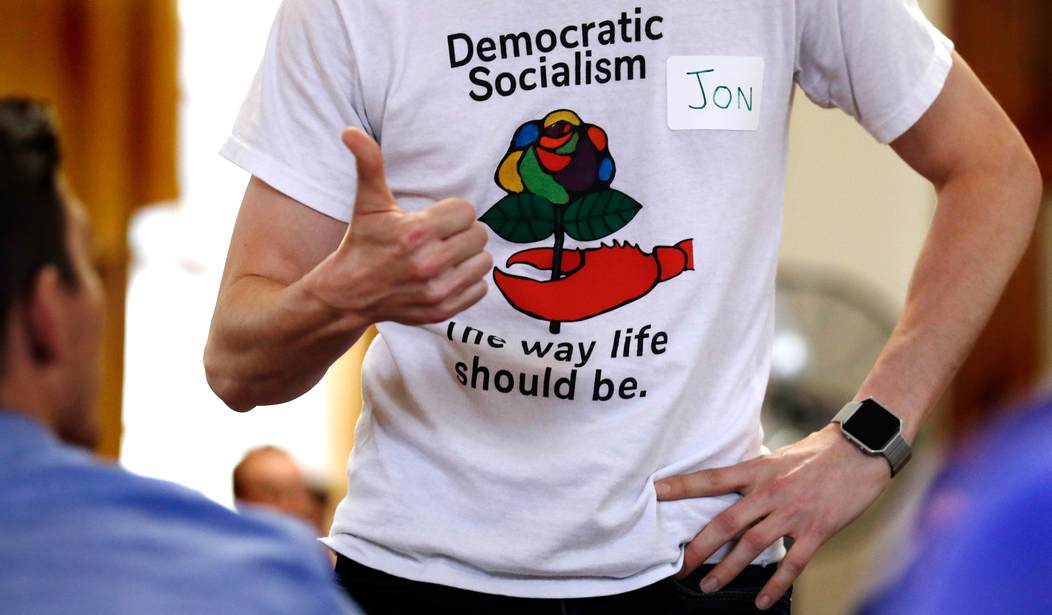
Every time a grassroots revolt starts knocking off incumbents, somebody in the media reaches for the Tea Party comparison. It's the go-to reference for a movement that shakes a party from the bottom up. So it's no surprise that the wave of socialist candidates toppling Democrat incumbents this year got the same treatment. The comparison falls apart once you look at who's doing the revolting and what they actually want.
Back in July, CNN's Harry Enten argued there was indeed a parallel between the Tea Party movement of 2010 and the DSA uprising of 2026. "We have seen something like this before," Enten said. "You have to go back 16 years. Remember, it was that Republican Tea Party wave of 2010. I would argue the Democratic version of it is a new Tea Party, but it's on steroids."
I pointed out at the time that Enten left out one detail, and it's a big one. The Tea Party wave came from inside the Republican electorate itself. Those were GOP voters who felt their own party had drifted from the principles it claimed to stand for, and they fixed it at the ballot box. The Tea Party was a realignment, a self-correcting force that pulled the GOP back toward the values of the nation's founding.
The DSA surge works differently. Much of it is organized from outside the Democrat Party altogether, by candidates tied to the Democratic Socialists of America who are simply borrowing Democrat ballot lines and party infrastructure to get where they want to go. The socialist wave looks more like an insurgency, or a hostile takeover, aimed at turning the Democrat Party into something wholly un-American.
And I mean more un-American than it has already become.
ICYMI: AOC's Presidential Ambitions Face a Humiliating Setback
Greg Gutfeld took up the question on The Five last week, and argued there's no comparison between the two movements. He makes some fascinating points, starting with what the Tea Party had in common with the Republicans it was running against.
"You can't compare this to a Tea Party because the Tea Party shared the foundational truths of the people they were rebelling against," Gutfeld said. "I mean, they still believed in a border, they still believed in free markets, and they still believed in biology. You can't say that with the DSA."
That's the heart of it. Tea Partiers fought about spending, debt, and the size of government, but they started from the same foundation as the GOP establishment. The DSA crowd rejects the foundation itself, and Gutfeld explained why that makes moderation so unlikely.
"You have to repudiate your claims in order to evolve," he continued. "I don't think they're going to do that. It's because they fused every policy with identity."
He then walked through how that plays out on issue after issue.
"So they fused sex with gender identity, so that a medical fact then becomes an attack on someone's existence," Gutfeld explained. "They fuse the borders with racism, so if you just want what other countries want, then you are an oppressor. They fused capitalism with systemic oppression. So that means if you defend markets, you're defending exploitation."
Asked whether the far left can evolve, he pointed to abortion.
"I mean, think about like, has anybody evolved from abortion except the wrong way?" he asked. "We used to be safe, legal and rare? Now it's up to nine months or your money back. Is that evolution?"
“You CAN’T compare this to the Tea Party.” @greggutfeld says the DSA rejects foundational beliefs about biology, borders and free markets, making its radical agenda impossible for Democrats to simply “moderate.”
— The Five (@TheFive) September 28, 2026
Tune in to ‘The Five’ weekdays at 5 p.m. ET on Fox News Channel. pic.twitter.com/SqO1gDc3Mf
Here's why that matters for the midterms.
When every disagreement gets treated as bigotry, there's no room to compromise, and no way to win over the voters in the middle who decide elections. A Tea Party Republican could argue with a moderate Republican about how much to cut. A DSA candidate treats a moderate Democrat as the enemy.
That's why I believe the two movements will have opposite effects at the ballot box. The Tea Party gave the GOP a massive boost in 2010, when Republicans picked up 63 House seats and took back the majority, the biggest midterm swing for either party since 1938. The socialist insurgency is doing the reverse, and it threatens to limit Democrat gains in a year when they expected a huge wave.