The Supreme Court handed down a ruling Wednesday that has Democrats in full meltdown mode — and for good reason. The decision touches something they've spent decades building: a legal architecture that lets them lock in political power by drawing congressional maps around race. That system just suffered a fatal blow. But here's the thing: One justice thinks the court still didn't go nearly far enough. And when you hear his argument, it's hard to disagree.
After the 2020 census, a lower court ruled that the Voting Rights Act required Louisiana to add a second majority-black district, and the state complied but challenged it as an illegal racial gerrymander. In a 6-3 decision in Louisiana v. Callais, the court agreed, striking down Louisiana's second majority-black congressional district.
Justice Samuel Alito wrote the majority opinion, taking the narrow path. He acknowledged that complying with the Voting Rights Act can sometimes require some use of race, but held that Louisiana had no compelling interest in packing black voters into the challenged district. "'Our acceptance of race-based state action has been rare for a reason,'" Alito wrote, concluding the map was unconstitutional.
Predictably, the left exploded.
Chuck Schumer called it a betrayal of democracy's "most sacred promises." Barack Obama declared that the ruling "effectively guts a key pillar of the Voting Rights Act," claiming it gives states a free pass to dilute minority voting power under the cover of partisanship. The panic is real because the corrupt system they built is crumbling, and they know it.
Recommended: Iran Is in a ‘Death Spiral’ and Time Is Running Out
One might think that we could all agree that drawing congressional maps based solely on skin color is racist. But apparently not. The entire premise of race-based redistricting is that black voters must be grouped together to have political power — an assumption that is, at its core, deeply patronizing and racially deterministic.
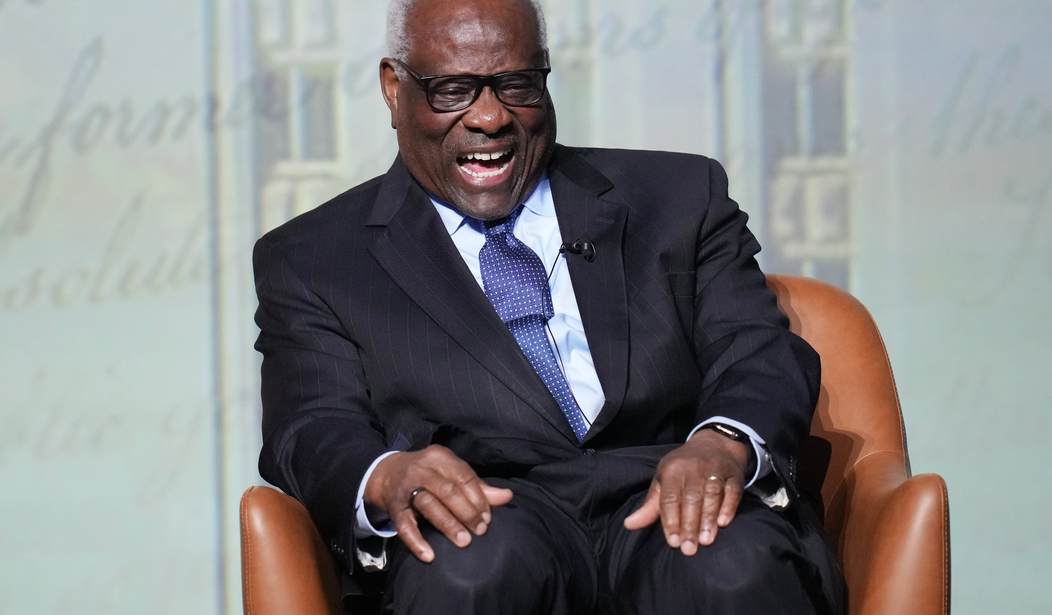
While the majority stepped away from that cliff. Justice Clarence Thomas wanted to leap off it entirely.
Thomas, joined by Justice Neil Gorsuch, filed a concurring opinion arguing the majority still didn't go far enough.
And he's been making this argument for decades.
"As I explained more than 30 years ago, I would go further and hold that [Section 2] of the Voting Rights Act does not regulate districting at all," Thomas wrote. In his view, Section 2 — the civil-rights-era provision barring racial discrimination in voting — was never meant to govern how legislative maps are drawn. It covers ballot access and voting procedures. That’s it. End of story.
Thomas didn't mince words about the court's prior adventures in this territory. He writes that "today's decision should largely put an end to this 'disastrous misadventure' in voting-rights jurisprudence,” a phrase he lifted from his own 1994 concurring opinion in Holder v. Hall. Back then, he wrote that the assumptions underlying vote dilution decisions "should be repugnant to any nation that strives for the ideal of a color blind Constitution."
Thirty years later, he's still right.
The liberal dissenters, led by Justice Elena Kagan, warned the ruling "renders Section 2 all but dead letter" and accused the majority of stripping away protections for minority voters. "Under the Court's new view of Section 2," Kagan wrote, "a State can, without legal consequence, systematically dilute minority citizens' voting power."
What Kagan frames as a catastrophe, Thomas frames as a correction. One man's "gutting of the VRA" is another man's return to what the law actually says. Clarence Thomas has been the most consistent, principled voice on this court when it comes to colorblind constitutionalism, and history keeps catching up to him. He's not just a national treasure. He's a man who has been right for decades while everyone else was still figuring it out.