





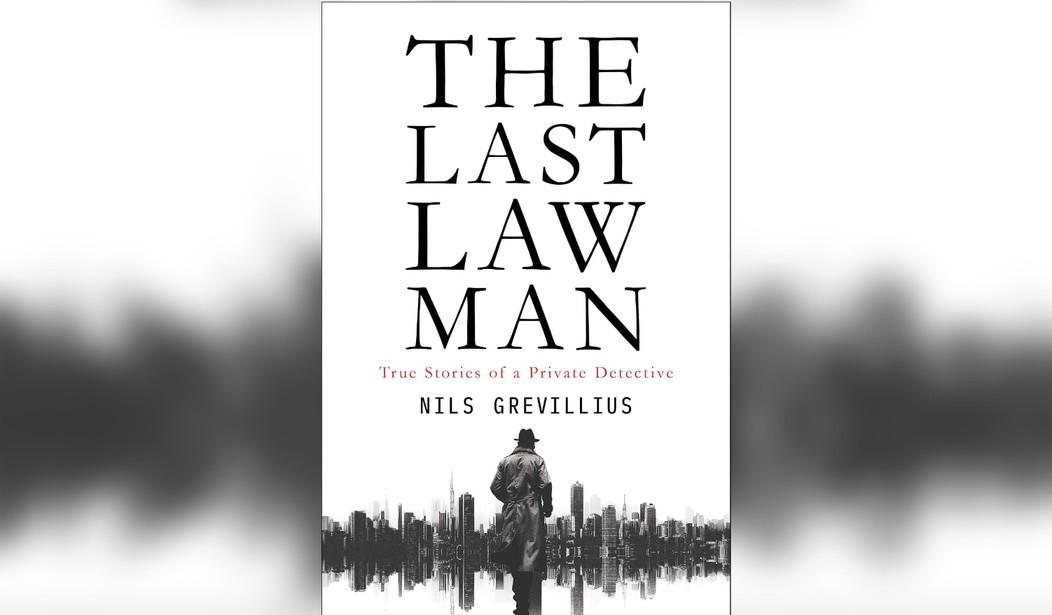
If you’re a fan of the private-eye genre — from Sherlock Holmes to Magnum P.I. and Agatha Christie’s Hercule Poirot — you’re going to want to pick up a copy of The Last Lawman: True Stories of a Private Detective.
As the title of his latest book reveals, Nils Grevillius shares stories that are truly “stranger than fiction,” and strangely truer than official narratives. As a former Pinkerton investigator, U.S. Army counterintelligence specialist, and private detective, Nils has amassed stories that are not only a good read, but that also reveal deep truths about our own society well worth understanding from a street-level perspective.
In a recent episode of Dangerous Laughter with A.J. Rice, Grevillius pulls back the curtain on a world most of us know exists, but rarely see firsthand: surveillance, tracking, private investigations, counterintelligence and undercover operations.
And that world has changed dramatically.
From old-school stakeouts and Pinkerton investigations to sophisticated modern tools capable of locating and monitoring movements, Grevillius reveals just how much can be discovered about someone who thinks he’s safely “off the radar.” His experiences raise questions that extend well beyond the world of private eyes:
Are we already living in a surveillance state?
How much privacy do we really have?
How much power should government and other institutions have to watch, track, and compile information about us?
Drawing on more than 30 years as a private investigator, Nils also recounts some of the remarkable cases behind The Last Lawman: bizarre investigations in Los Angeles, hidden identities, staged kidnappings, elaborate surveillance operations, and other stories that sound more like Hollywood screenplays than actual case files.
But that’s precisely what makes Nils’ perspective so compelling. These aren’t theories or fictional detective stories. They’re lessons learned from decades spent watching people, finding fugitives — and discovering just how difficult it really is to disappear.
And leave it to veteran publicist, author, and comedian A.J. Rice to expertly draw out the intriguing personality of Nils and some of his most provocative views, based on a “private dick’s” view of the world.
Nils cut his teeth as a counterintelligence agent in the ebbing days of the Cold War, with a prescient observation that Islamic terrorism would become a major global problem. “Bill Clinton did his part by treating Islamic terrorism like a criminal problem rather than a national security problem,” he says.
Bush preserved America’s dependence on Middle Eastern oil, opines Nils, adding that after 9/11, the United States should instead have spread the burden of war more broadly through national service and war bonds while aggressively developing domestic energy production. From this perspective, bin Laden’s strategy was not simply to attack America, but to destabilize U.S.-friendly petroleum regimes in the Persian Gulf and exploit an energy dependence that left the nation strategically vulnerable.
Grevillius shares an informed dose of skepticism toward government-run investigations — a sentiment that resonates with a growing number of Americans. Public confidence in the nation’s intelligence and federal law-enforcement institutions has fallen dramatically in recent years, with both the CIA and FBI suffering historically low ratings as distrust mounts toward the very agencies charged with protecting the American people.
But Grevillius takes the argument a step further: Sometimes the private guy simply does it better.
He points to Allan Pinkerton, whose private detective agency performed functions in the 19th century that would later become the province of federal law enforcement and intelligence. Pinkerton and his operatives gathered intelligence for the Union during the Civil War and helped protect Abraham Lincoln, including famously uncovering an alleged assassination plot before Lincoln's inauguration. In Grevillius’ telling, Pinkerton was something of a 19th-century precursor to the modern private security contractor — doing privately what government agencies would later institutionalize.
That distinction matters to Grevillius. Private operators have powerful incentives to produce results: fail, and you lose the client. Government bureaucracies rarely face the same immediate consequences. He sees that dynamic extending far beyond detective work, pointing to everything from federal law enforcement to disaster response. His larger point is provocative but difficult to dismiss: government doesn't possess a monopoly on competence simply because it possesses a badge, a bureaucracy or a budget — and sometimes the people outside the system outperform those entrusted to run it.
Asked whether people come to private investigators as a last resort or because they don’t trust law enforcement bureaucracy, Grevillius responds, “I get it both ways. People who have been cycled through the system and punished appropriately for their belief that their government is here to help them…sometimes the government does help them; usually not.”
“I have a radical idea that incompetence and indifference are the most endemic, pernicious, damaging forms of civil corruption you could imagine,” asserts Grevillius. But what has helped him succeed and thrive in a very hostile, high-risk profession boils down to two things: his ability to understand the subtext of what is going on and read between the lines often; secondly and most importantly, Grevillius emphasizes emotional roughness.
“Take any healthy man of the correct age and you can make him into the physical specimen,” he says. “But if he lacks the emotional toughness, you can’t breed it into him; you can’t create emotional toughness where it doesn’t already exist.”
“It’s because the things that make us tough are being replaced by things that make us soft,” agrees Rice, comparing the toughness of Reggie Jackson and Willie Mays to athletes today. “The things that make us tough are being replaced by things that make us soft. A lot of it is just the digital nonsense and devices,” he says.
“Cyborgs, A.J., they’re cyborgs,” responds Grevillius. “You take away the digital device, they’re half a human being.”
So, this summer, do yourself a favor: put down your own digital devices, stop scrolling your socials, and pick up a real book. If you love L.A. Confidential, hard-boiled detective stories, or those gritty serialized dramas that keep you turning pages long after you should have gone to sleep, The Last Lawman delivers something even better: stories that actually happened, lived by a guy who spent more than three decades doing the real thing. Spend a few hours in the decidedly real world of The Last Lawman.
Your phone will still be there when you get back — and after reading what Nils Grevillius has to say about surveillance, you may want to change the settings.
Editor's Note: Do you enjoy PJ Media's conservative reporting exposing the radical left and woke media? Support our work so we can keep bringing you the truth.
Join PJ Media VIP and use promo code FIGHT to receive 60% off your membership.



Join the Conversation
VIP members get the ability to comment on articles.