





“Deflating.”
“Sickening.”
“It’s not good news.”
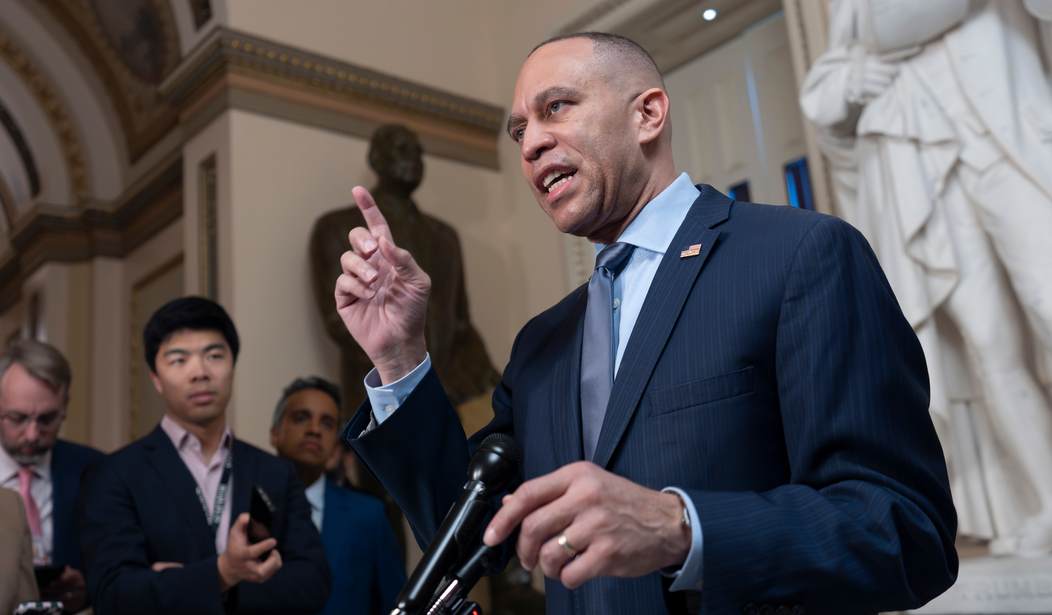
If someone heard the reactions of House Democratic lawmakers to the Virginia Supreme Court’s decision on the Commonwealth’s recent partisan gerrymandering scheme, they might be forgiven for assuming the ruling posed some kind of existential threat to the rule of law in the Commonwealth. In a letter to his party, House Minority Leader Hakeem Jeffries referred to the decision as “egregious” and “dripping with far-right partisanship,” the result of “MAGA extremists desperate to rig the midterm elections.”
Chalk these wildly hyperbolic statements up as yet another reason to disbelieve left-wing partisan hype. In fact, Jeffries must have been looking in the mirror when he made those claims, since it was Virginia Democrats’ “egregious” misbehavior “dripping with far-left partisanship” that was the culmination of “Democratic extremists trying to rig the midterm elections” in the state.
The Virginia Supreme Court’s decision in Scott v. McDougle was, in fact, a full-throated defense of the state’s constitution, the rule of law, and the people of Virginia’s right to make informed decisions on possible alterations to the Commonwealth’s constitution.
What was lost in the frenzied hysteria of Democrats and their allies in the media in the immediate aftermath of the decision was that the majority opinion, written by Justice D. Arthur Kelsey, simply upheld the process outlined in the Constitution that was required to adopt the proposed redistricting amendment. The Democrats’ hasty process violated Article XII, Section 1 of the Virginia Constitution. There was no partisanship in the opinion at all, with the exception perhaps of the dissent by three justices who refused to enforce the constitutional requirements.
Article XII requires the General Assembly to vote on any proposed amendment to the Constitution twice, with a general election of members to the House of Delegates occurring between the two votes. The court’s ruling centers on that (supposedly) intervening House election, held in 2025, not the recent vote on the amendment itself.
The Virginia Supreme Court found that the 2025 House election did not actually occur after the first time and before the second time the General Assembly voted on the amendment. Early voting (Virginia law allows voting to start 45 days before Election Day) for the House of Delegates elections began on September 19, but the General Assembly didn’t vote on the proposed amendment until October 31 in a “special” session that was itself open to challenge. Accordingly, 1.3 million votes, 40% of the election total, had already been cast when the legislature approved the referendum. That was 1.3 million people who had already voted who had no way of knowing their future representative’s position on an amendment to their Constitution.
The violation of Article XII, Section 1 here is obvious—to everyone but the Virginia government, now entirely controlled by Democrats, which argued that when the state constitution said the Assembly’s vote needed to occur before the election, it meant Election Day. Justice Kelsey’s opinion masterfully dissects this argument as lacking any meaningful support from law or history.
The word “election,” Kelsey said, has never been used to exclusively refer to the single day at the end of the electoral process. “The definition of ‘election’ has always broadly denoted ‘the act of choosing.’” He cites Black’s Law Dictionary, the most frequently used legal dictionary in the U.S., as “correctly observ[ing]” that “‘election day is normally the last day on which voters may cast a vote in a given election’” [Justice Kelsey’s emphasis].
If the Democrat AG’s claim was correct, Kelsey noted, election officials would have to tell an early voter asking to cast a ballot that “‘you can vote in the election, but we are not conducting an election today.’”)
This distinction between elections and Election Day is also deeply rooted in Virginia history. Kelsey reminds us that until travel to polling places became easier, “it was common in Virginia… for elections to last for days” as officials collected all of the votes in a very large state. Even into the mid-1800s, the U.S. Congress recognized that Virginia’s votes “‘were not polled in one day’”.
Lax absentee-voter standards may be a modern innovation, but multi-day elections are certainly not. By waiting a month-and-a-half after the 2025 House of Delegates election had begun to propose their gerrymandering scheme, the Commonwealth robbed over a million Virginians of “their constitutionally protected right to vote for or against delegates who favor or disfavor amending the Constitution.”
Of course, Virginia Democrats weren’t going to let this “sickening” defense of Virginians’ constitutional rights stand without a fight. So they filed an egregiously misspelled motion asking the Virginia Supreme Court to not enforce its own ruling, followed by an emergency application for a stay at the U.S. Supreme Court… referring to it as the Supreme Court of Virginia.
The U.S. Supreme Court did exactly what it should have done – threw out the state attorney general’s petition without a single dissent. There was no explanation in the order, but besides the comedy of spelling and other errors in the filings, the high court invariably defers to state supreme courts in interpreting their own state constitutions, unless that interpretation runs afoul of the U.S. Constitution, which was not the case here. There was no federal issue in this case of any kind despite the meritless claims by Virginia’s spelling-challenged attorney general.
The redistricting fights in various states will continue. But what the Virginia Supreme Court’s majority did in Virginia, contrary to the unhinged criticisms you may have heard, was to take seriously its duty to “declare the constitutional boundaries of political power” and to have “the courage to ‘fearlessly’ protect them.”
Editor's Note: Unelected federal judges are hijacking President Trump's agenda and insulting the will of the people.
Help us expose out-of-control judges dead set on halting President Trump's mandate for change. Join PJ Media VIP and use promo code FIGHT to receive 60% off your membership.


Join the Conversation
VIP members get the ability to comment on articles.