Note: Most Thursdays, I take readers on a deep dive into a topic I hope you'll find interesting, important, or at least amusing. These essays are made possible by — and are exclusive to — our VIP supporters. If you'd like to join us, take advantage of our 60% off promotion.
"Often the demise of old adversaries leads to the emergence of new, sometimes more dangerous challenges rather than to peace and harmony among nations." —Richard Nixon on Russia, in Beyond Peace, 1994.
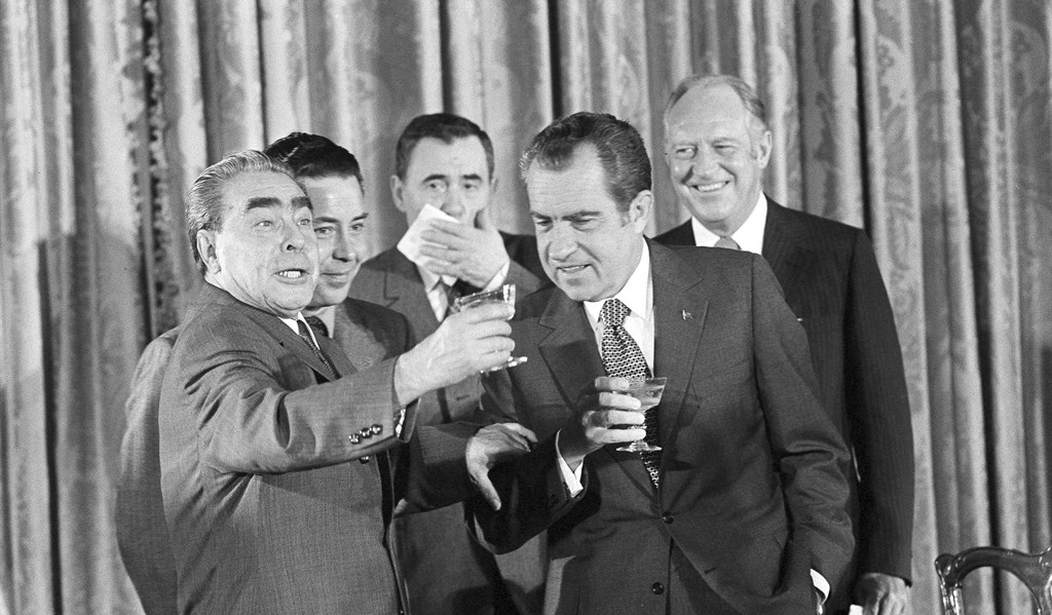
The ashes of the Soviet Union barely had time to go cold before former President Richard Nixon issued his "Save Russia" memo to then-President George H.W. Bush. "The hot-button issue in the 1950s was 'Who lost China?'" Nixon wrote, but "If [Russian President Boris] Yeltsin goes down, the question 'Who lost Russia' will be an infinitely more devastating issue in the 1990s."
Bush barely listened, focused as he was on his faltering reelection effort. "I think Baker and Bush have good instincts on what to do in the former Soviet republics," Nixon told New York Times columnist Thomas Friedman during the campaign, "but I think they’ve been a little too timid in doing it... I think they’re afraid of looking like they’re too preoccupied with foreign policy."
Bringing freedom and economic advancement to the Russian Federation became almost an obsession for Nixon between the Soviet flag’s final lowering over the Kremlin on Christmas Day 1991 and Nixon's death in early 1994.
With Bill Clinton in office, the Nixon Foundation wrote that the former president's Save Russia message "found a more receptive audience." Clinton famously remained friends — or at least maintained a friendly working relationship — with Russian President Boris Yeltsin, securing massive economic aid through the International Monetary Fund meant to stabilize his shaky new government.
The economic and political stability of Russia, however, remained fragile and collapsed in 1993 as the Russian Parliament tried to impeach Yeltsin and by military force, Yeltsin dissolved the parliament. By declaring parliament violated “the will of the people” and establishing control of the media by Presidential decree, Yeltsin passed a new constitution granting himself strong, centralized authority. Amidst the pandemonium, Nixon traveled to Russia in the spring of 1994 to assess the situation.
When Nixon returned to the U.S., he told CNN, "Yeltsin is in very bad shape, physically and politically. He’s just uncontrollable," and that the administration should look to the next generation of Russian leaders, "many of whom I met — such as Grigory Yavlinsky, an impressive, young economist; Sergei Shakhray, the analytically minded Minister of Nationalities; and the formidable economics minister, Alexander Shokhin."
Nixon did not mention a 41-year-old former KGB spook named Vladimir Putin among Russia's "impressive" future leaders. Today, Yavlinsky is a not-very-consequential dissident opposed to the "Special Military Operation" against Ukraine, Shakhray has barely been heard from in more than a decade, and Shokhin hasn't held office since 1998.
I can't think of a single one of the promising reformers from the immediate post-Soviet era who didn't share a similar fate. Or worse.
"The Communists have been defeated," Nixon told Inside Washington in 1992, "but the ideals of freedom are now on trial."
Nixon continued: "If they don't work, there will be a reversion to — not Communism, which has failed — but what I call 'a new despotism.'" The former president went on to say that such a Russia would be "a mortal threat" to the rest of the world, because it would be "infected with the virus of Russian imperialism, which of course has been a characteristic of Russian foreign policy for centuries."
Neither freedom nor democracy took root in Russia.
Instead of free markets, Russians found themselves saddled with crony billionaires. Instead of free elections, it's one suspicious-looking Putin victory after another. Instead of an orderly transfer of power, Russia got elections with all the suspense of a Soviet tractor parade. Instead of strong opposition parties to help keep things honest, opposition leaders seem to end up in Siberia, out the window, or poisoned.
And instead of peace, war.
Less than a decade after Putin assumed power, he ordered troops into tiny Georgia while a mortally weakened George W. Bush administration could do little but watch. The hapless Obama administration watched the first phase of the Russo-Ukraine War begin in 2014, followed in 2022 by the even more hapless Biden administration practically egging on a full-scale invasion.
Poor Belarus is an even sadder case than the Russian Federation, and does mostly what the Kremlin tells it to do.
Russia's failure — and there's no single sinister figure to blame — pains me more than readers might expect.
Before going any further, please don't take any of this week's essay as anti-Russian. I grew fascinated with Russia during my teen years when Ronald Reagan was winning us the Cold War, and took a deep dive through the culture during the '90s — and fell in love.
I tore through all the giants of Russian literature... or at least as much as one can "tear through" Dostoevsky, Tolstoy, and Turgenev, which is to say "not at all." And I still sometimes debate myself on whether Anna Karenina or Fathers and Sons is the better (or at least more representative) Russian novel.
Beef Stroganoff was for years my impress-the-new-girl with a dinner prepared at home dish, and my blinis aren't much short of angelic. They took me countless tries to perfect, but now I make small golden wafers of buckwheat dreams, somehow both ethereally fluffy and delicately crispy. Each bite decadent enough for a Tsar.
I gave up perfecting my borscht because my wife hates the stuff, so there just didn't seem to be much point to it.
If there's a more moving science fiction movie than Andrei Tarkovsky's 1972 Soviet-era classic, Solaris, I haven't seen it in any language. I've owned it on VHS, DVD, and Blu-ray, and I'm on Blu-Ray.com's mailing list to get an alert when it finally gets a much-deserved 4K UHD restoration. C'mon, Criterion, help a fella out here.
And Another Thing: It ain't all great, and I'm here to tell you with 100% certainty that the films of Sergey Eisenstein are cask-strength twaddle. I'll go further and tell you with 110% certainty that the only reason Western critics go crazy for Eisenstein is that he was an effective Communist propagandist.
And while I'm out here being far too revealing, I'd be remiss if I didn't admit that this scene from 1988's A Fish Called Wanda — one of my favorite flicks — helped launch my studies.
If there was something, anything that turned on Jamie Lee Curtis in her prime, you'd better believe that 19-year-old me would at least dabble in it.
Don't even get me started on Russia's pre-Soviet classical composers, or I'll never get back to the point.
I never studied the Russian language beyond trying to learn the Cyrillic alphabet well enough to sound things out. Partly because I'd moved on to new obsessions, partly because I have no knack for foreign languages. Just ask my perpetually frustrated-with-Steve high school German teacher.
So I don't pretend to understand the Russian soul, but I appreciate enough history and culture to understand that only a Russian can. Do please consider me a longtime admirer of the Russian culture — particularly of the last century or so before the filthy Bolsheviks did their best to uglify everything — and someone who wants few things more to happen on the world stage than for Russians to finally, fully orient themselves to the West.
Longtime readers understand that's hardly the only brick wall I bang my head against from time to time with the misplaced enthusiasm of a hungry woodpecker furiously pecking at a boulder.
So I've probably spent too much time thinking about the Russia that might have been, and must now look at the Russia that is — and at what the West might have done differently.
We could re-re-rehash whether NATO expansion was unwise, although I'm on the record going back decades that NATO's continued existence after 1991 was likely unnecessary, and allowed strong allies to become decadent freeloaders. We could talk for the umpteenth time about whether Kyiv should have submitted early rather than dared to look West. We could argue once more over which revolt or coup in Kyiv really represented the people, and which one was merely the machinations of Moscow or Washington.
That's because, despite my on-and-off fascination with this curiously stupid and awful war, the Russo-Ukraine War might have been both inevitable and merely a symptom of broader issues.
Earlier this year, Dinesh D'Souza repeated a conclusion so old that I can't remember who first reached it. "Blue cities like Oakland have become Third World cesspools," he posted, "but don’t try to talk the Democrats into making things better — they like it this way." One election after another going back decades certainly points in that direction.
Likewise, I'd hardly be the first person to notice that ancient Muscovy's history of foreign hordes, vassalage, and finally victory over its neighbors instilled in that elusive Russian soul a yearning for authoritarianism at home and dominance over the near abroad that Americans will never comprehend.
Even Yeltsin, Russia's stumbling drunk excuse for a reformer, carried that attitude. "I ask you one thing," Yeltsin said to Clinton at a 1999 summit in Istanbul weeks before he ceded power to Putin. "Just give Europe to Russia."
Just. Give. Europe. To Russia.
It was never only about Ukraine, was it?
Yeltsin continued in a now declassified transcript of their private meeting: "Bill, I’m serious. Give Europe to Europe itself. We have the power in Russia to protect all of Europe, including those with missiles."
So it may well be that no matter what the West did, Russia’s post-Soviet experiment with freedom and democracy was doomed — along with our hopes for a prosperous and peaceful coexistence.
Back in 2008, David Goldman argued in Asia Times that "partition is the destiny of Ukraine." Goldman went on to say, "Russia’s help in containing nuclear proliferation and terrorism in the Middle East is of infinitely greater import to the West than the dubious self-determination of Ukraine." Instead, "The West should do its best to pretend that the 'Orange' revolution of 2004 and 2005 never happened," and that "in return for an understanding of Russia’s existential requirements" in the former Soviet republics, the West could "secure Russia’s assistance in the Iranian nuclear issue."
Goldman's proposal was a callous but perhaps workable deal. Yet if Nixon was correct, by 2008, Russia and the West were already fated to clash.
Besides, four-plus years of seemingly impossible resistance completely refuted Goldman's estimation of Ukraine as nothing more than "an amalgam of provinces left over from failed empires." Whatever Russia is, it's safe to say that Ukraine is something different — and, at least within its reduced borders, something far more cohesive than most outsiders imagined.
Whether Goldman was right or wrong about the West and Russia making peace over the remains of Ukraine, this line still stands: "Russia is sufficiently important that its tragedy will be our tragedy, unless averted."
In that Washington Insider talk from so long ago, Nixon practically pleaded when he said that "The West has, the United States has, all those that want peace and freedom in the world have a great stake in freedom succeeding in Russia."
We still do.
Last Thursday: Maybe God Is in the Stars