


Hello and welcome to Sunday, Sept. 13, 2026 — the one day out of 365 that manages to celebrate both peanuts and grandparents without anyone batting an eye.
National Observances: My calendar says it's Peanut Day, Grandparents Day, Bald Is Beautiful Day, Positive Thinking Day, Uncle Sam Day, Celiac Disease Awareness Day, String Cheese Day, Fortune Cookie Day, Truck Driver Week and Housekeeping Week. So call your grandparents, thank a trucker, skip the crackers if you're celiac, and if the fortune cookie tells you something you don't like, crack open another one — nobody's checking.
Today in History:
1759: British forces defeat the French on the Plains of Abraham, sealing the fall of Quebec.
1788: The Congress of the Confederation authorizes the nation's first federal election, and names New York City the temporary capital. 1803: Commodore John Barry, considered the father of the American Navy, dies in Philadelphia.
1814: British warships bombard Fort McHenry through the night, inspiring Francis Scott Key to write what becomes "The Star-Spangled Banner."
1848: A railroad explosion drives an iron rod clean through foreman Phineas Gage's skull — and he survives, reshaping science's understanding of the brain in the process.
1862: Union soldiers stumble onto Confederate General Robert E. Lee's battle plans, wrapped around a bundle of cigars near Frederick, Maryland.
1922: New Yorkers riot over straw hats worn past the unofficial deadline, because apparently outrage has always found a reason.
1922: Thermometers in El Azizia, Libya, record the highest shade temperature ever measured on Earth's surface: 136.4 degrees Fahrenheit.
1948: Margaret Chase Smith wins election to the U.S. Senate from Maine, becoming the first woman to serve in both chambers of Congress.
1955: George de Mestral patents Velcro.
1971: State police and National Guardsmen storm Attica Prison, ending a four-day uprising and leaving 43 dead.
1985: Nintendo releases Super Mario Bros. in Japan.
1993: Israel and the Palestine Liberation Organization sign the Oslo Accords on the White House lawn.
1998: Cubs outfielder Sammy Sosa hits home runs 61 and 62, tying Mark McGwire in the single-season home run chase.
Birthdays Today include: Roald Dahl, author (Charlie and the Chocolate Factory, James and the Giant Peach, Matilda); Milton Hershey, chocolate manufacturer and founder of the Hershey Company; Jacqueline Bisset, actress; Fiona Apple, singer-songwriter ("Criminal"); Dave Mustaine, guitarist and founder of the band Megadeth; Jean Smart, actress (Hacks); Goran Ivanišević, former professional tennis player; Niall Horan, musician, formerly of One Direction; Stella McCartney, fashion designer; Tyler Perry, actor, director, and screenwriter (Diary of a Mad Black Woman); Lili Reinhart, actress (Riverdale).
If today's your birthday, too, grab some peanuts and celebrate.
* * *
I keep seeing people claim that GLP-1 drugs and weight loss are somehow "fascist." If that sounds ridiculous, congratulations — you still have functioning brain cells. It is ridiculous.
But something more interesting, and frankly more threatening, hides underneath the absurdity. It illustrates a phenomenon I've pointed out for years: when the left really, really hates something, sooner or later somebody reaches for Hitler. Sometimes it's "Nazi." Sometimes it's "fascist." Sometimes, apparently, it's "genocide." Now we've arrived at the point where Ozempic is fascism.
Forget that shedding those pounds helps people live longer. Genocide? Sure. Why not.
At the Socialism 2026 conference, author Da'Shaun L. Harrison built an argument more elaborate than "Ozempic bad." Harrison claims society's obsession with health, fitness and thinness marginalizes people in larger bodies, and that the rise of GLP-1 drugs feeds that same machine. Harrison even coined a term for it: "body fascism" — the promotion of an "ideal" body as a stand-in for health, discipline and worth.
Fine. People can make that argument, dumb as it is. Here's where the vocabulary train derails: fascism doesn't mean "a social expectation I find oppressive." Fascism named an actual political phenomenon — authoritarian government, extreme nationalism, suppression of political opposition, mass mobilization, political violence, and, in its most notorious form under Hitler, systematic persecution and mass murder. The definition has edges. Harrison sanded them off.
Consider the company this claim keeps. Barack Obama forced every American to buy insurance, and fined the ones who couldn't afford it. Joe Biden threatened people with arrest and job loss for going to work or to church during COVID. Somehow Donald Trump remains the fascist. Funny how that works.
A little history is in order. There's a little something called Godwin's law that applies here. As most of you will know, I was one of the early adopters of electronic discussion of politics on both the Bulletin Board Systems of old, (FIDO, GT etc.), and then on the internet. Attorney Mike Godwin coined Godwin's Law in 1990 on Usenet. It was pretty much a text only thing, Usenet, and the discussions tended to get pretty intense. Godwin told us that as an online discussion grew longer, the probability of someone comparing another party to Hitler or the Nazis approached 1. Give any argument enough time, and someone drags out the swastika.
These days, Godwin's Law is nearly 35 years old, and describes a much smaller, slower internet — Usenet threads which went on for megabytes of typing, not a 280-character platform where the Hitler comparison now often arrives in the first reply, not the hundredth. The law assumed escalation over time; social media collapsed the timeline to near-instant.
Usually there's a twist in the logic of the application of the charge. Fascism, for those of us who still respect the language, doesn't mean "something makes me uncomfortable." It doesn't mean "society has expectations I don't like." And it sure doesn't mean "a medication exists that might help people lose weight."
Nobody forces anyone to inject semaglutide. No squad of jackbooted diet inspectors kicks down doors and checks refrigerators. No Gestapo of personal trainers stakes out the pharmacy waiting to frog-march you inside. A class of medications exists that people can choose to take for medical reasons, including weight management. Debate over whether those drugs are wonderful, overrated, dangerous, expensive, unnecessary or revolutionary — that's a legitimate argument. But "I dislike the cultural pressure around weight loss" and "GLP-1 drugs are fascistic" are not the same claim, and pretending otherwise doesn't make you clever. It makes you exhausting.
Once fascism becomes a synonym for every social pressure, political disagreement, commercial trend, cultural norm or medical treatment somebody finds annoying, the word stops doing any work at all. And this isn't only a conservative gripe. NPR examined the exact phenomenon in 2025, asking outright whether "fascism" had become a meme, and noting the label already covered Donald Trump and "Skinny-Tok" alike before Harrison's panel ever convened. The segment raised the obvious question: does throwing the word at everything make it mean nothing?
There's a name for this: concept creep, or conceptual inflation. Take a word that once described something specific and serious. Stretch its definition to cover increasingly remote examples. Watch the word eventually grow so wide that almost anything fits inside it. Political scientists writing in Cambridge University Press's "A Warning" documented exactly this drift with fascism, coup, crisis, genocide, racism, terrorism and violence — terms for especially serious problems, extended so far past their original meaning that they now cover cases the authors call "diminished subtypes." Their blunt conclusion: no analytical justification exists for calling a populist American president any version of "fascist," and manufacturing softer neologisms such as "pre-fascism" doesn't fix the problem — it just admits the word doesn't fit and slaps a bandage on it anyway.
That's the real cost. Words are tools, and tools only work with precision. Call every disagreement "violence," and actual violence gets harder to spot. Call everything "racist," and actual racism gets harder to identify. Call every mass death or political grievance "genocide," and actual genocide loses the gravity it demands. Once someone can look at a person taking a voluntary weight-loss medication and declare it fascism, what's left that isn't?
And that's the real problem: whoever defines the language ends up defining the society that speaks it.
Nobody bans metaphors. The problem starts when the metaphor becomes the entire argument. Slap "body fascism" on a drug, and you've smuggled the moral weight of Mussolini and Hitler into a conversation that should've just required you to state your actual objection. That's rhetorically convenient. It's also intellectually lazy, and it doesn't stop at GLP-1 drugs.
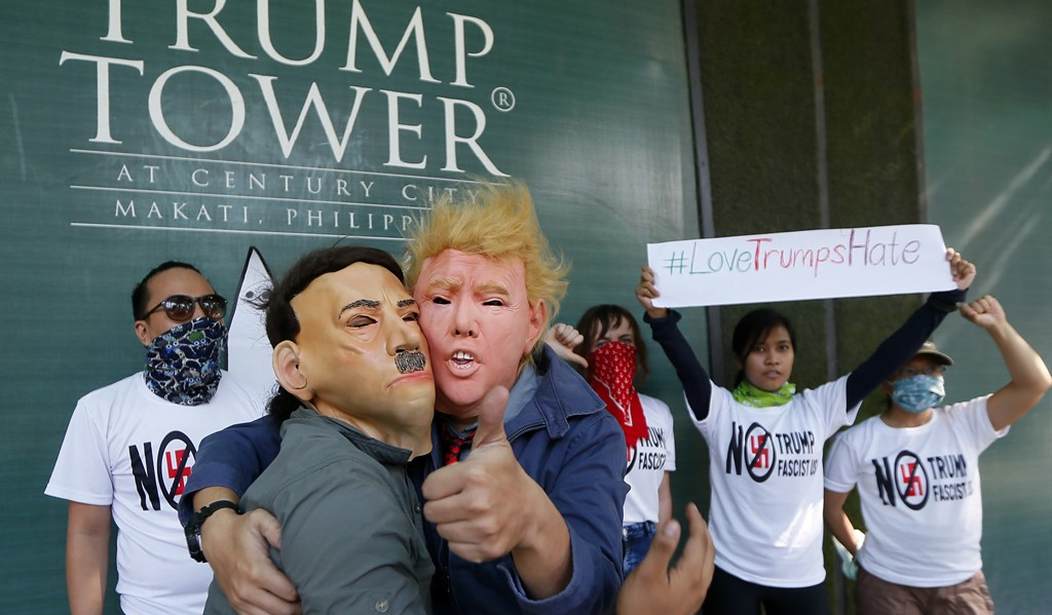
We've watched this movie before, on repeat, for decades. Reagan got the Hitler treatment. George H.W. Bush got it. George W. Bush got it. Romney got it. Trump has soaked up so many Hitler comparisons that the internet could probably assemble a complete photographic history of the Third Reich without ever showing an actual Nazi. Different president, different election, different policy dispute — same mustache, stamped on with the same stencil every time. Somewhere a Photoshop template exists labeled "Politician We Don't Like — ADD HITLER," and the left keeps reaching for it, because coming up with an original insult apparently takes more creativity than anyone over there has budgeted for.
Now the same rhetorical machinery has folded in weight-loss medication. The comparison got so cheap that the punchline writes itself: Everything the left doesn't like is Hitler.
Norman Rockwell painted a piece called The Gossips, showing a rumor traveling from person to person, each one embellishing it a little more with every retelling. The GLP-1 controversy runs that painting backward. The story doesn't grow more exaggerated as it spreads — it started at maximum absurdity, and everyone downstream spends the next few days trying to catch up. A medication becomes a cultural trend. The cultural trend becomes a system of social coercion. The system of social coercion becomes "body fascism." And somehow, before the afternoon ends, we're discussing genocide. That's not an argument. That's a rhetorical escalator with a snapped brake cable.
Here's the deeper irony: the more casually people throw these words around, the less power they carry when the real thing actually shows up. Fascism names a serious historical and political category. Genocide names an extraordinarily serious accusation. Neither word should double as an all-purpose verbal Molotov cocktail for whenever somebody encounters an idea he or she doesn't like.
The people flinging "fascist" around most freely are often reaching for the same playbook the actual fascists used in 1933.
Here's the punchline: if everything is fascism, eventually nothing is. If every political opponent is Hitler, Hitler becomes just another political opponent. If every unpleasant social pressure is genocide, genocide becomes just another word for "I object." And if taking Ozempic counts as fascism, the next great authoritarian struggle apparently gets fought in the checkout line at CVS.
Somewhere, Mussolini looks at the world and wonders when fascism turned into a weight-loss program.
And here's the biggest problem buried in all of this: watering down "fascism" until it means nothing gives the left cover to use actual fascist tactics with impunity, because nobody's left to call it out with a straight face. The Nazis painted Communists, Jews, Social Democrats and other opponents as existential threats to Germany — not merely wrong, but dangerous, and therefore fair targets for extraordinary measures. Nazi propaganda blamed every political and social problem on an identifiable enemy.
Sound familiar?
If you think I'm exaggerating, revisit what I wrote yesterday:
Headen visited the Dachau concentration camp memorial and posed for a photo, smiling in front of the crematorium ovens, captioned: "Visiting Dauchau [sic] Concentration Camp in Germany… This is where Trump supporters belong."
Honey, that's spelled Dachau, for starters. Second, and rather more urgently: that's the site where the Nazis imprisoned, tortured and murdered human beings by the thousands. Headen's caption proposed the same treatment for her political opponents. Whether she meant it as a joke doesn't matter — the comment lands just as badly either way, standing in front of those ovens.
It lands badly for you and me. It didn’t land badly for her, and it likely won't land badly for the people who'll vote for her. The definition of fascism has become so watered down that even inside her own mindless leftism, she sees nothing wrong with blasting that comment out to her followers.
Somewhere, Godwin is smiling.
Oh, he's still alive and active, Mike is. He's currently the policy and privacy lead at Anonym, a privacy-focused advertising startup, and in 2026, he's been publishing a Substack series called "Godwin's Ethic," still writing about internet culture, AI and integrity. Worth checking out, if you can.
In any event, maybe it's time we took the language back. Just a thought.
Thought for the Day: Every word gets cheaper the more people spend it on things it was never meant to buy.
VIP members: Time for you to do what you do so well: Comment on the subject of today. Your voice matters here.
Have a great Sunday, gang. And Go Bills!
Editor's Note: Do you enjoy PJ Media's conservative reporting exposing the radical left and woke media? Support our work so we can keep bringing you the truth.
Join PJ Media VIP and use promo code FIGHT to receive 60% off your membership.





Join the conversation as a VIP Member