





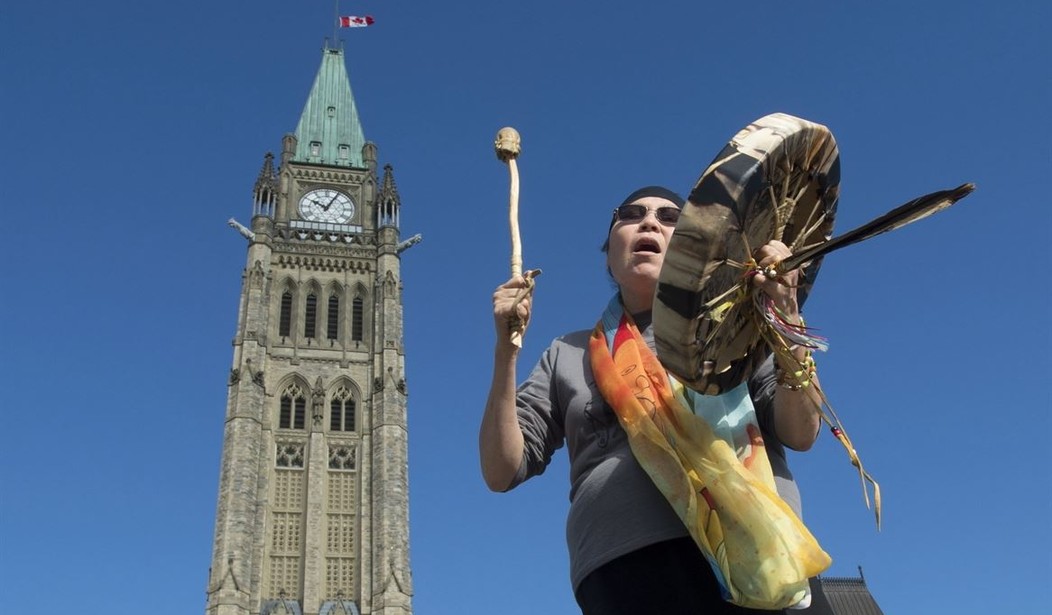
It is no secret that Canada is now a country receding into barbarism with little hope of reversing direction. A lost decade with Justin Trudeau and a subsequent year with his hapless ideologue of a successor, Mark Carney, have bludgeoned the country with the twin weapons of bad doctrine and public deception. The lamentable fact that Canada is now a feminist, post-national, anti-Christian and crushingly indebted country has led to deficits — moral, political and economic — that we are now unlikely to overcome.
A major issue that has come increasingly to the fore involves the canard that authorities at Canada’s Residential Schools, where native children were taught from 1831 to 1996, engaged in acts of rape, murder, and secret nocturnal burial of these children. The result has been public outrage, court persecution, prohibitive payouts to aboriginal claimants, and the burning of 130 churches. Two important books, Grave Error and Dead Wrong, plus a just released documentary film Making a Killing, have revealed a manufactured chronicle of pedicide violence that has become an unassailable public dogma.
People have come fervently to believe in the false narrative of clandestine graves and missing children, which is nothing less than a national lie propped up by a duplicitous government, a decadent academy, a self-righteous tribal consensus and a reprehensible media consortium. Not a single grave has been excavated despite the millions of dollars granted to the plaintiff band in question to disinter the bodies as evidence of their claims. This is “sacred ground,” after all. Ground-penetrating radar indicates only “anomalies,” almost certainly sewage trenches dating from 1924. And not a single child had been reported missing by parents. There is absolutely no doubt that fraud is everywhere. The native tribes and the legal profession have profited obscenely at the expense of both the country and the truth. Meanwhile, Canada has become a global pariah and a victim of the United Nations scandal-mongering.
The latest installment of such obvious chicanery, primarily in the province of British Columbia, is the conflict between Fee Simple Rights — property owners’ absolute rights to land and buildings purchased in good faith and according to the law — and Aboriginal Title Rights — the collective right of Indigenous Peoples to land and harvesting privileges not granted by the state, but considered inherent. Thanks largely to the worst provincial premier in Canada, David Eby, a woke socialist intent on surrendering his province back to the Indians, and the trouble-making Supreme Court Justice Barbara Young, proprietors in portions of the district of Richmond, part of Metro Vancouver, have just learned that they no longer own the properties that they own.
Court declarations have rendered Richmond’s fee simple titles “defective and invalid” and stipulated that the Crown owes a duty to the petitioners, the Cowichan tribe, to negotiate fee simple interests to the tribe’s advantage. In other words, there is no assurance that you own what you own. To date, no compensation has been earmarked for manifest losses, and mortgages are now problematic. This has the effect of potentially evicting legal owners from their homes and lands on the strength of obscure Treaty documents and merely oral testimony respecting tribal traditions.
It appears British Columbia’s NDP government withheld evidence from the Court or, alternatively, the Court did not do its homework. Or both. The Cowichan claimed to have had a village named Tl’uqtinus in the area, but “the Cowichan were only there during the summer salmon run and resided at their home villages on Vancouver Island the rest of the year.” They were not permanent residents. Moreover, the 1859 survey map showed no village of Tl’uqtinus which was supposed to have been located there, a finding which would have invalidated the subsequent disposition of the land. “In summary,” concludes researcher Nina Green, “it appears the Cowichan case was wrongly decided, and it is to be hoped that the application to have the case re-opened to include new and relevant evidence will be successful.” There is, regrettably, no guarantee of such.
The implication of corruption or exploitation seems justified by the facts. Indigenous groups have obviously profited from their relations with government officials, citizen associations, and, of course, the media. These tribes are, by and large, among the same “nations” — there are over two hundred so-called “First Nations” in British Columbia — many of which are attempting to block Alberta’s oil pipeline to the B.C. coast, contributing to more of Canada’s self-inflicted economic damage.
In a feature on B.C.'s growing land use and pipeline-blocking efforts, Dr. Caroline Elliott, political analyst with the Public Land Use Society, breaks down legal rulings that sit downstream from reconciliation virtue-signals now promoting two conflicting laws for the country, with the upper hand going to UNDRIP (United Nations Declaration for the rights of Indigenous Peoples). As Alexander Brown, Director of the National Citizens Coalition, warns, “The future looks uncertain for British Columbian jobs, investment, housing, and Canadian energy projects.”
Interestingly, Brian Lilley points out in the Toronto Sun that many of these tribes are political advocacy groups with no legal authority to impose their will on the cadastral situation. They have been “set up with millions of dollars from left-wing American foundations opposed to oil and gas development in Canada. These native communities are being subsidized not only with provincial grants but foreign and government-funded NGOs: the Tides Foundation, the Rockefeller Brothers Fund, the Gordon and Betty Moore Foundation, and Margaret A. Cargill Philanthropies that have donated millions to stop oil and gas production in Canada.” It’s an extortionate affair, a shakedown operation run by some of those in the business of defrauding the nation of its birthright. Let’s face it. There is much wampum in wigwam.
The harm being done to the province is almost comical in its effects. Street names are being changed into aboriginal script that few can pronounce, including some Indians. Trutch Street in Vancouver, for example, is now šxʷməθkʷəy̓əmasəm Street, a “gift” from the Musquean people (who were, in fact, paid for their donation). Property owners cannot intelligibly give their address for deliveries of goods. The Queen Charlotte Islands are now officially known as Haida Gwai, and the Village of Queen Charlotte had its name “restored” to Daajing Giids (pronounced "daw-jean geeds").
The Sea-to-Sky Highway from Vancouver to Whistler is uglified with Squamish tribal names to honour the language Sḵwx̱wú7mes, and to acknowledge their Indigenous history and presence in the region. Other names have been cropping up here and there to gradually recognize and prepare what seems like a change of stewardship, at least in selected portions of the province. Consider Sḵwiḵw for Whistler, Ch'iyáḵmesh for the Cheakamus River, and to crown the list with the veritable prize, K'emk'emeláy for Vancouver itself.
It has now come to light that the Secwépemc Nation, comprising the Tk̓emlúps te Secwépemc and the Skeetchestn Indian Band, filed a claim in 2015 seeking a declaration of Aboriginal title over the City of Kamloops. The claim entails 1.25 million hectares of their declared traditional territory, which includes the entirety of the City of Kamloops, the Sun Peaks Resort, roads, railways, and both Crown land and private property. The case remains active. We recall that almost all universities in the country recognize pro forma that they are occupying Indian land which they will often name in the original language—though none have scrupled to surrender title. The hypocrisy, of course, is typically academic.
Only in those cases where lands were clearly and originally ceded by treaty with Aboriginal approval to the provinces is fee simple ownership secure. It now turns out that the cities of Perth, Pembroke and Ottawa in Ontario are in reality owned by the Algonquin (Anishinaabe) Indigenous people because the land was never ceded to Ontario by a treaty. This will come as a surprise to Premier Doug Ford and Prime Minister Mark Carney. The hilarity is exquisite.
One might hazard the observation that all these hijinks are not really so funny, though they are straight out of the Theater of the Absurd. British Columbia looks like it is on the way out. Ionesco and Beckett could not have done better than Eby and Young. But the overall picture is uniformly gloomy, the Indian burlesque only the latest in a cultural scene of unremitting social, political and economic disaster that has overtaken the country and the province. We have reached the point where we can only laugh as, to quote poet Rosanna Warren from Hindsight, we find ourselves part of “a country clawing its very idea to shreds.”
Editor’s Note: Do you enjoy PJ Media’s conservative reporting that takes on the radical left and woke media? Support our work so that we can continue to bring you the truth. Join PJ Media VIP and use the promo code FIGHT to get 60% off your VIP membership!

Join the Conversation
VIP members get the ability to comment on articles.