


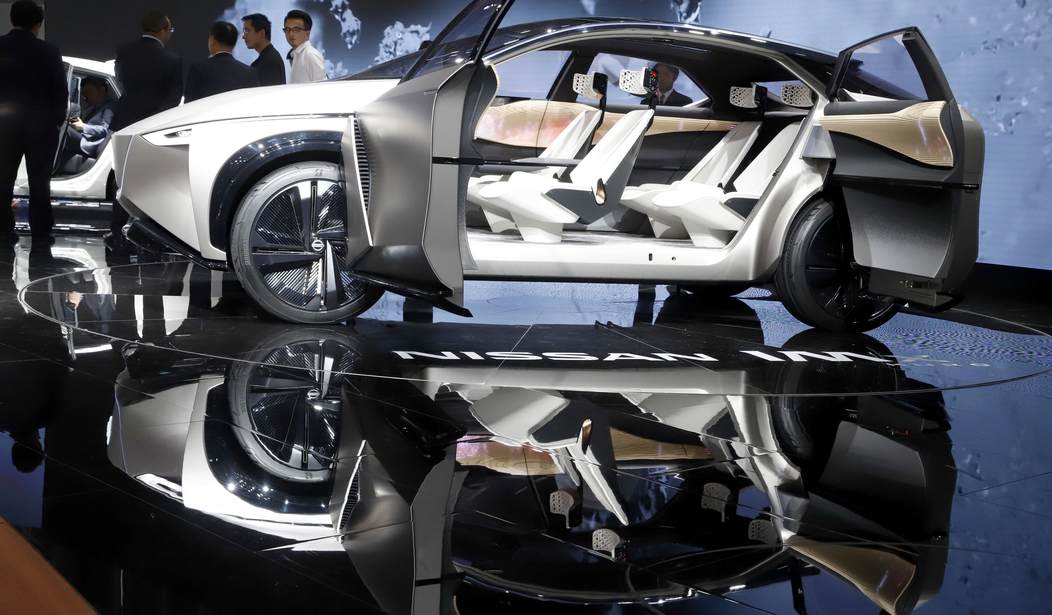
President Donald Trump has a simple proposition for Chinese automakers: if they want American customers, build the factory here and hire American workers.
I understand the appeal.
Trump said Saturday that he would be comfortable with Chinese companies manufacturing cars in the United States as long as they employ Americans. He contrasted that with Chinese manufacturers building vehicles in Mexico and shipping them north across the border.
From Reuters:
"If China wanted to come in and open a plant to build their cars here, I'd be okay with that," Trump said in an interview on the Fox News program "The Ingraham Angle."
"Japan does it, but they hire our people. The big thing is they hire our people," he said.
He added that he does not want Chinese automakers to build cars in Mexico and ship them to the United States. "I'm not knocking Chinese cars," Trump said.
U.S. automakers have urged Trump, who is due to meet Chinese President Xi Jinping in Washington in two weeks, not to agree to allow Chinese automakers access to the U.S. market.
On Wednesday, U.S. Senator Elissa Slotkin, a Michigan Democrat, said there were "rumors that Trump is planning to allow Chinese cars to be sold in the U.S., as part of a larger deal he’s putting together. That would be a strategic mistake."
Trump called Slotkin's statement a "total phony rumor" and said he had kept Chinese vehicles out of the United States.
Factories and manufacturing jobs are important (duh!). American communities have spent decades watching plants close while production moved overseas. Trump made rebuilding domestic industry one of the defining goals of both of his presidencies.
Chinese connected vehicles create a separate problem, however, and putting the factory in Michigan or Ohio doesn't automatically solve it.
The Commerce Department concluded last year that certain vehicle software and communications hardware tied to China or Russia create unacceptable national-security risks.
Modern vehicles contain cellular connections, Wi-Fi, Bluetooth, satellite systems, GPS, cameras, microphones, and automated-driving technology. The government warned that hostile access could expose sensitive driver data or allow remote manipulation of vehicles.
From the Bureau of Industry and Security:
“Cars today aren’t just steel on wheels – they're computers. They have cameras, microphones, GPS tracking, and other technologies that are connected to the internet. Through this rule, the Commerce Department is taking a necessary step to safeguard U.S. national security and protect Americans’ privacy by keeping foreign adversaries from manipulating these technologies to access sensitive or personal information,” said U.S. Secretary of Commerce Gina Raimondo. “This is a targeted approach to ensure we keep PRC and Russian-manufactured technologies off American roads and protect our nation’s connected vehicle supply chains.”
“Connected vehicles yield many benefits, but software and hardware sources from the PRC and other countries of concern pose grave national security risks. Today, we are taking strong action to protect Americans against these national security risks by safeguarding our critical infrastructure and automotive supply chain. President Biden has been clear: we will not hesitate to take needed action to protect the safety of the American people,” said National Security Advisor Jake Sullivan.
“China is trying to dominate the future of the auto industry, but connected vehicles with software and hardware systems linked to foreign adversaries could expose the American people to risks of misuse of their sensitive data or interference by malicious actors,” said National Economic Advisor Lael Brainard. “Today’s rule will prohibit Chinese and Russian software and hardware from being used in connected vehicles on American roads, protecting consumers and ensuring a more secure American auto industry.”
The resulting rule is unusually direct. Beginning with model year 2027, manufacturers sufficiently connected to China or Russia are prohibited from selling new connected vehicles in the United States, even if those vehicles were manufactured here. Restrictions on Chinese- or Russian-linked connectivity hardware phases in later.
From the Bureau of Industry and Security:
On January 14, 2025, the U.S. Department of Commerce’s Bureau of Industry and Security (BIS) issued a rule restricting the import and sale of certain connected vehicles and related hardware/software linked to China or Russia. BIS determined these transactions pose national security risks, as companies from these countries may be compelled to share data or allow remote access to connected vehicles in the United States.
The rule applies to vehicles under 10,001 pounds and introduces phased restrictions:
- Model Year 2027: Prohibits sales of connected vehicles by connected vehicle manufacturers owned by, controlled by, or subject to the jurisdiction or direction of China or Russia, and vehicles using their covered software.
- Model Year 2030 (or January 1, 2029, for non-model-year components): Prohibits the imports of VCS hardware from companies owned by, controlled by, or subject to the jurisdiction or direction of China or Russia.
The rule went into effect on March 17, 2025.
That rule came from the Biden administration, but Republicans shouldn't reject the security concern simply because Joe Biden's name is attached to it.
China has spent years building a massive advantage in electric vehicles, batteries, software, and automotive supply chains.
From Reuters:
Even as trade restrictions tighten, Chinese carmakers have continued to gain traction overseas, expanding their presence in Europe and winning customers in emerging markets with competitively priced, technology-rich models.
China's vehicle exports are forecast to reach 12 million units this year, according to Cui Dongshu, secretary-general of the China Passenger Car Association (CPCA). Annual exports are expected to climb further to between 18 million and 20 million units by 2030, he said.
Among those looking abroad is Xiaomi (1810.HK), opens new tab. The EV latecomer, which is scrambling to meet its annual sales target, has signed agreements with German auto dealers ahead of its planned European launch next year.
Seres (601127.SS), opens new tab, which co-develops Aito cars with Huawei, illustrates the growing cost of lagging in the export race. The company faces intensifying competition in China's crowded premium EV segment, while its relatively late push overseas has left it at a disadvantage at a time when exports are becoming a key source of growth. Its total vehicle sales plunged 44% last month.
The export boom has raised regulatory concerns that the cut-throat competition battering carmakers, suppliers and dealers domestically could spread to overseas markets.
Chinese automakers are now expanding aggressively overseas as their domestic market weakens.
In August alone, Chinese passenger-vehicle exports rose 77.5% from a year earlier.
American automakers are worried enough that their largest industry group recently asked Congress to make the existing restrictions permanent. The Alliance for Automotive Innovation represents companies including Ford, General Motors, Toyota, Volkswagen, Hyundai, Honda, and Stellantis. It wants Congress to ban Chinese-connected vehicles, software, and hardware before the current session ends.
Alliance for Automotive Innovation president and CEO John Bozzella wrote to congressional leadership:
“Right now, Chinese automakers are dumping subsidized vehicles with connected software and hardware around the world. China is capturing market share in Europe, Australia, Southeast Asia, Mexico and South America with vehicles capable of collecting, processing and transmitting sensitive vehicle and consumer data to the Chinese Communist Party.
“This hasn’t happened inside the U.S. yet, but given the scale and urgency of this threat, we urge you to enact a Chinese vehicle, software and hardware ban before adjourning this year and make this policy the law of the land. …
“Enacting a permanent ban on Chinese vehicles and high-risk hardware and software in the 119th Congress will send a clear and bipartisan message that China’s strategy to dominate global automotive manufacturing will be met with a national security policy response from the American government.”
Their concern isn't merely that Chinese companies might sell cheaper cars.
Connected vehicles collect information, communicate with outside networks, and depend increasingly on software for basic operation. Chinese law also gives Beijing substantial power over companies operating under its jurisdiction.
A Chinese manufacturer employing Americans in Tennessee would still answer ultimately to a Chinese corporate structure and Chinese law.
Trump's economic instinct is understandable. If foreign companies want access to our market, forcing them to invest here is far better than watching another wave of manufacturing disappear overseas.
But some industries carry risks beyond payroll numbers.
We wouldn't measure the value of a Chinese telecommunications network only by how many Americans it employed. Vehicles containing cameras, location records, communications systems, and remotely updated software deserve the same kind of scrutiny.
America should welcome foreign investment when it makes the country richer and stronger.
China's auto industry requires another question first.
Who controls the technology after the factory opens?
A Chinese car built by American workers is still a Chinese-connected car.
Before we invite those companies inside the gate, we ought to be very sure we can know who holds the keys.
China's economic challenge isn't simply about tariffs anymore. Technology, manufacturing, data, and national security are increasingly tangled together. Join PJ Media VIP and help us keep following where those lines meet. Get 60% off with promo code FIGHT.







Join the conversation as a VIP Member