





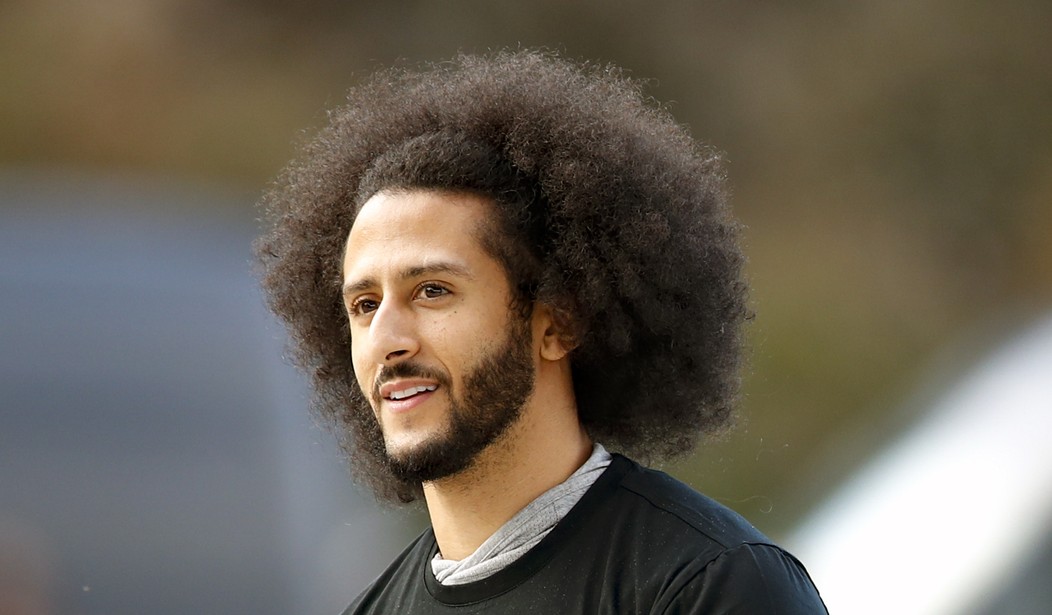
Ten years after Colin Kaepernick turned the national anthem into his personal protest stage, the encore has arrived. On Tuesday, the Muhammad Ali Center named the former NFL quarterback and Know Your Rights Camp founder its 2026 Humanitarian of the Year.
The Muhammad Ali Center has named legendary NFL quarterback, civil rights activist and entrepreneur Colin Kaepernick as the recipient of its ‘Humanitarian of the Year’ award. Kaepernick will receive the honor at the 13th annual Muhammad Ali Humanitarian Awards, the Center’s largest annual fundraiser to support the Center’s mission-based programs and events. It will take place on November 7 in Louisville, KY.
Kaepernick joins an esteemed class of ‘Humanitarian of the Year’ recipients since the launch of the Muhammad Ali Humanitarian Awards in 2013, including Shaquille O’Neal, Christina Aguilera, Michael J. Fox, Common, Patricia Arquette, Geena Davis, and more.
“Colin was chosen for his courage to stand against racial injustice and his unwavering commitment to empowering underserved communities. Like Muhammad, Colin has used his platform to advocate for equality, human dignity, and social change, even when doing so came at significant personal and professional cost.” said Lonnie Ali, Co-Founder and President & CEO of the Muhammad Ali Center. “Through Know Your Rights Camp and his broader philanthropic efforts, Colin has turned his convictions into meaningful action by educating, empowering, and supporting young people and communities. His courage, sacrifice, and sustained dedication to service embody the humanitarian spirit and enduring legacy of Muhammad Ali.”
“Receiving the Muhammad Ali Center’s Humanitarian of the Year Award is an incredible honor,” said Colin Kaepernick. “Muhammad Ali lived with an uncommon courage to stand firmly in his convictions, even when doing so came at a great personal cost. He understood that our platforms are not simply ours to benefit from, but ours to use in service of others. To be recognized in his name is simultaneously humbling and a responsibility. I remain committed to bring about justice, uplift our communities, and develop a world where all people can live with freedom, dignity, and self-determination.”
His memoir, The Perilous Fight, arrives Sept. 15, and his organization just announced another $1 million giving pledge.
Apparently, one decade of Kaepernick wasn't enough.
Start with what his admirers and critics should both admit. Kaepernick worked his tail off. San Francisco drafted him 36th overall in 2011. He helped take the 49ers to Super Bowl XLVII, finished his career with 12,271 passing yards and 72 touchdown passes, and earned about $59.2 million from football.
Nobody handed him those snaps; he earned them.
He also didn't rise from desperate poverty. Kaepernick grew up in a stable adoptive family in California. His father became vice president of operations at a cheese company, and his mother was a registered nurse.
From the Turlock Journal:
Twelve years after that letter was written, Kaepernick is in high demand. He’s heading into his senior season at Nevada as a three-year starter. And even though the Wolf Pack’s first game isn’t until Sept. 2, some 40 NFL agents are already bombarding his parents’ Turlock home with calls.
The next NFL Draft isn’t until months away. But before he’s placed under a microscope at the NFL Scouting Combine, it’s important to look at his upbringing, his present life and his future. Potential coaches, general managers and scouts probably would like to know the same.
In fact, let’s start with this date: Nov. 3, 1987. That’s the day he was born in Milwaukee, Wis., and, five weeks later, Rick and Teresa Kaepernick assumed the roles of adoptive parents. Before Colin, their two previous infant sons died shortly after birth from congenital heart defects.
Doctors told the Kaepernicks that if they continued to have boys, they could possibly suffer the same fate. Ultimately, they decided to stop trying and go to an adoption agency. They wanted a healthy baby, one who could grow up with older brother Kyle and older sister Devon. Their search for a son led to a struggling 19-year-old mother who worked in retail sales, who asked for three main criteria from an adoptive household: siblings, financial stability and a sports background. The birth mother read letters from the prospective parents and appreciated their background, as well as the fact that Rick and Teresa Kaepernick were working parents. Soon enough, Colin was theirs.
In late 1991, when Colin was 4, the family moved from the snowy winters of Fond du Lac, Wis., to their new home in Turlock after Rick became the operations manager at Hilmar Cheese Company — he later became the vice president of operations. Teresa is a registered nurse.
Older brother Kyle was against the move at first. He was junior high age, and worried about continuing hockey in a town without a hockey rink and initially didn‘t like the idea of making new friends.
“It was a massive shakeup,” Rick says, “but the job felt right.”Unbeknownst to the family at the time, the move was not only a boon to Pitman High’s athletics — a school that opened in 2002 — but also allowed Colin to grow up in a more diverse community.
Racial injustice can certainly reach someone from a comfortable home. Kaepernick's own life still showed how much room America offered him to work, compete, fail, recover, and become spectacularly successful.
Then came August 2016. Kaepernick explained his refusal to stand by saying, "I am not going to stand up to show pride in a flag for a country that oppresses black people and people of color."
From NFL.com:
The 49ers issued a statement about Kaepernick's decision: "The national anthem is and always will be a special part of the pre-game ceremony. It is an opportunity to honor our country and reflect on the great liberties we are afforded as its citizens. In respecting such American principles as freedom of religion and freedom of expression, we recognize the right of an individual to choose and participate, or not, in our celebration of the national anthem."
Niners coach Chip Kelly told reporters Saturday that Kaepernick's decision not to stand during the national anthem is "his right as a citizen" and said "it's not my right to tell him not to do something."
The NFL also released a statement, obtained by NFL Media Insider Ian Rapoport: "Players are encouraged but not required to stand during the playing of the national anthem."
By taking a stand for civil rights, Kaepernick, 28, joins other athletes, like the NBA's Dwyane Wade, Chris Paul, LeBron James and Carmelo Anthony and several WNBA players in using their platform and status to raise awareness to issues affecting minorities in the U.S.
However, refusal to support the American flag as a means to take a stand has brought incredible backlash before and likely will in this instance. The NBA's Mahmoud Abdul-Rauf of the Denver Nuggets, formerly Chris Jackson before converting to Islam, refused to acknowledge the flag in protest, citing similar reasons as Kaepernick and saying that it conflicted with some of his Islamic beliefs.
Abdul-Rauf drew the ire of fans and was briefly suspended by the NBA before a compromise was worked out between the league and player, who eventually stood with his teammates and coaches at the playing of the national anthem.
Kaepernick said that he is aware of what he is doing and that he knows it will not sit well with a lot of people, including the 49ers. He said that he did not inform the club or anyone affiliated with the team of his intentions to protest the national anthem.
"This is not something that I am going to run by anybody," he said. "I am not looking for approval. I have to stand up for people that are oppressed. ... If they take football away, my endorsements from me, I know that I stood up for what is right."
He also invoked bodies in the street and police officers getting away with murder. His target wasn't one department, one prosecutor, or one bad cop. He put the country and its flag on the clock.
America responded to its supposed role as oppressor in a curious fashion. Kaepernick kept speaking, the 49ers defended his choice, and the NFL said players were encouraged but not required to stand.
He later became a centerpiece of Nike's "Just Do It" campaign and settled his collusion grievance with the NFL under confidential terms. Apparently the American boot on his neck came with excellent branding opportunities.
The cultural legacy is hard to laugh off. Kaepernick helped popularize a model where grievance becomes identity, identity becomes celebrity, and celebrity somehow graduates into moral authority.
Ten years later, he's getting another award, another book tour, and another round of applause.
Kaepernick reached football's biggest stage because he could run, throw, endure pain, and compete. His second act has required a different talent: making America the villain and waiting for fashionable America to congratulate him.
The congratulations are still coming.
Support independent conservative journalism and get 60% off PJ Media VIP with promo code FIGHT.

Join the Conversation
VIP members get the ability to comment on articles.