





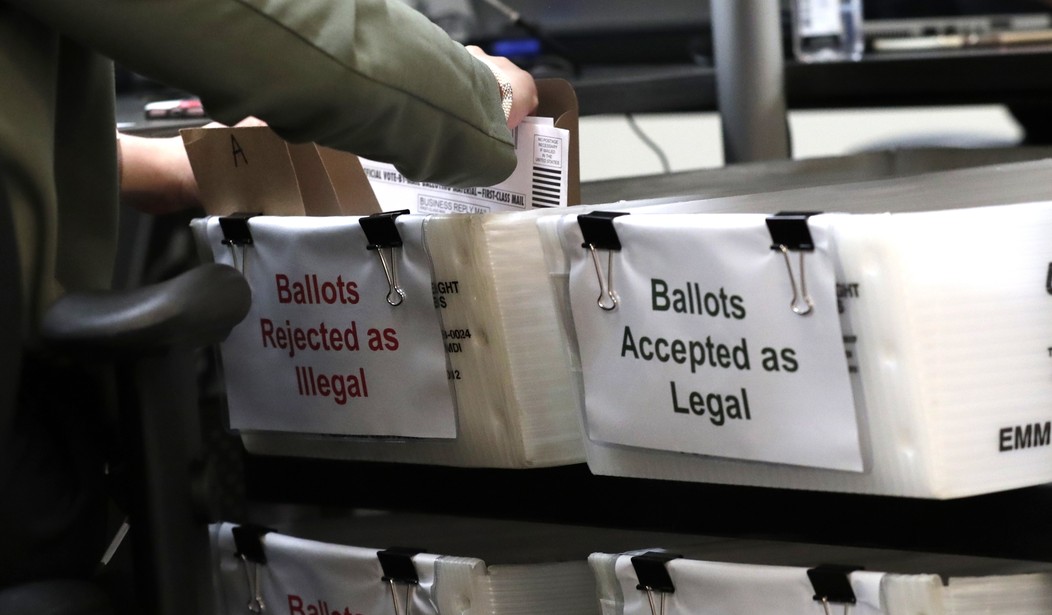
In administratively staying the meritless injunction issued by Massachusetts District Court Judge Indira Talwani, an Obama appointee, while the underlying case is being litigated, a majority of the justices on the U.S. Supreme Court applied both its long-established rule on standing and common-sense rationality to President Donald Trump’s March executive order on mail-in ballots. Contrary to hostile media reports claiming it “restricts” mail-in balloting, this executive order simply improves the integrity of the process and tries to ensure that ineligible individuals are not voting, which would dilute the votes of legitimate voters.
As the Supreme Court explained in Trump v. California, a 6-to-3 per curiam decision (meaning the author is not listed), the executive order “is an internal directive from the President to his subordinates mandating that certain agencies pursue certain policies.” The order “neither requires nor forbids anything of anyone outside the Executive Branch,” including the states who sued the administration. And all provisions of the executive order must “be implemented consistent with applicable law,” another important point noted by the Court.
There were three parts of the executive order that the states claimed were unconstitutional and that Talwani enjoined. The first was a directive to the Department of Homeland Security to “create and send” to the states lists of their residents who are U.S. citizens and 18 years of age or older.
This was, obviously, to provide states with a list that they could use to verify that individuals registered to vote are actually U.S. citizens and not aliens who are illegally registered. But as the Court pointed out, the executive order explicitly said that states were not required to use the list, so how could providing such a list possibly be considered unconstitutional? Moreover, how could merely providing such a list possibly harm the states?
Keep in mind that in order to file a lawsuit, you have to demonstrate standing, which means showing a concrete, particularized, and imminent injury. What is clear from this claim, and what should anger voters in those states, is that these state officials don’t want to receive any information that might show that they have ineligible aliens registered to vote in their state. Not only would that be embarrassing, but it might interfere with the seeming objective of certain Democrats who don’t want to stop aliens from voting because they believe it will help them win elections. What other possible reason could there be for objecting to simply receiving such relevant information on eligibility? Why don’t they want clean voter rolls?
The second provision that Talwani enjoined was the directive that the Department of Justice “prioritize the investigation and, as appropriate, the prosecution of State and local officials or any others” who issue federal ballots to ineligible voters. In other words, Talwani was essentially telling DOJ that it could not prioritize or prosecute any state or local election official who clearly violates existing federal laws, one of the craziest orders I’ve ever seen from a federal judge.
As the Supreme Court said, states have no standing to challenge this presidential directive since “[i]t does nothing to them.” It simply tells DOJ to “prioritize” the prosecution of “those who violate existing federal laws.” Not only do states have no authority to interfere with the president's Article II power to set prosecutorial priorities, neither does an Article III federal judge.
The third part of the executive order that Talwani enjoined, which the Supreme Court stayed, was a directive to the U.S. Postal Service to initiate a proposed rulemaking on mail-in ballots. One such provision was the development of a unique barcode on mail-in ballot envelopes to “facilitate tracking.” You know, the type of tracking that all of us now expect whenever we order a product online and are sent information that allows us to track the progress of our package. But the executive order, the Court noted, “Does not demand that any proposed provision appear in the final rule.”
Why would these states like California, Oregon, Washington, and Colorado oppose putting in place a modern tracking system for mail-in ballots? These states have gone to all-mail elections, and other blue states are moving in that direction. Could it be because accurate tracking would give you data on the real problems with the current mail-in balloting process by showing how many ballots are misdirected, misdelivered, not delivered on time, lost, and never returned?
How could a tracking system possibly “restrict” mail-in balloting as all of these states and their allies in the media claim? How could a system that enables voters to track where their ballots are so they can ensure the ballots are properly distributed, completed, and received in time to be counted possibly be considered a “restriction”?
Could it be that the states don’t want this because they fear such data could undermine the myth their election officials have been propagating for years that mail-in balloting is entirely safe and has no problems? There is, so far as I can tell, no other reasonable explanation for opposing implementation of a sophisticated tracking system as is used in virtually all of our online commercial transactions.
The executive order also said that the USPS rule should include things like putting a logo on ballot envelopes labeling them as “Official Election Mail,” which would obviously help distinguish ballot envelopes from other mail and, hopefully, make sure they get expedited processing by the USPS. The president also wants the USPS to get a list from states of all of the voters being sent mail-in ballots to help verify the proper handling of those ballots and to ensure that only those approved by the states were receiving ballots.
Yet Talwani enjoined the USPS from even initiating the process to even consider a proposed rule. According to the majority, her claim that this somehow inflicted “an Article III injury on the States rested on an attenuated chain of inferences.” As the Court said, Talwani had to “engage in a string of speculations” to hold that the states had standing to sue. She had to “speculate” about whether the USPS would propose a rule, how the USPS would weigh the comments it received, whether the USPS would issue a final rule, and about what the final rule would actually say.
You cannot base standing on speculation piled atop speculation, and the states could not “preemptively concretize their injury by expending funds before the Postal Service finalized a rule. Spending money to hedge again a ‘speculative threat’ does not constitute an Article III injury,” said the Court.
This interim Supreme Court decision was about standing and the injunction issued by Talwani. If and when a final rule is issued by the USPS, the Court said that the states might be able to show an injury that would give them standing to sue: “On that score, time will tell.” But the bottom line is that the president’s executive order “itself does not harm the States, so the District Court lacked jurisdiction to bar the government from trying to implement it.”
Two days after the Supreme Court’s decision, Talwani canceled the second injunction she had issued in August that extended her injunction in favor of the 23 states that filed the lawsuit to all 50 states. This nationwide injunction, something the Supreme Court has frowned upon, prevented the USPS from implementing any final rule. Once the final rule is implemented, the challengers will be able to file new suits if they can legitimately claim some type of actual damage that gives them standing.
The fact that these blue states do not seem to want any information from the federal government that would show that their voter rolls are woefully deficient and that aliens are illegally registered to vote is a shameful reflection on their unwillingness to protect the integrity of the votes that are cast by eligible citizens who reside in their states.
Editor's Note: Do you enjoy PJ Media's conservative reporting exposing the radical left and woke media? Support our work so we can keep bringing you the truth.
Join PJ Media VIP and use promo code FIGHT to receive 60% off your membership.
![[UPDATE] Audio Appears to Confirm Talarico’s Stay at Mental Health Facility; Campaign Denies It](https://media.townhall.com/cdn/hodl/2026/257/05654322-cebe-4479-a0f1-67bd873ecc9f-536x311.jpg)
Join the Conversation
VIP members get the ability to comment on articles.