





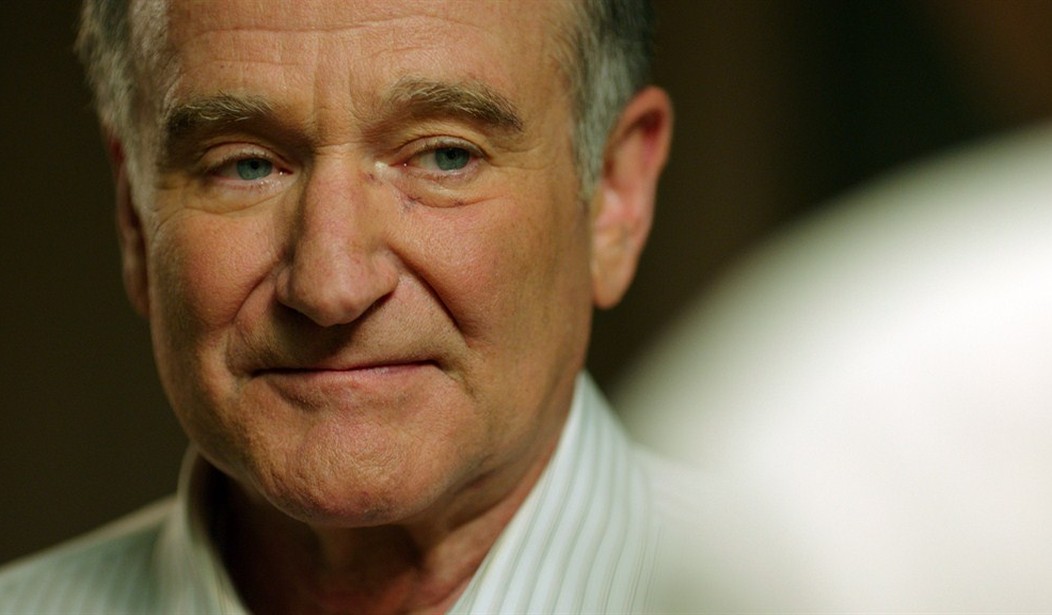
Robin Williams once named a fear that sounds almost unbearable now. Asked what frightened him, he said, "I guess I fear my consciousness becoming, not just dull, but a rock. I couldn't spark."
Twelve years ago today, on Aug. 11, 2014, Williams died by suicide at 63. Only after his death did doctors find the disease attacking the very thing he feared losing: his extraordinary mind.
Williams had been diagnosed with Parkinson's disease months earlier. His symptoms went far beyond a tremor. He struggled with anxiety, paranoia, insomnia, confusion, memory problems, and changes in his ability to think and work.
A postmortem examination found widespread Lewy body disease throughout his brain and brain stem.
Lewy body dementia is linked to abnormal deposits of a protein called alpha-synuclein in brain cells. It damages thinking, memory, movement, behavior, mood, sleep, and automatic body functions.
From Alzheimers.com:
More than 1 million people in the United States are diagnosed with LBD, which is one of the most common forms of dementia. It is a progressive disease, meaning symptoms start slowly and worsen over time.
Although younger people can have LBD, it typically begins at age 50 or older. People with LBD live on average five to eight years — but may live as few =as two years or as long as 20 years — from the time of diagnosis to death. How fast symptoms develop and change varies depending on the person’s overall health, age, and level of symptoms.
In people with LBD, abnormal clumps of a protein called alpha-synuclein accumulate in areas of the brain involved in thinking, memory, and movement. The clumps are called "Lewy bodies" after the doctor who discovered them. They build up inside neurons, or nerve cells, in the brain and cause the neurons not to work well and eventually die. Certain chemicals in the brain that act as messengers between cells are also affected. What causes these changes in the brain is not yet fully understood.
Most cases of LBD are not inherited and rarely does more than one family member have the disease. Certain genetic variants may increase the chance of developing dementia with Lewy bodies, but having a genetic variant does not mean that a person will definitely develop the disease.
It can bring Parkinson-like stiffness and tremors together with dementia, hallucinations, severe changes in attention, and confusion.
There's still no cure.
Someone close to me watched his mother die from complications of Lewy body dementia. When I asked him what it was like, he didn't reach for medical language, calling it frightening, terrible, and horrible, and then kept adding adjectives as if none were strong enough.
After reading what Williams went through, I understood what he meant.
Consider what was being taken from him. Williams could turn a pause, a facial expression, or a stray thought into comedy before most people had figured out where the joke was headed.
Then he could walk into a movie set and break your heart.
He gave us Mork, Adrian Cronauer in Good Morning, Vietnam, John Keating in Dead Poets Society, Mrs. Doubtfire, the Genie in Aladdin, and Sean Maguire in Good Will Hunting.
The Academy nominated him four times for acting, and he won the Oscar for Good Will Hunting.
His widow, artist and Lewy body dementia advocate Susan Schneider Williams, later described a man who knew something was terribly wrong but couldn't name it. From The Guardian:
Schneider Williams is neither a neurologist nor a film-maker but an artist and, as if to prove her bona fides, behind her is a canvas and easel, all set up. “Robin and I loved to go to museums together. He was a big history buff, so he would bring the history and I would bring the art side and we would double our fun. People tend to assume that the guy he was on stage was the guy he was at home, and let me make it clear: I would never marry somebody like that,” she says with emphasis.
So he wasn’t riffing in different voices while making soup for lunch?
“Definitely not. The man at home, my husband, he was quiet, contemplative, an intellectual. The standup and acting, that was his work.”
Schneider Williams met Williams in late 2007, when she happened to stop in at the local Apple store. “I walked in and saw this man and I thought: ‘I think that’s Robin Williams.’ Then on my way out I happened to look at him again and he was smiling at me and something inside me said: ‘Oh, just go over and say hi.’ He was wearing camouflage print so I said: ‘How’s that camo working out for you?’ And he said: ‘Not too good – you found me.’” Four years later they got married, his third marriage and her second, and they lived in Marin County, with her two young sons from a previous relationship. Just two years later, the symptoms started.
Initially, Williams complained of stomach pains. Then his hand started trembling and he had terrible insomnia. Even more noticeable to Schneider Williams was his spiralling anxiety. “It was very out of character for Robin to be so paranoid. And that was the start of this 10 months drumbeat of increasing symptoms, and the thing with LBD is the symptoms don’t come all at once – they change. So they’re incredibly confusing to the patient and caregiver,” she says.
Some of the most moving parts of Robin’s Wish are the interviews with people whom Williams worked with towards the end. David E Kelly, who created the sitcom The Crazy Ones, which Williams starred in, describes him having to hide his tremoring hand in his pocket. Shawn Levy, the director of the Night at the Museum franchise, recalls Williams saying to him: “I’m not me any more”, adding: “His brain was not firing at the same speed, the joy wasn’t there.”
Friends and coworkers saw the change, too. His quickness faded, the joy became harder to reach, and Williams knew he was losing access to something essential in himself. From LBDA.org:
In the last year of his life, Robin experienced a startling pattern of behavior. His friends, family, and film colleagues could tell he was not himself as he began exhibiting symptoms like confusion, forgetfulness, paranoia, hallucinations, anxiety, personality changes, and difficulty with movement. Robin could tell something was wrong, too, but he did not know what was happening to him, why it was happening, or how to stop it.
Robin and his wife, Susan Schneider Williams, sought help from numerous medical specialists, but were unable to obtain a correct diagnosis before his untimely death. After his death, an autopsy revealed advanced stages of Lewy body dementia, a less common form of dementia that affects an estimated 1.4 million people in the US.
Following Robin’s death, Susan learned everything she could about LBD and how it could explain Robin’s symptoms. Shortly after that, she bravely came forward to publicly reveal the findings of Robin’s autopsy. Susan has since become an advocate for Lewy body dementia awareness, research, and education by spreading information about this devastating disease with the hope of preventing anyone else from going through what she and Robin experienced.
Robin Williams was not alone in his traumatic experience with Lewy body dementia. The goal to fully understand, effectively treat, and even prevent this neurological disease continues to be an active and ongoing area of research. Scientists are investigating various aspects that may influence how the disease develops, including genetics, the environment, and other factors. There is also a goal to identify the biomarkers for LBD, which would make diagnosis and treatment tracking far easier.
As Susan Williams puts it, “Robin is and will always be a larger-than-life spirit who was inside the body of a normal man with a human brain. He just happened to be that one in six who is affected by brain disease.”
Maybe his old answer about fear hurts because he understood the value of his own consciousness without sounding vain about it. He feared losing the spark that let him create, connect, improvise, and give something joyful to strangers.
LBD ravaged his brain, while his work remains everywhere. Twelve years later, people still laugh at the Genie, still feel John Keating's urgency, and still go quiet with Sean Maguire.
We remember the speed of William's mind, the tenderness behind the comedy, and the humanity he could summon when the laughter stopped.
Lewy body dementia explains more of his final months today than the public understood in 2014. It should also remind us to look harder at a disease that can steal movement, memory, judgment, sleep, and identity from people who may remain painfully aware something is going wrong.
Robin Williams feared he would lose his spark; his disease attacked it, but his life's work made sure the spark never disappeared.
If you value columns that look beyond the headline and remember the human being underneath it, join us at PJ Media VIP. Use promo code FIGHT and get 60% off your subscription.


Join the Conversation
VIP members get the ability to comment on articles.