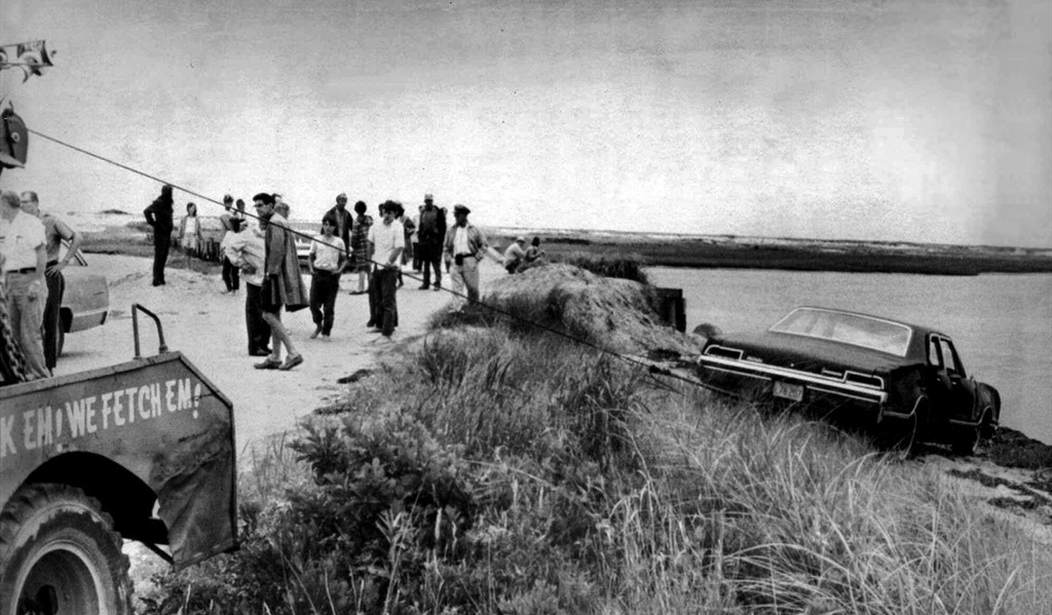

Saturday marks 57 years since Sen. Ted Kennedy drove off Dike Bridge on Chappaquiddick Island with Mary Jo Kopechne trapped inside his car.
Kennedy escaped. Kopechne, a 28-year-old campaign worker, didn't. Kennedy waited until the following morning to report the crash, after the car and her body had already been discovered. From Time:
The car, with Kennedy at the wheel, careened off the island’s Dike Bridge. Kennedy managed to extricate himself from the overturned vehicle, but Kopechne drowned. Kennedy reported the accident to the police at 9:30 a.m. the next day.
That delay in reporting remains the central mystery surrounding the incident, and the resulting scandal destroyed any hopes of another Kennedy in the nation’s highest office. About a week after the fall, Kennedy told the world in a televised address from his home that he had been “overcome…by a jumble of emotions” in the wake of the event, in a statement masterminded by Ted Sorenson and a damage-control dream team of people who had served in his brother John’s administration. But weeks later, and even now, many agreed with Kopechne’s mother when she said she could not understand what had happened: “Why didn’t they get help?”
Kennedy pleaded guilty to leaving the scene of an accident involving personal injury. A judge gave him a two-month suspended sentence. No prison, no manslaughter charge, and no end to his Senate career.
A later inquest found probable cause to believe that Kennedy drove negligently and contributed to Kopechne's death. Judge James Boyle also rejected important parts of Kennedy's account, including his claim that he accidentally turned onto the dirt road leading to the bridge. Again, from Time:
A grand jury also looked into the case, and on April 1970, it was concluded that there was not enough evidence to indict Kennedy on any charges.
The accident’s run in the courts thus ended, but it would keep coming up throughout Kennedy’s life. A TIME-Harris poll published in the Aug. 8, 1969, issue found that while 68% of Americans agreed that “the same thing could have happened to anyone,” at the same time 40% agreed with that his reaction “showed that he should not be given high public trust, such as being President.” (On that last question 45% disagreed, and 15% were unsure.) It dogged him during his failed presidential run in 1980 and contributed to his decisions not to run for president in 1972, 1976 and 1984. “NOBODY DROWNED AT WATERGATE,” some bumper stickers read. A TIME analysis of whether he could win in 1972 deduced that he couldn’t carry the Midwest because of the question of what a married man was doing in a car with a single woman in the first place. On the 1980 presidential campaign trail, Jimmy Carter made a dig at Kennedy by saying he had never “panicked in a crisis” — thought to be a coded reference to Kennedy fleeing the scene.
“His self-confessed ‘inexplicable’ behavior in a moment of stress raises the issue of how he might act in a major crisis,” a TIME essay on how the public judges political scandals put it in the immediate aftermath of the event. “His carefully prepared and yet unsatisfying explanation leaves room for the suspicion that he was somehow trying to escape blame for his actions.”
Picture the same event today with a Republican senator behind the wheel.
Every minute would be reconstructed on television; producers would display maps, tides, phone records, travel times, and animated images of the car sinking. Reporters would surround the senator's home; party leaders would face demands to condemn him before breakfast, and activists would gather outside the Capitol.
His career would end before the first court appearance.
No Republican would receive 40 more years in the Senate. Nobody would later call him the “Lion of the Senate.”
The press did cover Chappaquiddick heavily in 1969. The greater failure came afterward; Kennedy remained in office, won reelection eight times, became a Democratic icon, and built a “respected” legislative record.
His political achievements slowly moved Kopechne's death toward the edge of his biography.
Modern political coverage still follows party instincts. Tafari Campbell, former President Barack Hussein Obama's personal chef, drowned while paddleboarding near the Obama home on Martha's Vineyard in 2023. The medical examiner ruled his death accidental, and police found no evidence of trauma or suspicious circumstances, and the Obamas weren't home. From the Associated Press:
The drowning death of former President Barack Obama’s personal chef near the family’s home on Martha’s Vineyard last month has been ruled an accident by the Massachusetts medical examiner.
Tafari Campbell, 45, of Dumfries, Virginia drowned while using a paddleboard in Edgartown Great Pond on July 24, the Massachusetts State Police said.
Campbell was employed by the Obamas and was visiting Martha’s Vineyard. The Obamas were not present at the home at the time of the accident.
Campbell’s death was determined to be an accidental drowning following “submersion in a body of water,” Timothy McGuirk, a spokesperson for the state Office of the Chief Medical Examiner, said Wednesday.
Those facts should control any judgment about Campbell's death. The comparison concerns the press's appetite for questions. Coverage quickly moved from the unusual circumstances to warnings against speculation, then largely disappeared.
A Republican connection would likely produce months of stories about unanswered questions, missing details, and possible influence. Reporters would insist that curiosity was a public duty.
Kennedy's later conduct made his rehabilitation even harder to defend. A detailed 1990 profile recounted the notorious “waitress sandwich” allegation involving Kennedy and former Connecticut Sen. Chris Dodd at a Washington restaurant. A waitress said the drunken senators grabbed her and pressed her between them.
Kennedy's office dismissed questions about his behavior as gossip and speculation.
Kennedy's defenders point to his legislative work, friendships across party lines, and support for healthcare, labor, and civil rights. Good votes don't erase private conduct. Bills passed decades later can't rescue Mary Jo from an overturned car.
Remove the Kennedy name and Democratic label, and the story ends differently. A Republican senator who left a young woman underwater, delayed calling police, received a suspended sentence, and later faced ugly allegations involving women would be remembered as disgraced.
Instead, Teddy Kennedy became a lion.
The title reveals less about his character than it does about the political and media institutions that granted him absolution.