Adolf Hitler, German chancellor, didn't become Germany's dictator in one burst of thunder; he climbed by promise, fear, backroom deals, and the steady breaking of every guardrail around him.
By June 1934, he had the office, the party, the police power, and the propaganda machine. What he still needed was the army's loyalty and the final removal of rivals who knew too much. From the Holocaust Museum:
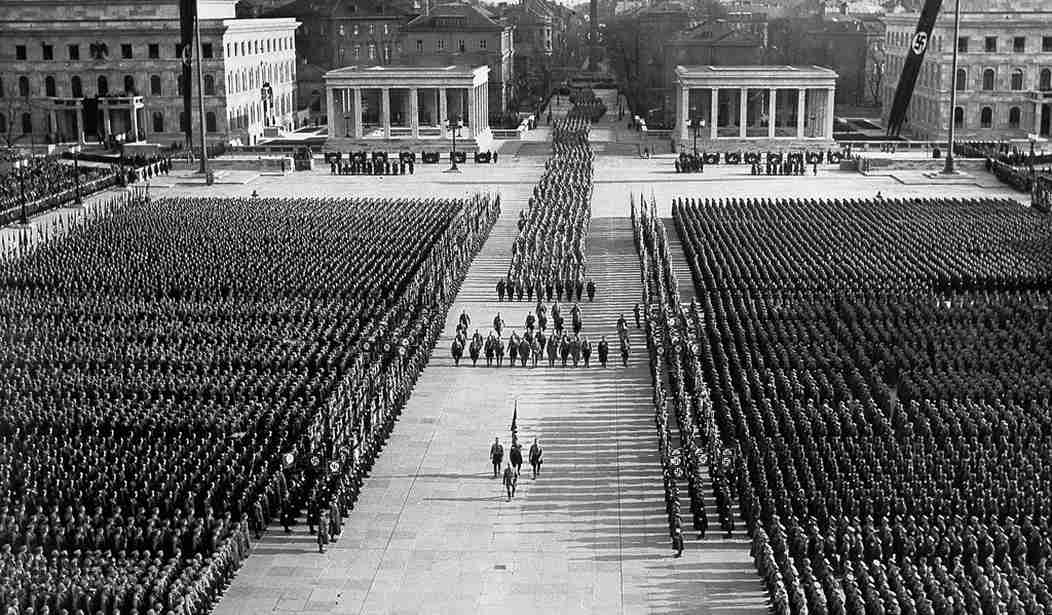
The SA was led by Ernst Röhm, the SA Chief of Staff and a longtime friend of Hitler’s. By June 1934, the SA had expanded to a force of nearly three million men. It significantly outnumbered the German army. The Treaty of Versailles (1919), signed in the aftermath of World War I, had limited the German army to 100,000 men. The SA had provided an intimidating and often violent presence as the Nazi Party rose to power during the 1920s and 1930s. After Adolf Hitler became chancellor in 1933, many political leaders, including President Paul von Hindenburg and Vice-Chancellor Franz von Papen, feared that the SA had become too powerful.
The SA continued to provide key support to the Nazi regime as it consolidated its power into a dictatorship in 1933. However, the SA leadership had demands to “finish” the Nazi revolution. This behavior became a source of embarrassment and discomfort for Hitler in his dealings with the traditional German nationalist elites. The SA leadership sought to remove the elites from power and replace them with fanatical Nazis. However, Hitler, Nazi Party leadership, and the leadership of the SS (at the time a formation of the SA) understood that the Nazi regime needed to work with the traditional elites. They would need their support to consolidate power and prepare the nation for a war of expansion.
The SA was not satisfied with what its leaders perceived to be a slowing pace of the Nazi revolution. By the late winter and spring of 1934, their outlook threatened to split the Nazi-Nationalist coalition. SA leaders held ambitions to replace the officer corps of the Reichswehr and the professional army with a “People’s Army.” Such a goal became a threat to the Nazi regime itself. Army leaders responded by demanding the elimination of the SA as a condition for permitting the Nazi government to remain in power. Further, Röhm and his top commandants had lost the confidence of other key Nazi leaders, including Prussian Prime Minister Hermann Göring, Deputy Nazi Party Chief Rudolf Hess, and the SS leadership, Heinrich Himmler and Reinhard Heydrich.
The largest problem stood inside his movement. Ernst Röhm, chief of staff of the Sturmabteilung, or SA, commanded a huge force of brown-shirted street fighters. The SA had helped smash Hitler's enemies in the streets, but Röhm wanted more; he talked of a “second revolution” and wanted the SA to absorb or replace the professional German army.
German generals hated the idea; conservatives feared it. Hitler knew he couldn't rule for long with Röhm demanding a revolution beside him. From the Beaches of Normandy:
As head of the government, Hitler desperately needed to be on good terms with two groups: industrial magnates and the military's top leadership. The first was needed to build up a new, reinvigorated military, while the second was vital for eventually carrying out Hitler's plans of conquest. As it happened, both groups had reason to fear and hate Röhm and his thugs
The Nazis were not reluctant to use socialist rhetoric and talking point in their early career, a fact attested by the party's full name: "National Socialist German Workers' Party." This drew many lower-class people to the party early on and also helped syphon away public support from the Communist and Social Democratic parties. Naturally, the redistribution of wealth along socialist principles was no longer desirable once the Nazis were actually in power, but Röhm wasn't willing to let go of the idea. He continued to demand an overtly anti-capitalistic "second revolution," which understandably upset the very same industrial magnates Chancellor Hitler was courting.
The military's problem with Röhm was equally profound. The Treaty of Versailles limited the German armed forces to 100,000 men, while the SA, unfettered by such rules, swelled to over 3 million members by 1934. Many people, Röhm himself included, wanted the SA to supplant the military as Germany's official armed forces, with the former military relegated to the duty of training new SA men. Röhm was also vocally disdainful of the entrenched officer elite, who largely came from the old aristocratic families of Prussia.
President Paul von Hindenburg was old and failing. Hitler needed the army's support before Hindenburg died because the presidency was the last great office standing outside his full control.
The generals wanted Röhm and the SA cut down, while Hitler wanted the army quiet, obedient, and grateful. The bargain was written in blood.
On June 30, 1934, Hitler flew to Munich and then went to Bad Wiessee, where Röhm and other SA leaders had gathered. Röhm was arrested; across Germany, SS units and police rounded up SA leaders and targets.
Heinrich Himmler, the head of the SS, and Hermann Göring, Prussian minister president, helped drive the purge. The killing ran from June 30 to July 2. From German History:
Even before “Operation Hummingbird,” Hitler saw to it that rumors were spread about a possible coup d’état being planned by the SA. The day after the purge, propaganda minster Joseph Goebbels declared that Ernst Röhm and Kurt von Schleicher had been plotting a “second revolution,” which the Nazis had managed to thwart, thus saving the country from chaos. The National Socialist press also stressed the homosexuality and alleged perversion of Röhm and his followers, who, as the party emphasized, no longer presented any moral danger to the German people. On July 3, 1934, the regime decreed the “Law on State Self-Defense Measures” [Gesetz über Maßnahmen der Staatsnotwehr, or Staatsnotwehrgesetz], which retroactively legalized the political murders committed on what became known as “the Night of the Long Knives.”
The main headline of the July 3, 1934, edition of the Völkischer Beobachter reads: “The ‘Second Revolution’: Pledges of Loyalty to the Führer from throughout the Reich. – The Impression the ‘Cleansing-Action’ Made Abroad – Reich Minister Dr. Frick to Civil Servants.” Other headlines read: “A Strong Fist and an Iron Will Rule in Germany,” “The Reich President to the Führer: The German People Saved from Serious Danger,” and “The People Greet the Führer.”
Röhm was held in Stadelheim Prison. Hitler first spared him from immediate execution, then sent men to give him a pistol and a chance to kill himself. Röhm refused; SS officers Theodor Eicke and Michael Lippert shot him on July 1.
The message was plain enough: old comrades, loyal thugs, early believers, and useful instruments could all be discarded when power required it.
The purge didn't stop with the SA; Hitler also used the crisis to settle other scores. General Kurt von Schleicher, Hitler's predecessor as chancellor, was murdered. So was Schleicher's wife, Elisabeth. Other conservatives, critics, and perceived enemies were killed or arrested. The official lie claimed Hitler had stopped a treasonous plot.
The truth was colder; he had removed obstacles and made murder an arm of government.
On July 3, the regime issued the Law Regarding Measures of State Self-Defense. It made the killings of June 30, July 1, and July 2 legal after the fact. A state that can murder first and legalize later has already left law behind. Hitler didn't only kill rivals; he taught Germany that legality would now follow power, not restrain it.
On July 13, Hitler defended the purge before the Reichstag and declared himself the judge of the German people. Less than three weeks later, on August 2, Hindenburg died. Hitler merged the offices of chancellor and president, took the title Führer, and the German army swore a personal oath to him. From the Holocaust Museum:
Hitler rewarded the SS for their loyalty and role in the purge. On July 20, 1934, he decreed the SS independent of the SA. This gave a distinct advantage to the SS in realizing its goal to gain control of the German police. During the second half of 1934, the SS assumed control of a centralized political police force and a centralized concentration camp system. By 1936–1937, Himmler would complete the consolidation of all German police forces under SS control.
Third, the Röhm Purge ended the role of the SA as a political player in the Nazi regime. The SA did continue to exist under Röhm’s successor, SA Chief of Staff Viktor Lutze. It also outnumbered other formations of the Nazi Party and engaged in murderous violence during Kristallnacht. However, the SA never recovered its political clout after the purge.
Finally, the killings represented a vital watershed. The regime was prepared to commit murder as an act of state for the survival of the nation. This concept was not lost on key Nazi figures at the time. More than nine years later, Himmler gave his infamous speech to SS generals at Posen (Poznań) in German-occupied Poland on October 4, 1943. In this speech, often referred to as Himmler’s Posen speech, he addressed the issue of the so-called Final Solution. In introducing the topic, he explicitly referred to the SS role in the Röhm Purge as a reflection of the SS commitment to do whatever Hitler deemed necessary.
The Night of the Long Knives left Germany with a hard lesson it learned too late: the law had become costume jewelry for tyranny, the army traded independence for order, and the public had watched violence clean up a political problem and accepted the result.
From there, the road grew darker because the regime had proved something terrible. Once the state could kill its own, insiders without consequences, outsiders had no shield at all.