


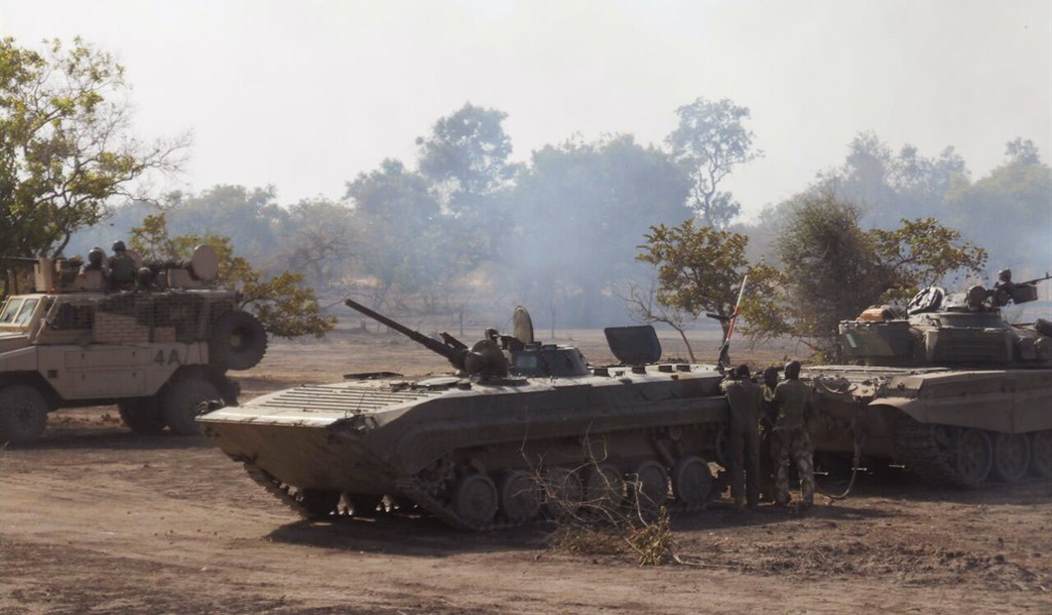
ISIS survives by hiding in the places decent people rarely see until the killing starts. President Donald Trump's team just reminded the terror group that distance, jungle, and darkness don't equal safety.
On May 16, U.S. Africa Command, working with the Armed Forces of Nigeria, struck ISIS targets in northeastern Nigeria. The group killed Abu-Bilal al-Minuki, whom U.S. officials identified as ISIS's director of global operations and the terror group's No. 2 worldwide leader. No U.S. service members were injured, but five Nigerian soldiers were killed.
Sebastian Gorka, deputy assistant to the president and senior director for counterterrorism, pointed to the Nigerian operation as proof that aggressive counterterror pressure works.
Gorka put the broader enemy toll at 199 fighters killed across the effort. Nigerian military officials separately said joint U.S.-Nigerian strikes killed 175 Islamic State fighters over several days.
Either figure tells the same hard truth for ISIS: leaders who thought they'd buried themselves deep enough in Africa still ended up found, fixed, and finished.
President Trump announced the death of al-Minuki and praised Nigeria's cooperation. Nigerian President Bola Tinubu backed the mission and called it a major counterterror success.
U.S. Air Force Gen. Dagvin Anderson, commander of U.S. Africa Command, credited the growing U.S.-Nigeria partnership and stressed that Africa has become central to the global fight against terrorist networks. From the United States African Command.
At the direction of the President of the United States and the Secretary of War, and in coordination with the Government of Nigeria, U.S. Africa Command conducted an operation against ISIS in Northeastern Nigeria on May 16, 2026.
The command’s initial assessment is that multiple terrorists, to include Abu-Bilal al-Minuki, the director of global operations for ISIS, as well as other senior ISIS leaders, were killed during this operation. No U.S. service members were harmed.
“As President Trump shared last night, AFRICOM in coordination with the Armed Forces of Nigeria, bravely and valiantly conducted a successful mission that resulted in the elimination of Abu-Bilal al-Minuki, and multiple other ISIS leaders,” said U.S. Air Force Gen. Dagvin Anderson, commander of U.S. Africa Command. “This operation underscores the exceptional value of the U.S.-Nigeria partnership and was made possible through the cooperation and coordination of our forces in recent months. Make no mistake, our two nations will relentlessly pursue and neutralize terrorist threats and are committed to protecting our people and interests.”
Al-Minuki provided strategic guidance to the ISIS global network on media and financial operations as well as the development and manufacturing of weapons, explosives, and drones. Al-Minuki was the most active terrorist in the world and has a significant history of involvement in planning attacks and directing hostage taking.
Sani Uba, spokesperson for Nigeria's military task force, said the strikes also hit weapons systems, checkpoints, and financial networks that ISIS-linked fighters use.
Al-Minuki wasn't just another fighter with a rifle and a black flag; U.S. officials had already designated him a global terrorist in 2023. He helped direct operations across West Africa and the Sahel, where ISIS affiliates have tried to turn weak borders, poor roads, and remote terrain into a shield.
Malik Samuel, senior researcher at Good Governance Africa, has warned that ISIS-linked groups in the region remain dangerous, because they adapt fast after leadership losses. Killing one leader doesn't end the war, but removing a senior planner disrupts money, orders, morale, and momentum.
The mission also shows why waiting for ISIS to reach Western headlines is a losing strategy. Terror groups quietly build strength; they tax villages, recruit young men, move guns, punish Christians and Muslims who reject them, and look for weak seams in local governments.
By the time Americans notice the name of a place on a map, families there may have lived with fear for years. The Nigeria strike moved before ISIS could turn one more hideout into one more staging ground.
America can't police every failed village or every borderland in Africa, and it shouldn't pretend otherwise. Still, intelligence, airpower, and trusted local partners can wreck a terror network before it grows teeth.
Nigerian forces brought local knowledge, while American forces brought reach and precision. Together, they hit a command structure that had counted on being too far away to touch. Terror leaders notice when a hidden camp stops feeling hidden.
Gorka's point lands because the result is plain: ISIS lost a senior global commander, multiple leaders, and scores of fighters in a coordinated operation, with no American casualties reported.
The group will try to replace men, shift camps, and lie to followers about its strength. History says fanatics rarely quit because one raid goes badly; it also says relentless pressure breaks their rhythm, drains their talent, and forces their leaders to spend more time hiding than planning.
In Nigeria, Trump's team found the nest, and ISIS learned again what happens when America decides to smoke it out.
Counterterror wins don’t stay clean for long once the spin begins. PJ Media cuts through the noise with clear reporting, sharp analysis, and the backbone to say what others soften. Join the PJ Media VIP family today and get 60% off with promo code FIGHT.



Join the conversation as a VIP Member