





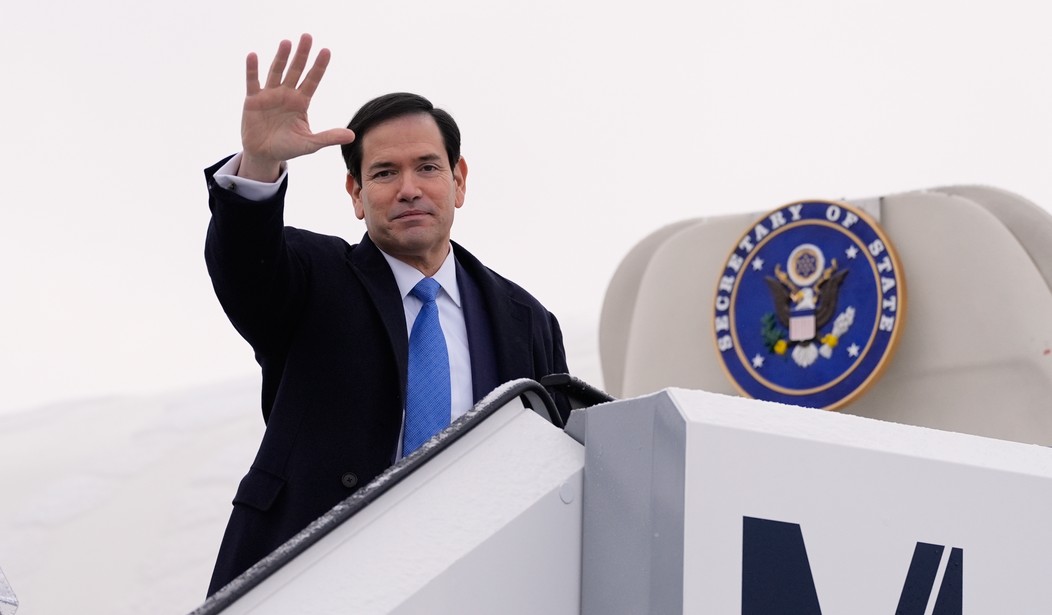
Secretary of State Marco Rubio arrived in India on Friday for his first official visit there, and the trip carries more than ceremonial value. Rubio met with Indian Prime Minister Narendra Modi and Indian External Affairs Minister Subrahmanyam Jaishankar. The four-day visit includes Kolkata, New Delhi, Agra, and Jaipur. From PBS:
Rubio and Jaishankar held a joint press briefing after Sunday's initial round of talks. They reiterated their aim to deepen the U.S.-India strategic partnership while pursuing their respective national interests.
The U.S.'s top diplomat said that India is one of the most important strategic partners of the United States and expressed optimism about finalizing a bilateral trade deal soon. “I don't view our relation with any country in the world as coming at the expense of our strategic alliance with India,” he said, adding that he hoped that India-U.S. relations would come out much stronger in the coming years.
Rubio stressed that the Trump administration's trade decisions were of a global perspective to serve the U.S. economy, rather than targeted at New Delhi. “There virtually is no country in the world that I could travel to that isn't going to raise the issue of trade because we did this from a global perspective.”
Jaishankar said the U.S.-India strategic partnership exists because of a “convergence of national interests” in multiple areas.
The agenda covered trade, energy exports, defense cooperation, maritime security, technology, and the Indo-Pacific, where both governments see China's reach as a long-term challenge. Rubio also invited Modi to the White House on behalf of President Donald Trump.
The United States and India opened diplomatic relations after India gained independence in 1947, but friendship didn't come quickly or easily. India pursued non-alignment during the Cold War, while Washington built a closer security relationship with Pakistan. From Reuters:
Successive U.S. administrations, including under President Donald Trump's first term, have sought to draw historically non-aligned India closer as a counterweight to rising Chinese influence in the Indo-Pacific, though ties were strained after Washington imposed steep tariffs on Indian goods last year.
More recently, New Delhi has closely watched U.S. efforts to stabilise relations with China and improve engagement with Pakistan, amid concerns in India over Washington's regional priorities.
Rubio described India as an important strategic partner and said the two countries were aligned on terrorism and energy. He also said India was among the countries with global influence.
Highlighting the breadth of ties between New Delhi and Washington, Rubio said the range of issues discussed underscored that India was "an important strategic partner of the United States, one of our most important strategic partners in the world."
Jaishankar said the United States had emerged as a reliable energy source for India.
India's nuclear program, its long defense relationship with Moscow, and its desire to protect strategic independence also kept distance between New Delhi and Washington. The relationship improved after India's 1991 economic reforms, then grew stronger through defense agreements, technology work, and the 2008 civil nuclear agreement.
Today, both countries have practical reasons to keep moving closer. India wants energy security, defense technology, stronger trade, and supply chains that don't depend too much on China. The United States needs serious partners in the Indo-Pacific, especially a democracy with India's size, military weight, manufacturing potential, and hard-earned understanding of regional danger.
Rubio described India as a major global and strategic partner. Jaishankar stressed safe maritime navigation, terrorism, energy, and the need for a stronger trade deal.
Old friction still sits under the surface. After 9/11, President George W. Bush made Pakistan a key U.S. partner because American forces required access, intelligence, and logistics for operations in Afghanistan.
Indian leaders watched the arrangement with frustration: New Delhi saw Washington send aid and attention to Islamabad while terror groups based in Pakistan kept striking Indian targets.
India didn't view Pakistan as a reliable anti-terror partner, viewing Pakistan as a government that helped fight on one front while tolerating danger on another.
Rubio's visit also comes after a rough stretch in U.S.-India relations. Tariff fights, Indian concerns over American outreach to Pakistan, and India's energy ties with Russia all created strain. Yet both governments still see the larger stakes: Washington wants India to buy more American energy, deepen defense cooperation, help secure sea lanes, and stay active through the Quad with Australia and Japan. Also from Reuters.
U.S. Ambassador Gor, dubbed "the India whisperer" by Michael Kugelman of the Atlantic Council think tank, arrived in New Delhi in January and has sought to reset ties. Gor is a friend of Trump's and previously a White House adviser.
In February, the two countries reached a "framework for an interim agreement" on trade to lower Trump's tariffs on Indian goods to 18% from a punishing 50%, half of which had been linked to India's prior purchases of Russian oil.
But talks to finalise the deal slowed after the U.S. Supreme Court in late February struck down Trump's tariffs.
That effectively brought the duty rate on Indian goods down to 10%, but New Delhi has been weighing its options as the Trump administration pursues investigations under unfair trade practices legislation widely expected to restore much of the prior levies.
New Delhi has pressed for a Trump visit to India, tied to a summit of the Quad group of countries, which groups the U.S., India, Japan and Australia. But analysts say that fell by the wayside amid trade tensions and distractions, including the U.S.-Israeli war on Iran.
New Delhi wants respect for its security concerns, room for strategic independence, and a trade relationship that doesn't turn into another political wrestling match.
It's a clear enough goal: Rubio wants to steady a relationship that Washington can't afford to let drift. The two countries share enough ground to build something durable: trade, energy, maritime security, counterterrorism, technology, and a common concern over Beijing's ambitions.
Good partnerships don't need to be perfect; they require clear eyes, steady leadership, and enough honesty to remember old wounds without letting them control the future.
Editor's note: An earlier version of this story indicated that Rubio arrived in India on Sunday. He has been there since Friday. We apologize to our readers for this error.
Editor’s Note: President Trump and Republicans across the country are doing everything possible to protect our Second Amendment rights and right to self-defense.
Help us continue to report on their efforts and legislative successes. Join PJ Media VIP and use promo code FIGHT to receive 60% off your membership.

Join the Conversation
VIP members get the ability to comment on articles.