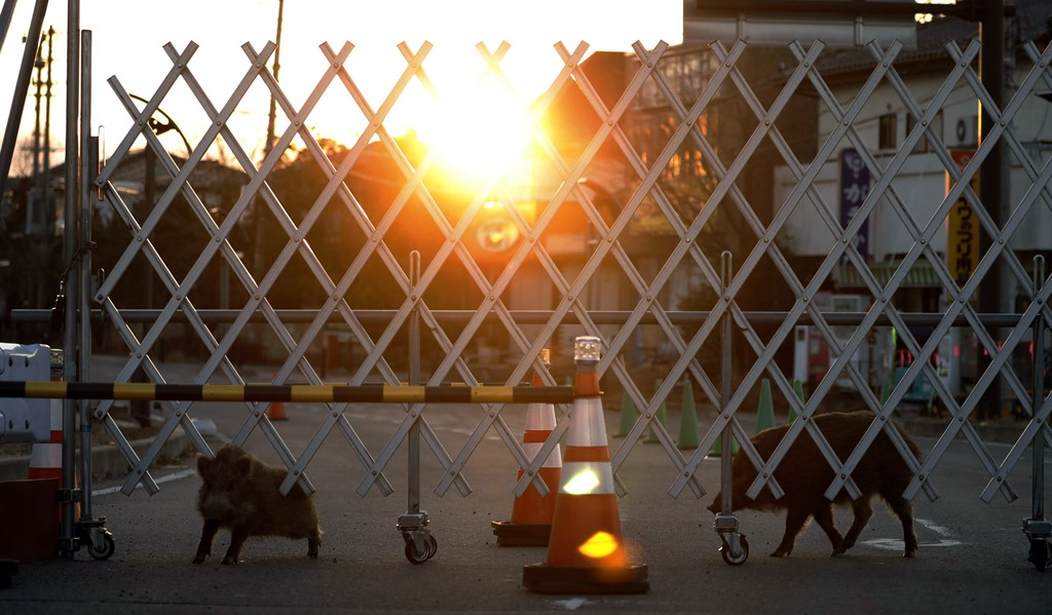

Japan has spent decades surviving monsters, earthquakes, tsunamis, nuclear nightmares, and enough Godzilla movies to make Tokyo twitch.
Now nature has produced its own sequel: supergiant mutant pigs running amok in the abandoned towns around Fukushima. From the New York Post.
The 2011 Fukushima Daiichi Nuclear Power Plant disaster, spurred by a massive 9.0-magnitude earthquake and tsunami, forced roughly 164,000 people to flee from their homes to escape the radiation zone.
Amid the chaos, domestic pigs escaped into abandoned farmland and began interbreeding with indigenous feral boars — creating a mutant pig population with alarming genes, Popular Science reported.
They don't glow and don't fire radioactive beams from their snouts. The real story lands somewhere stranger because it doesn't need special effects.
Domestic pigs escaped after the 2011 Fukushima Daiichi disaster, bred with local wild boars, and helped create a fast-breeding hybrid population in the empty land people were forced to leave behind.
The unfathomable combination of the 9.0-magnitude earthquake and tsunami wrecked the Fukushima Daiichi nuclear plant and forced roughly 164,000 people from their homes. Farmers fled, livestock was left behind, and domestic pigs wandered into overgrown fields and forests, where wild boars already had home-field advantage and apparently no objections to interspecies romance.
Professor Shingo Kaneko of Fukushima University, who works with the Institute of Environmental Radioactivity and the Faculty of Symbiotic Systems Science, led a newer genetic study on the hybrids.
Dr. Donovan Anderson, assistant professor at Hirosaki University's Institute of Radiation Emergency Medicine, helped examine DNA markers from 191 wild boars and 10 domestic pigs collected between 2015 and 2018. Also from the Post.
Researchers from Fukushima and Hirosaki Universities discovered through DNA analysis that the hybrid progeny inherited the maternal domestic pig’s rapid reproductive cycle, allowing populations to quickly multiply, unlike that of the boar, according to findings from the Journal of Forest Research.
“While it has been previously suggested that hybridization between rewilded swine and wild boars can contribute to population growth, this study demonstrates — through the analysis of a large-scale hybridization event following the Fukushima nuclear accident — that the rapid reproductive cycle of domestic swine is inherited through the maternal lineage,” Professor Shingo Kaneko of Fukushima University said in a statement.
Wild boars typically reproduce once a year, but domestic pigs reproduce in speedy, year-round cycles, creating a faster generational turnover of the mutant pig species.
Wild boars usually breed once a year, while domestic pigs can reproduce year-round. When escaped domestic sows entered the wild population, their maternal line carried the reproductive speed that let later generations multiply faster than pure wild boars. Many animals with pig-mother DNA already sat more than five generations past the first cross.
The hybrids didn't stay half pig and half boar for long. Backcrossing diluted the domestic genes, while the maternal signature remained visible; the animals began looking more like wild boars again while keeping the domestic sow's reproductive advantage in the bloodline.
Wild boar numbers surged after the disaster; hunters took about 6,000 animals one year after the accident. Nine years later, the count reached roughly 36,000. Abandoned land gave the animals room, human absence removed pleasure, and hybrid breeding added gas to the brush fire.
In their press release, Fukushima University emphasized those boars are different.
Prof. Kaneko emphasizes that Fukushima’s circumstances were exceptional. The sudden absence of human activity created conditions that allowed wild boar populations to expand rapidly. At the same time, maternal inheritance of accelerated breeding played a contributing role in the speed of genetic introgression.
Importantly, the findings are not limited to Fukushima. “We wish to emphasize that this mechanism likely occurs in other regions worldwide where feral pigs and wild boars interbreed,” notes Dr. Anderson.
Beyond advancing fundamental understanding of wildlife biology and genetics, the research has practical implications for managing invasive species.
“The findings can be applied to wildlife management and damage control strategies for invasive species,” Prof. Kaneko explains. “By understanding that maternal swine lineages accelerate generation turnover, authorities can better predict population explosion risks.”
Japan already had a wildlife headache with bears pushing deeper into towns and robotic wolves failing to scare them away. Now the pigs have joined the parade.
ICYMI: The Bears Are Coming, and Japan Is Running Out of Robotic Wolves (VIP)
Godzilla at least had the decency to announce himself with his famous call and by stomping through power lines.
Pigs just breed, dig, eat, and keep moving.
Feral swine already cause major ecological and agricultural damage across the world. They destroy crops, spread disease, damage habitat, and reproduce with grim efficiency. When domestic pigs meet wild boars, one farm escapee can reshape a local population faster than officials expect.
Fukushima's pig problem grew from disaster, abandonment, and biology. People left, fences failed, pigs escaped, and nature filled the silence with hooves. Japan will keep wrestling with cleanup, empty towns, wildfire, and the strange inheritance left behind by one terrible March day in 2011.
After Godzilla, the pigs arrived. Somehow, that feels both absurd and perfectly fair.