





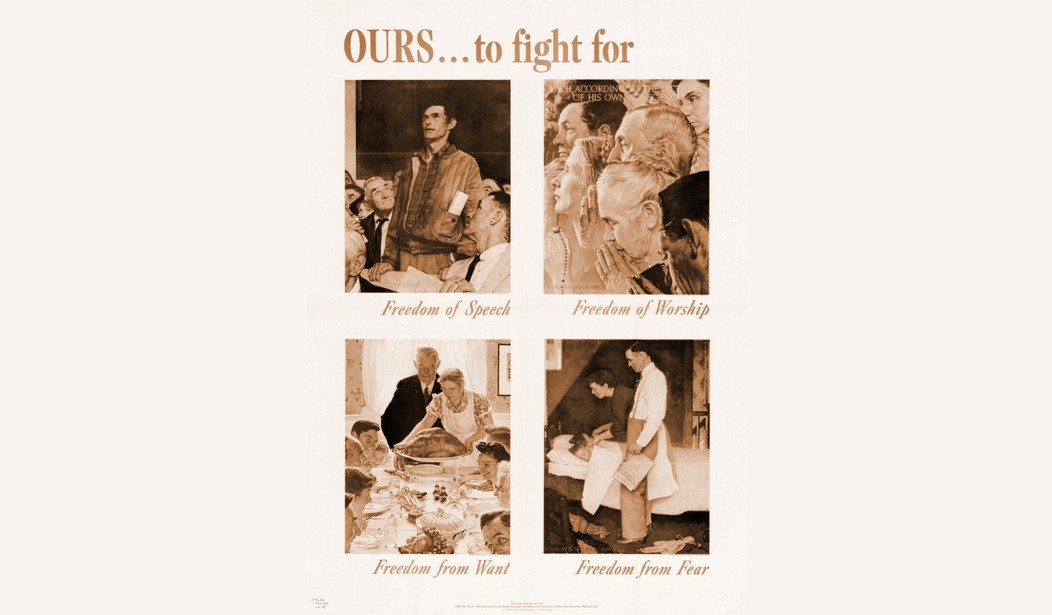
In his inaugural address in January of 1941, with war clouds looming on the horizon, FDR crystallized four freedoms he hoped would prevail in the world once the rising tide of totalitarianism had receded, which were depicted by Norman Rockwell in his famous paintings. They were:
- Freedom of speech and expression.
- Freedom of every person to worship God in his own way.
- Freedom from want.
- Freedom from fear.
The speech concluded this way:
Since the beginning of our American history, we have been engaged in change – in a perpetual peaceful revolution – a revolution which goes on steadily, quietly adjusting itself to changing conditions – without the concentration camp or the quick-lime in the ditch. The world order which we seek is the cooperation of free countries, working together in a friendly, civilized society.
This nation has placed its destiny in the hands and heads and hearts of its millions of free men and women; and its faith in freedom under the guidance of God. Freedom means the supremacy of human rights everywhere. Our support goes to those who struggle to gain those rights or keep them. Our strength is our unity of purpose. To that high concept there can be no end save victory.
Sounds high-minded, does it not? Let us take a closer look. First, there is that modern tendency to substitute the word “freedom” for what the founders called “liberty,” or more particularly “liberty well-ordered” (libertate quietem).
Jeremiah Johnson, the famed mountain man, had all the “freedom” a man could possibly have – no one there to tell him what he could and could not do, for as long as he kept his scalp, didn’t get mauled by a grizzly, or break his leg and freeze to death (and before you conjure up visions of handsome Robert Redford, the real deal was called “Liver Eating Johnson” due to stories that he ate the liver of Crow warriors he killed before finally making peace with the tribe).
“Liberty,” on the other hand, is the proper province of our dealings with one another, and the claims we may make upon each other. Our Declaration tells us that it is “self-evident” that such liberties are not granted to mankind by governments, but are “endowed by their Creator,” and are “unalienable.”
This author, and many others, have stressed that the American Revolution built upon British traditions of the rights of English-speaking peoples (something that both President Donald Trump and King Charles III pointed out at their recent dinner), but there is one very important and revolutionary difference. The man called “the Father of the Constitution,” James Madison, wrote in 1792 a short essay called “Charters,” which began:
In Europe charters of liberty have been granted by power. America has set the example, and France has followed it, of charters of power granted by liberty. This revolution in the practice of the world may, with an honest praise, be pronounced the most triumphant epoch of its history, and the most consoling presage of its happiness.
(We shall leave aside, for now, his inclusion of France, and recommend Edmund Burke’s Reflections on the French Revolution instead.)
What European charters was Madison referring to? The ones with which he was most familiar: The Magna Carta of 1215, the Petition of Rights of 1628, the English Bill of Rights of 1689, etc. These were rights conceded by a sovereign and, at various times, abrogated by them, up to and including the American Revolution. That which is granted by a power can be taken away by that same power, but who can legitimately take away that which is granted by our Creator?
Let us return now to FDR’s four freedoms. Do you notice something different between the first two and the last two? It is found in the difference between the words “of” and “from.” The first two are “negative rights,” i.e., they protect the holder from the actions of others. These are enshrined in our Declaration and our Constitution. The last two, so-called “positive rights,” assert a claim against others to provide the means to guarantee such “rights,” and in doing so, often veer into violating their rights.
The late Supreme Court Justice Ruth Bader Ginsburg gave the game away when she was asked in a 2012 interview on Egyptian TV what model she would recommend for emerging democracies in drafting a constitution. She declined her country’s own, and instead recommended the constitution of South Africa, which is chock full of rights to adequate housing, healthcare, food, water, clean environment, etc. Ask the descendants of the Dutch (who settled there around the same time the Pilgrims landed at Plymouth) whose lands have been confiscated, many of whom have been murdered, what THEY think of this “constitution.”
It is meet and just for our nation to have a safety net, but when that “net” is elevated and enshrined into rights on par with those of our Declaration and Constitution, there is no limiting principle, and the “net” too often becomes a lifestyle, in the best interest of neither the donors nor the recipients.
Editor's Note: Do you enjoy PJ Media's conservative reporting that takes on the radical left and woke media? Support our work so that we can continue to bring you the truth.
Join PJ Media VIP and use promo code FIGHT to receive 60% off your membership.


Join the Conversation
VIP members get the ability to comment on articles.