





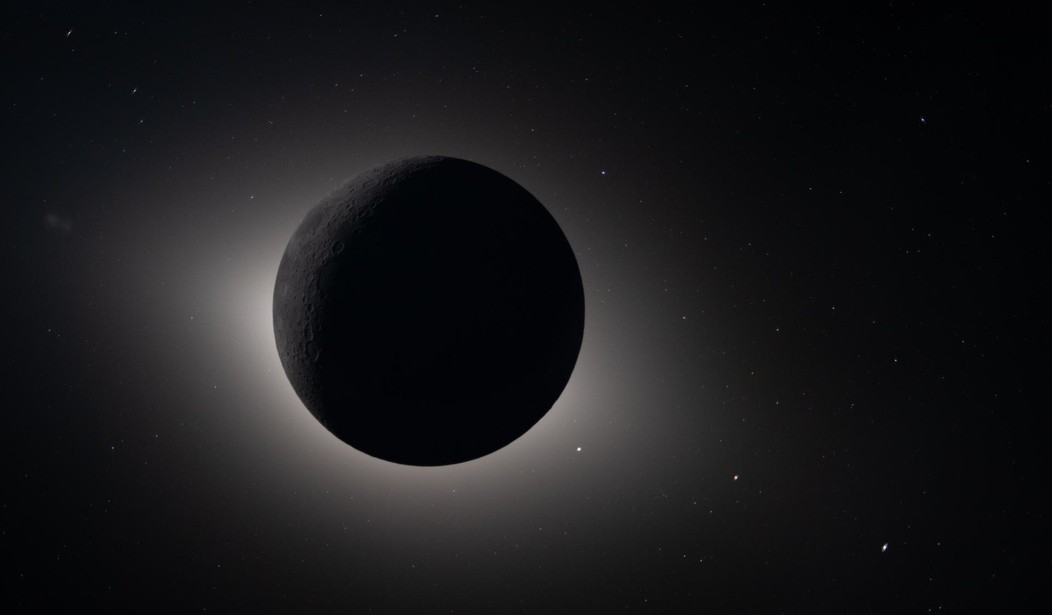
August 14's Sky Candy — obligatory link here —
Related: Total Eclipse of the Sky Candy
Was about the total solar eclipse that was visible starting in Siberia, crossed Greenland and Iceland, and was then visible in western Europe. Like all total solar eclipses, it was pretty spectacular where it could be seen, which sadly didn't include North America.
The red band that crosses Greenland, Iceland, and Spain shows where a total solar eclipse can be seen on Aug 12, 2026. Yellow curves across the map show where a partial eclipse will be visible. pic.twitter.com/atflfi9tUw
— Mario Livio (@Mario_Livio) August 12, 2026
I asked Grok for a clear explanation:
“Eclipses can only occur when the Moon is near one of the two nodes of its orbit (the points where it crosses the ecliptic). Because the Moon’s orbit is tilted ~5° to the ecliptic, these alignments with the Sun only happen during two roughly month-long ‘eclipse seasons’ each year. Within each season you almost always get at least one solar eclipse and one lunar eclipse (and occasionally three eclipses total).”
(And now you know why it's called the "plane of the ecliptic.")
So it's been two weeks since the solar eclipse, and it's time for a lunar eclipse to match. That comes on the night of August 27-28 and will be a very good eclipse — not complete totality, but 96%, so really close. The eclipse starts about 9:23 p.m. EDT on August 27 in North America (02:33 Central European Standard Time, August 28) and reaches 96% totality at about 12:12 a.m. EDT on the night of August 28.
The deepest lunar eclipse of 2026 lands on the night of Thursday, August 27 into the early hours of Friday, August 28, and North America has the best seat in the house.
— Space Weather Watch (@spacewxwatch) August 25, 2026
Penumbra occurs around 09:24pm ET/06:24pm PT Thursday night with maximum 12:13am ET/09:13pm PT. pic.twitter.com/JVkMbZ3GrY
If you miss this one, your next chance is going to be New Year's Eve 2028.
🚨: On Dec. 31, 2028, the Moon will turn blood red during a total lunar eclipse, with totality lasting about 61 minutes. Millions of people across parts of the world will have a chance to witness it! pic.twitter.com/v3tCTvVCj8
— Latest in Cosmos (@latestincosmos) August 18, 2026
Lunar eclipses are fairly regular, and astronomers in Babylon were predicting them as early as the late 8th or early 7th century BCE.
A partial lunar eclipse happened on May 22, 1453, during the Ottoman siege of Constantinople. There had been a prophecy that Constantinople would fall when the Moon gave a sign of impending doom. The defenders of Constantinople lost heart, and the city fell a week later.
A famous use of these predictions was in 1504. Christopher Columbus and his crew were stranded on Jamaica and running out of food, and the Arawak people were tired of feeding them. Columbus knew there was a lunar eclipse on the night of February 29 to March 1, so he told the Arawak that his God was angry at their refusal and would turn the Moon blood red, "Inflamed by wrath."
This impressed the ARAWAK considerably, and they started feeding the Spaniards again until their rescuers arrived.
Never let anyone tell you that knowledge of astronomy is of no practical use. You never know when you might be trapped on an island and trying to convince people to give you free food.
Related: Into the Future With Sky Candy.
Editor's Note: There are things happening that aren't political. Follow for Sky Candy and the special Sunday Supplement for news you can look up to.
Join PJ Media VIP and use promo code FIGHT to receive 60% off your membership.



Join the Conversation
VIP members get the ability to comment on articles.