Yeah, I'm late. Yesterday sucked. But here's some good stuff.
Today, we're going to focus on the Moon and the Artemis II mission, along with some history and some projections. And some normal sky candy just as seasoning.
Also, it's PJ Media policy to make fun of the New York Times whenever possible, so we'll start with some history.
“That Professor Goddard, with his ‘chair’ in Clark College and the countenancing of the Smithsonian Institution, does not know the relation of action to reaction, and of the need to have something better than a vacuum against which to react — to say that would be absurd. Of course he only seems to lack the knowledge ladled out daily in high schools.”
That's from a New York Times editorial from Jan. 13, 1920. To be fair, on July 17, 1969, the Times printed the following correction:
On Jan. 13, 1920, “Topics of the Times,” an editorial-page feature of The New York Times, dismissed the notion that a rocket could function in a vacuum and commented on the ideas of Robert H. Goddard, the rocket pioneer, as follows:
“That Professor Goddard, with his ‘chair’ in Clark College and the countenancing of the Smithsonian Institution, does not know the relation of action to reaction, and of the need to have something better than a vacuum against which to react — to say that would be absurd. Of course he only seems to lack the knowledge ladled out daily in high schools.”
Further investigation and experimentation have confirmed the findings of Isaac Newton in the 17th century and it is now definitely established that a rocket can function in a vacuum as well as in an atmosphere. The Times regrets the error.
So at least that's settled. We saw a new demonstration this week.
Moonbound.
— NASA Artemis (@NASAArtemis) April 1, 2026
The Artemis II mission lifted off from @NASAKennedy's Launch Complex 39B today at 6:35pm ET (2235 UTC). pic.twitter.com/xog8OJ2yQC
The Artemis program has many many problems, which the wonders of government contracting and the desire to have every NASA program have subcontracts in every state and, ideally, in every congressional district have largely driven. We've written about these elsewhere, for example in Rick Moran's Artemis II and the 'Waste of Space', and Stephen Green's We Need to Talk About Artemis. (Steve includes a notion I like — a $1 billion prize for the first private moon habitation. Write your congressbeasts.)
But for now, we have an actual moon mission in progress, and I propose to enjoy it.
We're going back to the Moon. pic.twitter.com/XqTxGuvVE3
— NoahKim (@Noah_Kim99) April 3, 2026
We've learned a lot about the Japanese attitude toward the US in the last few weeks.
Artemis Moon Mission: Thank you, Sailor Moon’s Artemis, to NASA’s control room 🌙* :゚ pic.twitter.com/PUIdMa3I8S
— ⛩🇯🇵ジャパメロ君🍈⛩/畜生/すっと子/構成員/獄潰し (@MAZARI_JAPAMERO) April 3, 2026
Space is big. Really big.
“Space is big. You just won't believe how vastly, hugely, mind-bogglingly big it is. I mean, you may think it's a long way down the road to the chemist's, but that's just peanuts to space.”
In perspective pic.twitter.com/KAICQcLMPy
— H⃗i⃗g⃗h⃗S⃗p⃗i⃗r⃗i⃗t⃗🪔 (@Highspirit31) April 3, 2026
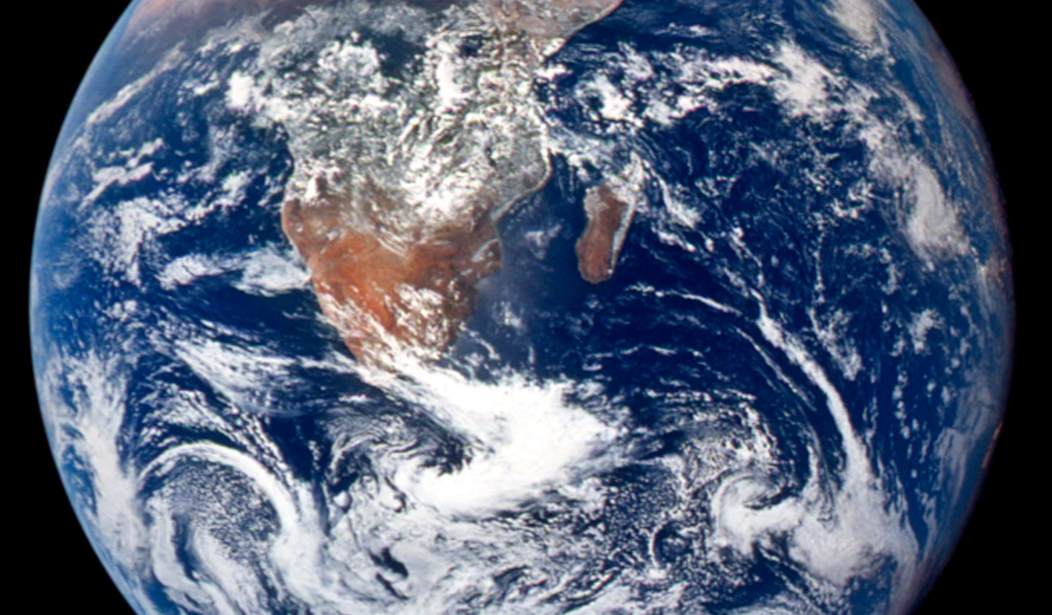
Views of the "big blue marble" have been in our minds since Apollo 8. Here's a comparison:
1972 ➡️2026
— NASA (@NASA) April 3, 2026
Apollo 17 ➡️ Artemis II pic.twitter.com/wGc2wtY0e2
Some people have been asking why the Artemis picture is so much dimmer, and inferring NASA went cheap on the cameras. The truth is, that's a picture of the Earth from the dark side, by moonlight. Film cameras couldn't have taken that picture at all. If you look carefully, there are aurora at both poles. For all the aurora pictures I've run in Sky Candy, I've never gotten both poles at once before.
There are actually five crew members on Artemis II. Or else four and a stowaway.
TFW your bestie enters the chat.
— NASA Artemis (@NASAArtemis) April 3, 2026
During Thursday’s downlink with the Artemis II crew, the zero-gravity indicator, Rise, made an appearance and the crew’s reaction says it all. Not only an important instrument—the ZGI also reminds the astronauts of home. 🌎 pic.twitter.com/7idIvYiKv4
There's more to come. You can follow here:
You can check out our 24/7 livestreams on YouTube. This one has views from the Orion spacecraft https://t.co/8hIf0jKMOb and this one has continuous coverage of Artemis II mission activities https://t.co/ouKmpB4fIu.
— NASA (@NASA) April 4, 2026
And now a bit farther out.
Jupiter under exceptional seeing conditions
— ZWO (@zwoastro) April 2, 2026
The Great Red Spot: a giant storm on Jupiter, bigger than Earth and still raging after 300+ years
Setup:
12" Dob (Skywatcher 300P Flextube Goto)
ZWO ASI585MC
Credit: Konstantinos Beis#ZWO #Jupiter #Planetary #Astrophotography pic.twitter.com/mg5DSLb5TZ
Lots to see on the trip.
❤️ Feel Good News
— English Read Club (@EnglishReadClub) April 1, 2026
Read this story and answer:
What happened?
Was it a happy ending?
New Views of Saturn Produced by Space Telescopes Help Researchers Understand the Planet’s Cloudshttps://t.co/8P0vu5ifZDhttps://t.co/ADs2QhtLGy
Got to have at least one nebula.
🚀Carina Nebula from the Northern hemisphere
— SVBONY (@SVBONYsvbony) April 2, 2026
⏱️40 minutes
⚓️using Svbony Sv535 lens and the new Sv220 3nm dual band filter.
Credit: Francisco Perez
get sv535 here: https://t.co/xfHRGjOA6a#SV535 #Astrophotography #DeepSkyPhotography pic.twitter.com/eL7WUSvpVk
How dull it is to pause, to make an end,
To rust unburnish'd, not to shine in use!
As tho' to breathe were life! Life piled on life
Were all too little, and of one to me
Little remains: but every hour is saved
From that eternal silence, something more,
A bringer of new things; and vile it were
For some three suns to store and hoard myself,
And this gray spirit yearning in desire
To follow knowledge like a sinking star,
Beyond the utmost bound of human thought.— Tennyson, "Ulysses"
Back next week, on Friday this time, with more Sky Candy.