Just relax, I got this.
I spent most of the week fussing with T-Mobile (TL;DR: when they tell you "on us," they mean "after you upgrade your account and pay $300 for a down payment. Oh, you don't want that? No problem, we'll break our own systems.") So I decided, let's just take it easy this week.
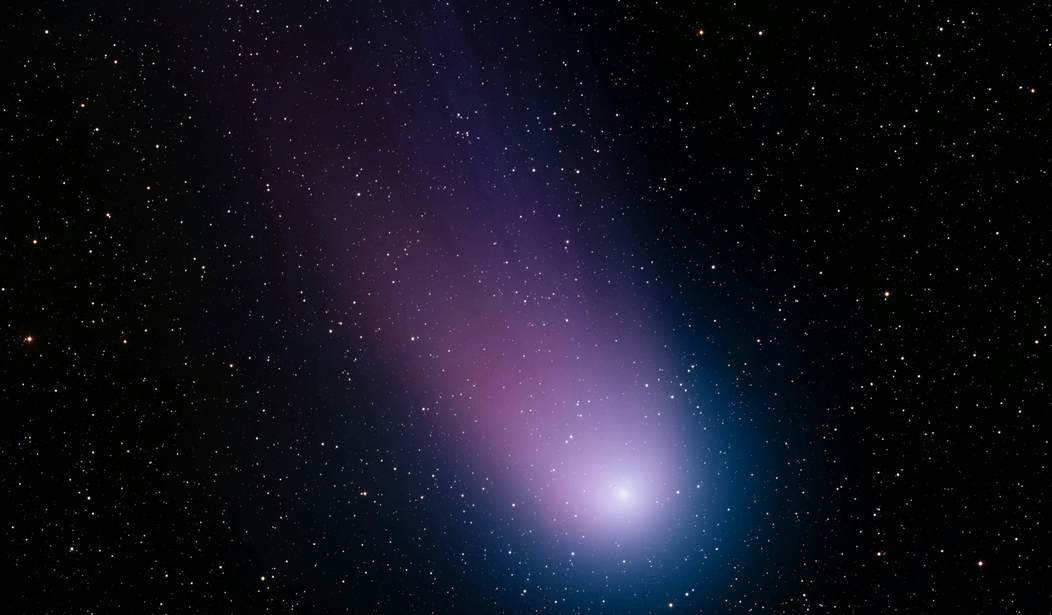
This is an APOD picture. It's real. Honest.
Northern Fox Fires
— Willie Aaron Lewis (@Parsec44) December 12, 2025
Image Credit & Copyright: Dennis Lehtonen pic.twitter.com/jb5mCedyob
So is this one. I know I've done pictures like this before, but it's cool.
Earth at night from Space.
— Black Hole (@konstructivizm) December 12, 2025
ISS pic.twitter.com/r9sez6zVbq
This one's not real, don't sweat it.
Earth next to Jupiter pic.twitter.com/ZqLMcNiodP
— Curiosity (@MAstronomers) December 11, 2025
How it's done (…done done).
The camera/the shot pic.twitter.com/XiZLS8DRUH
— Andrew McCarthy (@AJamesMcCarthy) December 12, 2025
It's not the camera, it's the photographer.
"The most important,
— Anik Sharma (@CosmicAnik) December 10, 2025
Feature of any telescope,
Is the imagination,
With which it is used"
- Dr. Vera Rubin✨️ pic.twitter.com/qAuRGPgYwK
Answer: really old. Well, 106. Not that old.
How old will you be when the Halley's comet visits Earth's sky again in 2061? pic.twitter.com/K9WDgIkHjY
— Night Sky Today (@NightSkyToday) December 12, 2025
One of the most important tools in astronomy is spectroscopy. Here's a little bit about him.
Joseph von Fraunhofer (1787–1826) was a German physicist and optical engineer who rose from humble beginnings as an apprentice glassmaker to become one of the most important figures in 19th-century science. Largely self-taught after surviving a workshop collapse that brought him to the attention of Bavarian royalty, he perfected the production of high-quality optical glass and developed the spectroscope in 1814. By passing sunlight through a prism and viewing it through a telescope, Fraunhofer discovered and meticulously mapped over 570 dark absorption lines in the solar spectrum—lines now known as Fraunhofer lines. These lines, caused by elements in the Sun’s atmosphere absorbing specific wavelengths, laid the foundation for astrophysics and spectroscopy. His precision instruments and discoveries enabled later scientists, including Kirchhoff, Bunsen, and Cecilia Payne-Gaposchkin, to decode the chemical composition of stars, transforming our understanding of the universe. Despite dying of tuberculosis at only 39, Fraunhofer’s work remains a cornerstone of modern astronomy.
Die Erfindung des Spektroskops im Jahr 1814 durch den deutschen Wissenschaftler Joseph von Fraunhofer ermöglichte es Astronomen Anfang des 20. Jahrhunderts zu entdecken, dass unsere Sonne hauptsächlich aus Wasserstoff und Helium besteht. pic.twitter.com/GX28udpRKb
— Noah Karl🌏🌌🚀 🇪🇺🇩🇪 (@NoahKarl1) December 10, 2025
Making galaxies while you wait.
NGC 986: A spiral caught in its own exquisite rebellionIn the lonely southern constellation of Fornax, 76 million light-years away, NGC 986 hangs like a cosmic question mark, beautiful, broken, and defiant all at https://t.co/RH0Edee5MZ first glance it’s a classic barred spiral… pic.twitter.com/mY7kJL3Wa5
— Black Hole (@konstructivizm) December 12, 2025
Making its Mark(arian)!
— Hubble (@NASAHubble) December 12, 2025
Markarian galaxies like the one in this new Hubble image get their name from astrophysicist Benjamin Markarian, who compiled a list of galaxies that were surprisingly bright in ultraviolet light: https://t.co/f2M4QAhw1R pic.twitter.com/o00GCNHNVz
Explore the universe in data-based 3D science visualizations, dive deep into images from the Hubble and James Webb space telescopes, learn how galaxies are made, and watch lectures on all things astronomy!
— Space Telescope Science Institute (@SpaceTelescope) December 12, 2025
Subscribe to your new favorite YouTube channel: https://t.co/7uW3cuH1jE pic.twitter.com/Yz0KuQlxE2
Raw materials.
STUDYING CHONDRITIC METEORITES WE TRAVEL BACK IN TIME to the first stages in Solar System formation. In fact, undifferentiated asteroids never melted, and are the parent bodies of #chondrites. I'm briefly introducing you to these rocks made of chondrules: https://t.co/DSWIlNUWe6 pic.twitter.com/yM8tYJtdhR
— Dr. Josep M Trigo ⭐🌛#PlanetaryDefense #DART HERA (@Josep_Trigo) December 12, 2025
Not quite the solstice, but getting close. Everyone knows the Summer Solstice, when the sunrise aligns with Stonehenge. Not as many realize that at the Winder Solstice, it's the sunset that aligns. Grok has lots of details (including that it's usually really cold and wet), but —
In short: Stonehenge at winter solstice is the moment the ancient builders apparently wanted to mark the death and rebirth of the sun, and today it remains one of the most atmospheric and spiritually significant events at the site.
Sunrise at Stonehenge today (12th December) was at 8.01am, sunset is at 4.00pm 🌤️ pic.twitter.com/PSwOxnWqcV
— Stonehenge U.K (@ST0NEHENGE) December 12, 2025
So that does it for this week. Not much Sturm und Drang, which, frankly, is what I needed.
Related: Sky Candy: To Infinity and Beyond
As always, I love comments, and come back for what will inevitably be a Christmas edition next Friday.