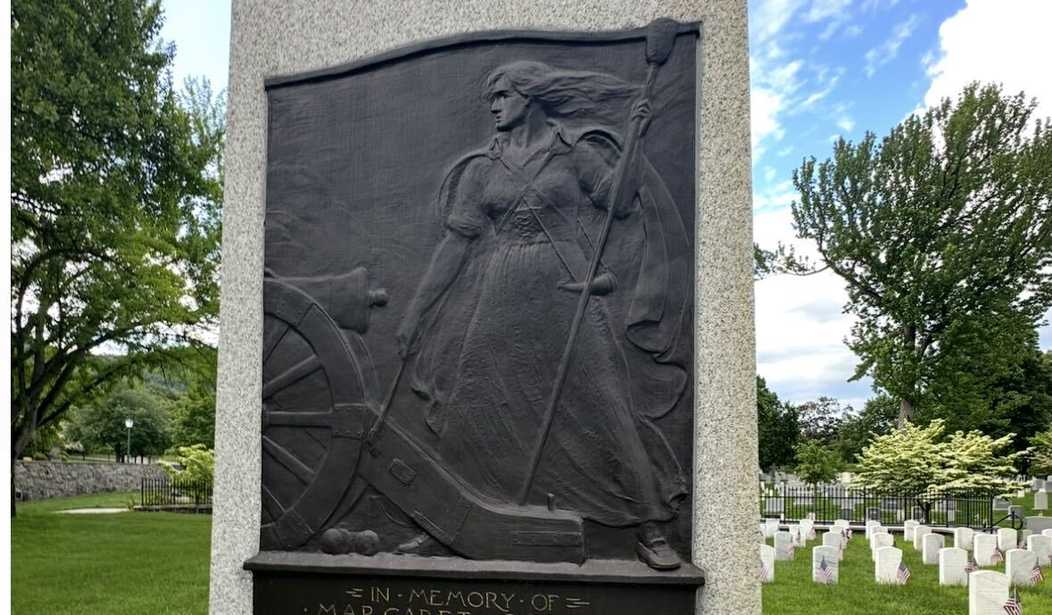

November 12 was the birthday in 1751 of a woman whose patriotic heroics and survival of a crippling injury were so impressive during the American Revolution that the Continental Congress made her the first woman to receive a military pension.
If you look up “Molly Pitcher” or “Margaret Corbin” on the internet nowadays, you will almost certainly find dozens of websites and "experts" who will either tell you that she never existed or that we have no way of knowing where she's buried, with that modernist passion for calling every historic hero a myth or a villain and every piece of historical evidence "insufficient" or "discredited."
Perhaps the confusion stems from the fact that there is more than one story of a woman nicknamed "Molly Pitcher" taking over her husband's cannon during a fight, which is not surprising, as there were a number of Patriot women capable of handling firearms who also helped serve refreshments to soldiers. Molly was a rather common nickname, and "Molly Pitcher" comes from the habit soldiers reportedly had of calling for a drink from a generous housewife by shouting something like, "Molly, pitcher!" That said, American authorities were so sure that Margaret Cochran Corbin, pensioned patriot, was the famous "Molly Pitcher" that they buried her at West Point with a beautiful monument for her grave. I have personally visited the rededicated monument in the cemetery at the military academy.
The National Women's History Museum states that Corbin's parents lived in Franklin County, Pa., which was still the frontier in 1751. When little Margaret was only five years old, Native American Indian raiders killed her father and captured her mother. Margaret's mother never came home, so an uncle adopted the girl and her brother.
In 1772, Margaret was 21, and she married John Corbin. With the outbreak of the American Revolution in 1775, John Corbin joined the Pennsylvania troops. Margaret Corbin went with her husband into the Army, where she was a "camp follower," one of the women who cooked and did laundry for soldiers. She also was a nurse for soldiers who were ill or injured in battle.
Read Also: Veterans Day: Disney's Voice of Bambi Became a Three-Time Purple Heart-Winning Marine
The National Women's History Museum says that Corbin was wearing men's clothing on November 16, 1776, when her husband was fighting at the Battle of Fort Washington in Manhattan. Margaret's disguise was apparently to justify her presence at the cannon helping her husband load the shot. Tragically, the British fire killed John Corbin. But "Captain Molly" didn't take the time to mourn him — there was a battle to fight. She immediately took charge of the cannon and kept firing.
Other soldiers commented on “Captain Molly’s” steady aim and sure-shot. Eventually, however, she, too, was hit by enemy fire, which nearly severed her left arm and severely wounded her jaw and left breast. She was unable to use her left arm for the rest of her life. The British eventually won this battle, with Corbin numbered among the prisoners of war who were paroled and released back to the care of Revolutionary hospitals.
Left to support herself alone, Corbin struggled financially. After she recovered, Corbin joined the Invalid Regiment at West Point, where she aided the wounded until she was formally discharged in 1783. Then, on July 6, 1779, the Continental Congress, in recognition of her brave service, awarded her with a lifelong pension equivalent to half that of male combatants. Congress also gave her a suit of clothes to replace the ones ruined during the conflict.
In 1782, Margaret Corbin married another soldier who had been injured during the war. Sadly, he died only a year into their marriage. This time, she remained a widow. She had lost two husbands to the war, but she lived until 1800. She died in New York not far from the fort that is now the U.S. Military Academy at West Point, so in 1926, authorities moved her remains to the West Point cemetery and gave her another funeral with full military honors, according to the museum.
Whether we call her Margaret Corbin, "Captain Molly," or "Molly Pitcher," the woman who fired the cannon at Fort Washington was a heroine. Her grave monument at West Point lauds "her deeds for the cause of liberty" and asks "that her heroism may not be forgotten," for which purpose "her dust was removed to this spot and this memorial erected by the National Society of the Daughters of the American Revolution in New York State." Captain Molly rests in a soldiers' cemetery, for she fought bravely and honorably in the cause of liberty.