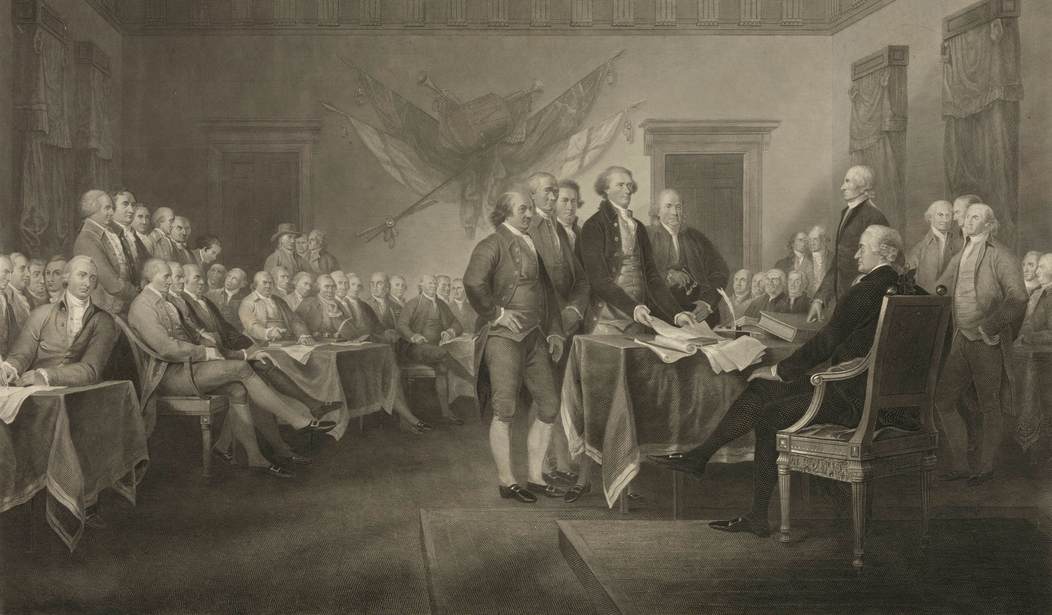

Continental Congress President John Hancock wrote to Gen. George Washington that voting for independence was a “Duty” owed posterity. Why might he have written that, and why was he prophetic?
Firstly, of course, we must begin with Hancock‘s own words. He wrote on July 6, which was four days after the vote for independence and two days after the approval of the Declaration, “Although it is not possible to foresee the consequences of human actions, yet it is, nevertheless, a duty we owe ourselves and posterity, in all our public councils, to decide in the best manner we are able, and to leave the event to that Being who controls both causes and events, to bring about his own determinations,” Hancock explained the Congress’s move to Washington.
He emphasized: “Impressed with this sentiment, and at the same time fully convinced that our affairs may take a more favorable turn, the Congress have judged it necessary to dissolve the connection between Great Britain and the American Colonies, and to declare them free and independent States, as you will perceive by the in closed DECLARATION, which I am directed by Congress to transmit to you, and to request you will have it proclaimed at the head of the army in the way you shall think most proper.”
We see from this passage that Hancock believed there was a natural and a divinely-given duty toward ensuring a better future for one’s descendants and to try and secure one’s own rights in the way most consistent with reason, courage, justice, and human dignity. Disinteresting that the decision for independence came after a series of military defeats for the patriot cause, which is why Hancock has to acknowledge that he hopes for more positive results in future. For that to happen, of course, Washington and his men had to win some victories.
We think of 1776 is a glorious year, because of the birth of America, and from that perspective, it was glorious. But for Washington and his troops much of the year was very discouraging. It was not until Washington’s brilliant stroke at Trenton and then Princeton that there really came a decisive, turning point in the Americans’ favor. And for the men who voted for independence in July and signed the Declaration in August, much of that year was also torturous with uncertainty and fluctuating prospects.
Related: The Day Philadelphia First Heard the Declaration of Independence
And yet, on July 9, 1776, in Washington had the Declaration read to his men, there was excitement and joy. Now the Patriots knew they were fighting for their own country and total freedom from the tyrant who had so long plagued them. From George Washington's Mount Vernon:
In the General Orders for July 9, Washington explained that the Congress, “impelled by the dictates of duty, policy and necessity” had “been pleased to dissolve the Connection” between the colonies and Great Britain. He ordered the brigades in New York to assemble at six o’clock that evening, “when the declaration of Congress, shewing the grounds & reasons of this measure, is to be read with an audible voice.” One voice alone would not be able to carry over such a large crowd; instead, someone stepped to the front of each brigade and read the Declaration aloud ...
Connecticut-born Samuel Blachley Webb, one of Washington’s aides-de-camp, wrote in his journal that, “Agreeable to this day’s orders, the Declaration of Independence was read at the Head of each Brigade; and was received by three Huzzas from the Troops.” He sensed that his fellow soldiers were “highly pleased” by the Congress’s decision to separate from Great Britain.
But the implications of the Declaration, of course, went far beyond the Revolution. Hancock was more prophetic than even he could have imagined. Posterity indeed would thank the men who risked everything for independence. The Founding Fathers fought not simply out of personal or political concerns but because they truly saw a moral imperative toward securing liberty and other God-given rights. That sense of duty carried them through a seemingly impossible war toward the creation of the USA, and we ought to revive it again in our day.