





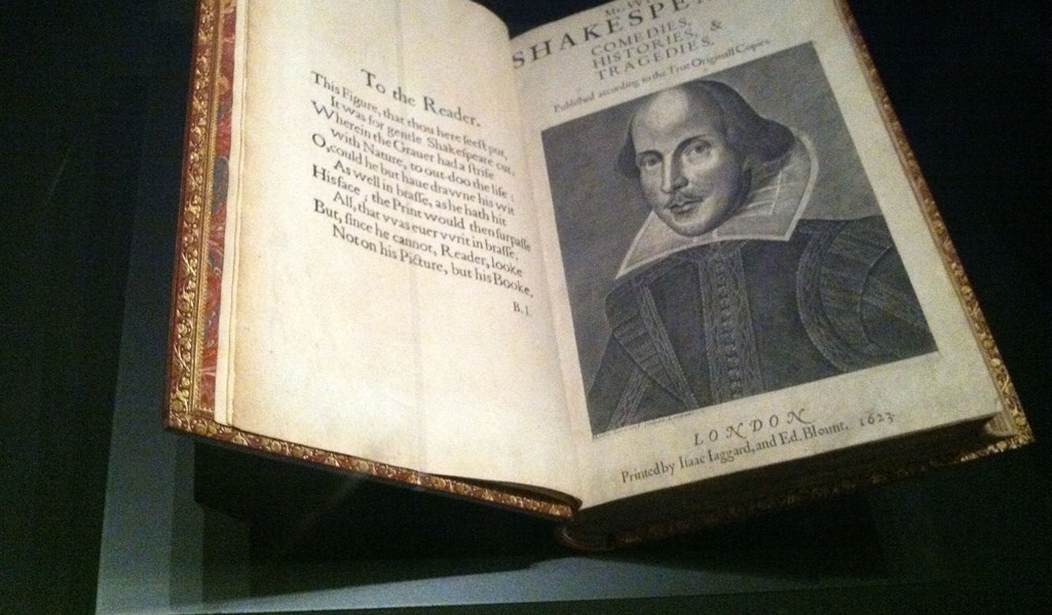
April 23 is the anniversary of both the birth and the death of the greatest English writer, William Shakespeare. One of the most fervent American admirers of the 16th century Bard of Stratford-on-Avon was America’s 16th president, Abraham Lincoln.
In an 1863 letter to actor James H. Hackett, President Lincoln wrote of his regret that he had seen "very little of the drama" but of his pleasure both in reading Shakespeare's plays privately and in seeing Hackett portray Falstaff on stage. "Some of SHAKESPEARE’s plays I have never read, whilst others I have gone over perhaps as frequently as any unprofessional reader," Lincoln wrote, mentioning among others "King Lear," "Richard III," and "Macbeth," which was his favorite. Then came the interesting reflection, "Unlike you gentlemen of the profession, I think the soliloquy in 'Hamlet,' commencing, 'O, my offence is rank,' surpasses that commencing, 'To be or not to be.'" So today, in honor of Shakespeare's birthday, I would like to share Lincoln's favorite soliloquy in "Hamlet."
If, like me, you did a momentary double take on "O, my offense is rank," it is King Claudius's speech acknowledging to himself his heinous crime of murdering his brother, seizing the throne, and wedding the widowed queen. It is, indeed, a magnificent speech, and both fascinating as a study of a criminal's struggle with guilt and repentance, and as key to the plot. At the end of the soliloquy, Claudius kneels and prays that his sin might be forgiven, horrific as it is. Hamlet comes in to find his murderous uncle praying, and resolves not to kill him then and there, desiring the deeper and more eternal revenge of killing his uncle in the midst of some sin so he'll go to hell. That postponement of revenge fuels the play's plot.
In a sense, Hamlet gets his wish, for Claudius, instead of acting out his repentance in a meaningful way, compounds his crime by plotting the murder of Hamlet. Yet in aiming to send Claudius to hell, in becoming more deeply enmeshed in the bloody intrigues that surround him, Hamlet destroys himself and multiple other people, including Ophelia. But since I could never hope to analyze all the complexities of one of Shakespeare's most psychologically and morally complicated plays in one article, I will instead share the Claudius soliloquy that Lincoln found so fascinating. And indeed, apart from all the rest of the plot, the soliloquy is a masterpiece as a soul’s struggle with sin, ambition, repentance and near despair, including both biblical imagery and utterly original descriptors.
For Our VIPs: ‘Rome, Rule the World’: The Eternal City’s Anniversary and Historic Impact
Below is the passage in full, and I have included multiple actors' interpretations of the soliloquy too:"O, my offence is rank it smells to heaven;
It hath the primal eldest curse upon't,
A brother's murder. Pray can I not,
Though inclination be as sharp as will:
My stronger guilt defeats my strong intent;
And, like a man to double business bound,
I stand in pause where I shall first begin,
And both neglect. What if this cursed hand
Were thicker than itself with brother's blood,
Is there not rain enough in the sweet heavens
To wash it white as snow? Whereto serves mercy
And what's in prayer but this two-fold force,
To be forestalled ere we come to fall,
Or pardon'd being down? Then I'll look up;
My fault is past. But, O, what form of prayer
Can serve my turn? 'Forgive me my foul murder'?
That cannot be; since I am still possess'd
Of those effects for which I did the murder,
My crown, mine own ambition and my queen.
May one be pardon'd and retain the offence?
In the corrupted currents of this world
Offence's gilded hand may shove by justice,
And oft 'tis seen the wicked prize itself
Buys out the law: but 'tis not so above;
There is no shuffling, there the action lies
In his true nature; and we ourselves compell'd,
Even to the teeth and forehead of our faults,
To give in evidence. What then? what rests?
Try what repentance can: what can it not?
Yet what can it when one can not repent?O wretched state! O bosom black as death!
O limed soul, that, struggling to be free,
Art more engaged! Help, angels! Make assay!
Bow, stubborn knees; and, heart with strings of steel,
Be soft as sinews of the newborn babe!
All may be well."
Editor's Note: Do you enjoy PJ Media's conservative reporting on the woke left and important cultural anniversaries? Support our work so that we can continue to bring you the truth.
Join PJ Media VIP and use promo code FIGHT to receive 60% off your membership.



Join the Conversation
VIP members get the ability to comment on articles.