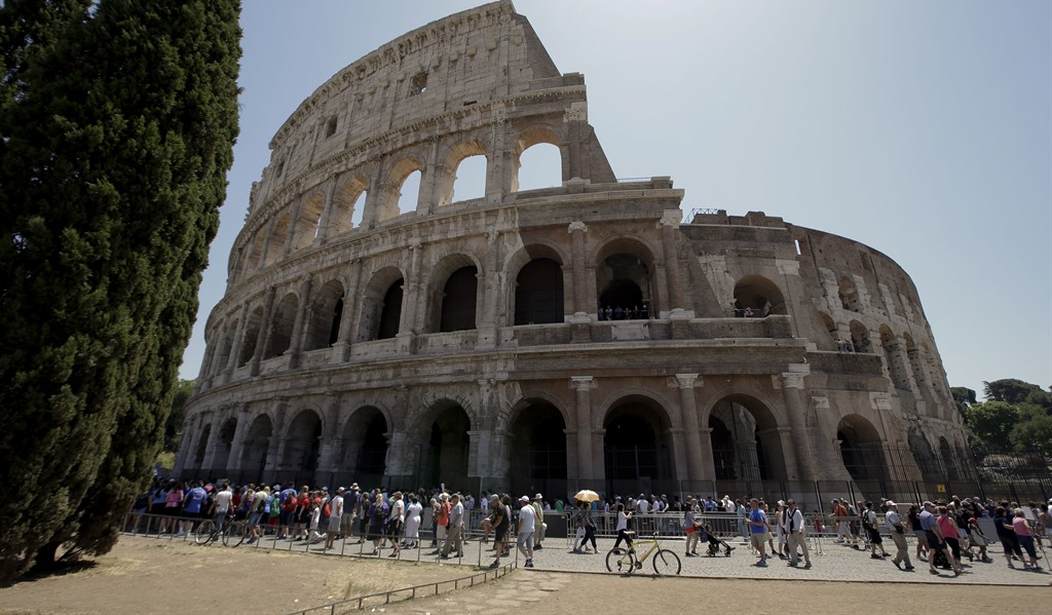

As April 21 is considered the birthday of “the Eternal City,” which has been shaping religion, culture, and history for thousands of years, it is the perfect time to reflect on why Westerners — especially Americans — should honor Rome.
April 21 is traditionally considered the day on which Romulus and Remus founded the city of Rome in 753 B.C. Through pagan and Christian eras, before Christ and after Christ, from ancient times up to our own day, Rome has almost continuously held political or spiritual sway over a significant portion of the world. Indeed, America’s Founders looked principally to Rome for political and philosophical inspiration when crafting the documents and principles on which our Republic is established. America has a debt to pay to the great thinkers of Rome.
Roman philosophers such as Seneca and Marcus Aurelius, Roman statesmen such as Cicero and Cincinnatus, Roman conquerors such as Scipio Africanus and Julius Caesar, Roman tyrants such as Nero and Caligula, and Roman writers such as Horace and Livy all contributed their brilliance or corruption, their greatness or evil, to the making and molding of global civilization, especially in the West.
Publius Vergilius Maro, commonly known today as Vergil or Virgil, believed that above all, Rome's greatest legacy was its power to bring peace, justice, and unity to the world. While Romans of course failed to live up to their own ideals many times over, it is undeniably true that from Rome — not from Greece, or Babylon, or any of the other ancient pagan nations — we received the ideals of basic universal human rights, political versus ethnic or racial citizenship, unity by ideals rather than by tribe, and natural law morality that were so crucial in forming the West's culture and thought. This was why the Jewish Messiah Jesus was born during the age of the Roman empire, when for the first time in history, the dominant global power had many ideas that would make its people receptive to the Judeo-Christian ethic and the high moral teachings of Christ.
Flashback: From Vergil to the Founders: Praise for the ‘Eternal City’ on Rome’s Birthday
Vergil is among the pagan Roman authors who, even while writing about "gods" and "nymphs" and "Furies," still expresses many views of political justice, personal morality, and justice in the life after death that are not only uniquely Roman but startlingly Christian. And therefore I think it is proper to quote from Book VI of his great work The Aeneid, where the character of Anchises predicts what the greatest glory of the Roman people will be:
“Others, I doubt not, shall with softer mould beast out the breathing bronze, coax from the marble features to life, plead cases with greater eloquence and with a pointer trace heaven’s motions and predict the risings of the stars: you, Roman, be sure to rule the world (be these your arts), to crown peace with justice, to spare the vanquished and to crush the proud.”
It is that ideal that Rome passed down through the years all the way to America's Founding Fathers. It is no mistake that the Founders adopted Roman pseudonyms when writing essays, that they used Roman terms such as "Republic" and "Senate" when establishing the American system of government, or that our national capital's buildings look like ancient Roman monuments. We are the inheritors of Rome, and our arts are its arts: to crown peace with justice, to spare the vanquished and to crush the proud.