
"Surely he hath borne our infirmities and carried our sorrows: and we have thought him as it were a leper, and as one struck by God and afflicted. But he was wounded for our iniquities, he was bruised for our sins: the chastisement of our peace was upon him, and by his bruises we are healed." —Isaiah 53:4-5
Today, April 3, is Good Friday 2026, commemorating Jesus Christ's Passion and death for the sins of mankind, through which He reopened the gates of Heaven for us. Naturally, most Good Friday reflections focus on Christ's trials, journey to Calvary, and crucifixion; indeed, my colleague Chris Queen published one such piece. But I would like to focus on the agony in the garden, which occurred very late on Thursday night and was the beginning of Christ's Friday Passion. Why? Because in the garden, Christ felt every single sin and tragedy in world history so acutely that He sweated blood and cried out to God in the most profound heartbreak.
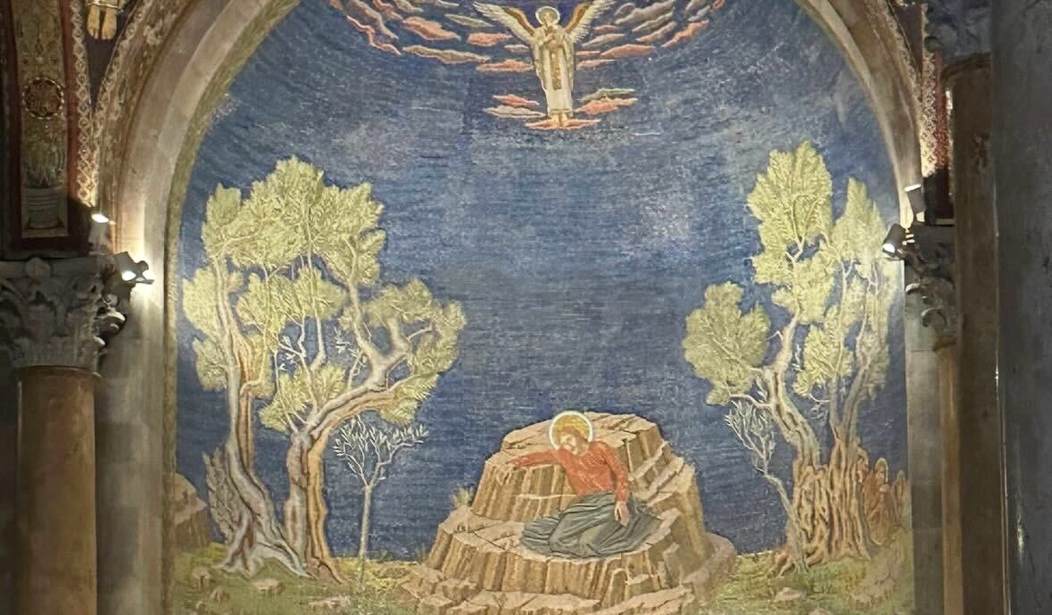
The Garden of Gethsemane is close to Old City Jerusalem but outside the walls. Possibly the most beautiful church I visited in Israel was the Church of All Nations, a Catholic basilica situated at the base of the Mount of Olives, in that Garden of Gethsemane where Christ's agony and arrest occurred, the beginning of His redemptive Passion. The image above is the mosaic over the main altar. Inside the church is the Rock of the Agony, which ancient tradition identifies as the exact location of Christ's prayer in the garden.
In the Garden of Gethsemane, 2023. Have a blessed Holy Thursday pic.twitter.com/Xro6kCdfD7
— Catherine Salgado (@CatSalgado32) April 2, 2026
Some of the olive trees in the garden, including those in my picture above, are over 2,000 years old, meaning they were growing there during Christ's agony. Walking in that garden and praying in that church is, in a sense, to travel back in time — at least, I felt it so. And the very peace and sanctity of the garden and basilica help one imagine the loneliness in which Christ suffered there — acute interior torture.
Christ knelt on that rock in Gethsemane and prayed. The wind rustled the leaves on the olive trees, and nearby, His closest friends, Peter, James, and John, slept soundly. How utterly alone Christ must have felt! And there was no tranquility for Him, because while in the garden, Jesus felt the pain of all losses, tragedies, heartbreaks, and injustices in human history. He saw every sin past, present, and future as vividly as we might see a movie.
Related: Holy Thursday Reflections: My Visit to the Upper Room in Jerusalem
The "problem of evil" has always been a stumbling block for non-believers and believers alike, but in a sense, Christ answered that problem with His agony in Gethsemane. There is no pain, no sorrow, you have experienced that Jesus did not also experience that night in Gethsemane. Every murder, rape, theft, death, disaster, lie, assault, humiliation, torture, and cry for help passed through the God-man's head and heart until His very blood vessels burst with the excruciating torment of it all. “And in His anguish, He prayed more earnestly, and His sweat became like drops of blood falling to the ground (Luke 22:44).”
Hematidrosis or bloody sweat is a rare but repeatedly documented medical phenomenon, as examined for instance in a 2024 scientific review of numerous instances over several millennia.
Dr. Liji Thomas wrote:
Hematidrosis is a rare and unusual condition that is characterized by the excretion of blood through the sweat gland pores. It has been described in the Bible as occurring to Jesus Christ when he was praying in the garden of Gethsemane…It is believed that under these conditions, the capillaries surrounding the sweat glands rupture and blood escapes into the gland lumen, only to emerge through the duct openings on to the skin.
Any touch on skin so injured would be extremely painful, and Jesus experienced hematidrosis before the scourging, the crowing with thorns, the carrying of the cross, and the crucifixion.
Ven. Fulton Sheen described Christ as being “crushed” under the weight of His agony until He cried out, pleading that He not have to endure the Passion. Jesus was fully God as well as fully man. He knew He would rise after His death and that only He could save mankind. And yet the unspeakable torture of experiencing all men’s sins and sufferings caused Him to gasp (Mark 14:36), “Abba, Father, all things are possible to thee: remove this chalice from me; but not what I will, but what thou wilt.”
The Gospel accounts of the Passion and detailed medical analyses are profoundly moving, and yet on top of every physical injury Christ suffered, we must remember that He suffered even more acutely in His soul, and that He carried the weight of the world’s sins as surely and painfully as He carried the cross.