
This week’s "Predator Watch" features another far-too-young victim, bitten in a place where she probably felt safest. Ifunanya Nwangene, a former contestant on The Voice Nigeria, died on Saturday, at the age 26, following a snake bite while she slept in her bed in Nigeria’s capital, Abuja.
A New York Post article on the tragic death notes that, according to Nwangene's friend, pain in the singer's leg woke her up. In a social media video showing two snakes being removed from the house, someone can be heard shouting, "It's a cobra!" The New York Times reports that the most deadly snake species in Sub-Saharan Africa are the puff adder, cobra, and black mamba.
Related: Predator Watch: 12-Year-Old Australian Boy Dies After Shark Attack
There are differing accounts of the treatment the singer received. Friends say she was not given the correct antivenom, while the Federal Medical Centre in Jabi says doctors administered polyvalent anti-snake venom and followed emergency procedures. The musical director of Nwangene's choir told BBC Africa, “While they were trying to stabilize her, she could not speak but she could make hand gestures. She was struggling to breathe.”
As a contrast to those tragic final moments, here's her powerful performance of Rihanna’s “Take a Bow” on The Voice Nigeria:
According to the scientific journal Nature Communications, Africa is home to more than 130 venomous snake species, which cause over 30,00 deaths per year. The World Health Organization notes:
In contrast to many other serious health conditions, a highly effective treatment exists. Most deaths and serious consequences of snake bites are entirely preventable by making safe and effective antivenoms more widely available and accessible. High quality snake antivenoms are the most effective treatment to prevent or reverse most of the venomous effects of snake bites.
The problem is that Africa doesn't have enough antivenom. Bloomberg reports that "the scarcity is due to a combination of too little production, difficulties in getting the product to where it’s needed and complications in keeping certain antivenoms refrigerated."
The low numbers of deaths from snake bites in the U.S. are primarily due to the availability of antivenom and advanced medical care. An article posted on the website of the National History Museum of Los Angeles puts the risk in perspective:
Each year, around 7,000–8,000 people are bitten by venomous snakes in the U.S. This may sound like a large number, but given that the U.S. population is quickly approaching 324 million people, this represents a tiny proportion of the population (less than 0.0025%). Of these 8,000 or so bites, on average, 5–6 result in fatalities. This means, you are 6 times more likely to die from a lightning strike or a dog attack, 8 times more likely to die from a TV set or other large furniture falling on you, 14 times more likely to die falling out of a tree, and 95 times more likely to die falling off a ladder.
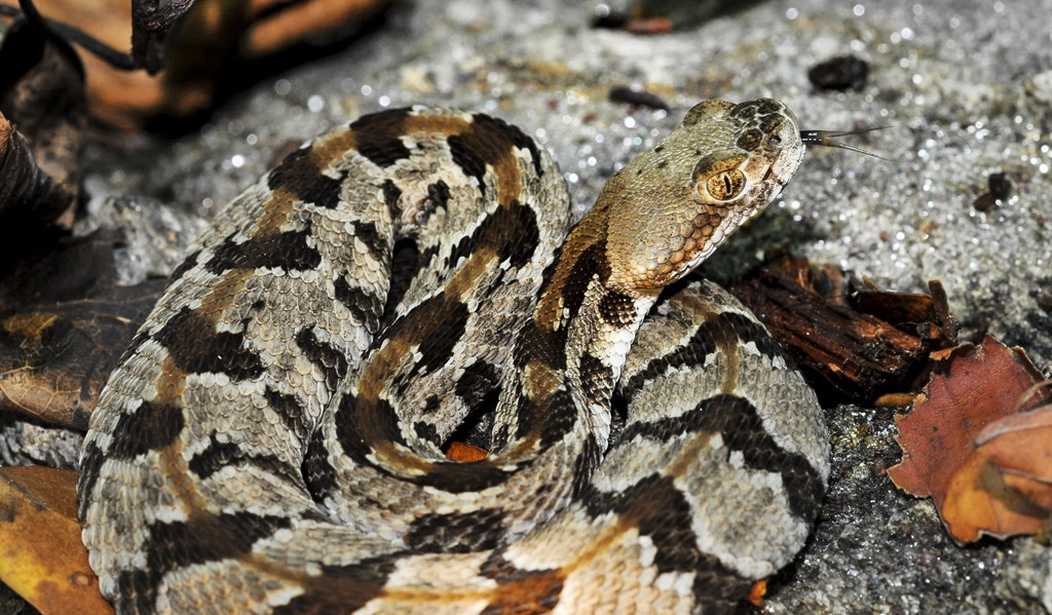
With numbers that low, any death in the U.S. makes headlines. Last year, a hiker died after being bitten by what was likely a Timber rattlesnake at a Tennessee state park. ABC News reported:
The Timber rattlesnake is the largest and most dangerous of the four venomous snakes found in Tennessee, according to the state's Wildlife Resource Agency. The species can measure between 3 feet and 5 feet long and prefers mature, heavily-wooded forests with rocky hillsides.
Timber rattlesnakes tend to be "more docile" than other rattler species and is likely to stay coiled or stretched out and motionless when encountered in the wild, according to the Smithsonian National Zoo.
A-Z Animals put together a list of the 11 most snake-infested states; Texas is at the top with over 105–115 species.
My home state, California, didn't make the list, but it is home to seven different species of rattlesnakes. I'm surprised I’ve never come across one on any of my hikes over the years.
Have you ever come face-to-face with a snake? Share your story in the comments.