



Irene: Watching the Surge
[NOTE: For the very latest on Irene, check my Twitter feed.]
* * * * *
As I’ve said repeatedly, the big storyline with regard to Hurricane Irene’s coastal impact isn’t the winds, but the storm surge. Even if Irene weakens to a tropical storm overnight, as she may, what we really need to watch is how high the surge gets. Of particular significance, New York’s subway system will reportedly flood if the storm surge is more than 3 to 4 feet above the already astronomically high tide tomorrow morning.
With that said, check out this NOAA chart, updating in real time (or close to it), of the water level at The Battery in Lower Manhattan:
Click on the chart for a larger version. The blue line is the expected, “normal” water level, as the tides come in and out. Actually, “normal” isn’t quite right, since we’re dealing with astronomically high tides, thanks to the New Moon. But anyway, the blue line is what the tides would be without Irene.
The red line is the actual water level. When you see the red line not declining, or only declining slightly, while the blue line is going way down, that’s bad news. It means the storm surge is preventing the tide from going out, so the next high tide will likely be much higher (assuming the surge is still present when the tide comes in).
But the one to really watch is the green line. This is the “residual” level, the difference between the red and blue lines. Basically, the green line is the storm surge. So, for instance, if the red line is declining as the tide goes out, but not as much as it “should” be declining (as in the scenario just discussed), that will cause the green line to go up.
Low tide is at 2:14 AM. High tide is at 8:07 AM. Irene’s expected closest pass is expected at around 8:00 10:00 AM — so it’ll be very nearby at high tide. Awful timing. (Once the storm passes, the winds shift to blowing offshore, and the storm surge begins to fall away. See, for instance, Yorktown, VA. But in NYC, that likely will not happen until after high tide.)
Oh, and wave heights, I should note, are on top of the surge.
Regarding the subway, if you want to get a little more into the weeds… based on what Dr. Jeff Masters has written about this, it appears the seawall that protects the subway is approximately 8 feet above the “MLLW,” or “Mean Lower Low Water” level. An average high tide is roughly 4.5 feet above MLLW. The New Moon adds another 0.5 feet to tomorrow’s high tide. That leaves a 3-foot margin for error, give or take a few inches. So a surge of greater than 3 feet at high tide would likely flood the subway, unless Dr. Masters is wrong or I’m missing something here.
Moreover, if the surge reaches 4.5 feet at high tide, here are some of the areas that would potentially be underwater at high tide, according to Climate Central:
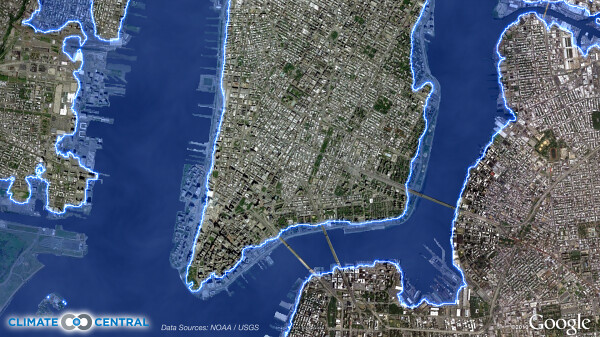
Note: I’m not sure if that map takes into account seawalls and such. So take it with a grain of salt, giving you a general idea of the amount of territory at risk, but not necessarily a precise block-by-block map of who’d be flooded.
The Weather Channel’s Bryan Norcross just broached the possibility of a 7- or 8-foot surge. I have no idea what that would do, beyond a vague assumption that it would be very bad. It seems high to me — but then again, New York harbor is acting like a giant funnel, so maybe it could happen. Hopefully not.
* * * * *
Anyway, that’s the situation with New York City. But of course, Gotham isn’t the only place at risk. And I thought it might be helpful to try and collect all the relevant tidal information in one place. NOAA maintains an excellent site where you can view tidal gauges for a variety of locales all around the country, including up and down the East Coast, but they’re all on individual pages. It also has a great “QuickLook” page where you can view this data, and more, about Hurricane Irene. But for viewing the critical storm surge data, and only that data, all in one place, I’m taking the liberty of combining a bunch of these charts in this post, on the next page.
One big caveat to all of this: I’m not a meteorologist, but I at least know a fair bit about meteorology from a layman’s perspective. Hydrology is a different story. I am definitely not a hydrologist, and I can’t even pretend to play one on the Internet. So while I think I’m getting the basic facts right here, it’s possible I’m making some mistakes in interpreting these charts. If someone more knowledgeable than I sees an error, please let me know!
Anyway, on with the tidal gauges:
Ocean City, Maryland
Low tide: 1:27 AM
High tide: 7:42 AM
Irene’s expected closest pass: ~12:00 AM
Lewes, DE (south side, mouth of Delaware Bay)
Low tide: 2:16 AM
High tide: 8:29 AM
Irene’s expected closest pass: ~1:00 AM
Delaware City, DE (well inside Delaware Bay)
Low tide: 5:47 AM
High tide: 11:11 AM
Irene’s expected closest pass: ~1:00 AM
Cape May, NJ (north side, mouth of Delaware Bay)
Low tide: 2:10 AM
High tide: 8:22 AM
Irene’s expected closest pass: ~3:30 AM
Atlantic City, NJ
Low tide: 1:12 AM
High tide: 7:17 AM
Irene’s expected closest pass: ~6:00 AM
Sandy Hook, NJ (mouth of New York Harbor)
Low tide: 1:44 AM
High tide: 7:41 AM
Irene’s expected closest pass: ~9:00 AM
Bergen Point, NY (north shore of Staten Island)
Low tide: 2:26 AM
High tide: 8:10 AM
Irene’s expected closest pass: ~10:00 AM
The Battery, NY (Lower Manhattan)
Low tide: 2:14 AM
High tide: 8:07 AM
Irene’s expected closest pass: ~10:00 AM
Kings Point, NY (north shore of western Long Island)
Low tide: 5:23 AM
High tide: 11:03 AM
Irene’s expected closest pass: ~10:00 AM
Bridgeport, CT (on Long Island Sound)
Low tide: 5:04 AM
High tide: 11:10 AM
Irene’s expected closest pass: ~11:00 AM
New Haven, CT (on Long Island Sound)
Low tide: 4:55 AM
High tide: 11:05 AM
Irene’s expected closest pass: ~11:00 AM
New London, CT (on Long Island Sound)
Low tide: 3:23 AM
High tide: 9:09 AM
Irene’s expected closest pass: ~11:00 AM
Montauk, NY (north side, facing Long Island Sound)
Low tide: 3:01 AM
High tide: 8:43 AM
Irene’s expected closest pass: ~11:00 AM
Newport, RI
Low tide: 1:14 AM
High tide: 7:36 AM
Irene’s expected closest pass: ~11:00 AM
Woods Hole, MA
Low tide: 2:45 AM
High tide: 7:56 AM
Irene’s expected closest pass: ~11:00 AM
UPDATE: Irene Makes Landfall in NYC







In this storm Hydrolodgy is the key. Not only the watershed but the tide and river flow. And most of the media is missing it.
BTW: I think you are one of the few who get the issue with hydrology.Certainly a lot as AoSHQ didnt. My aunt lives by a creek in Seaford VA…the northwestern edge of the Chesapeake… and at noon the tide seemed to be revising despite low tide being at 2:00… which is why she left to cousins house.
Do not be distracted by the Wind and architecture of the storm. The mass of water pushed forward by this system is amazing!
We live on Chisman Creek in Seaford, VA, but are stuck in British Columbia at the moment. Any word from your aunt as to how high the water got? Isabel height?
Sorry for the threadjack.
Thank you for the great charts! *Really* brings it home.
Ive been saying on another forum (waves to Quilly!)that the problem in NYC is that so much of the important infrastructure is underground and *very* apt to be renedered useless with flooding. I read an article earlier today that said that more than 15 million gallons of water are pumped out of the subways, every *dry* day. Of course, the rain alone will raise that amount, and then theres whatever storm surge may come creeping or crashing in. Think about everybodys sewer backing up and their electrical service going out, simultaneously.
It sounds like a storm surge operates a bit like a tsunami, if I’m understanding it correctly. It’s a great mass of ocean being pushed onshore, rather than waves.
How likely will there a be a catastrophic size storm hitting New York City? 50/50%? Are we possibly even talking about less than 5%? Is the threat truly one that must be taken this seriously by the governmental authorities?
The user, more than once, of the phrase, astronomically high tides has tobe one of the better double meaning usages Ive seen in a very long time.
Is it just me or does the new york chart remind anyone else of the unemployment predictions with and without stimulus?
That would be astronomical high tide,not astronomically high tide. The subways will probably flood but there are pretty extensive pumping facilities. It is not like they have not flooded before. And finally storm surge is a function of winds so your contention that storm surge is the big storyline is sort of meaningless. There is no big storm surge absent big winds. Most of the media is covering storm surge pretty adequately and I know that emergency service units are well aware of the interplay between winds, tides, and storm surge.
Thats why the Dutch are so concerned with AGW — theyre already working to design strategies by which the Netherlands can survive a 4-meter (13-foot) surge in sea-level rise by 2200.
Except the AGW-driven sea-level surge wont be a one-time event … it will be a twice-a-day year-in-year-out event … with storm surges added on top of it.
Without careful planning and foresighted national-level engineering, the Netherlands wont survive … as the Dutch now appreciate. Neither will cities like New York, Washington DC, Miami, New Orleans, Galveston, and hundreds more American cities.
——————————————————————–
bNatural disasters have a way of shattering complacency/b
URL: http://www.npr.org/templates/story/story.php?storyId=18229027
JOSE can you see ?
A TROPICAL WAVE CENTERED A FEW HUNDRED MILES SOUTHEAST OF THE CAPE VERDE ISLANDS IS PRODUCING A LARGE AREA OF SHOWERS AND THUNDERSTORMS. ENVIRONMENTAL CONDITIONS APPEAR CONDUCIVE FOR DEVELOPMENT OF THIS WAVE DURING THE NEXT COUPLE OF DAYS AS IT MOVES WESTWARD AT 10 MPH. THIS SYSTEM HAS A MEDIUM CHANCE…30 PERCENT…OF BECOMING A TROPICAL CYCLONE DURING THE NEXT 48 HOURS
It sounds like a storm surge operates a bit like a tsunami, if I’m understanding it correctly. It’s a great mass of ocean being pushed onshore, rather than waves.
Thats exactly what it is like. It is general increase in sea level in the area of the storm thanks to a combination of the winds driving the water and the low pressure of the storm pulling the water up a bit. The second effect is much smaller than the first.
As of 1pm BST 28th August it looks like from the live tide gauge feed that the water level above MLLW has already gone above 8 ft which is the danger-point for the subway flooding.
The solution is quite simple. Set up a teleprompter at New Yorks Battery Park and have Obama reprise his speech where he exhorts the adoring crowds that this is the time our ocean levels will recede. Yes, We Can!
Oh. But wait. Where are the adoring crowds?
Im commenting some days after this non-weather event because the NHC is now wanting cheese with their whine. You know, for being chicken littles instead of doing their job proficiently.
The NHC is claiming now they hadnt anticipated the cooler air in the North Atlantic and/or in the mid-upper levels to be such an energy killing result? As well as not taking into account cooler air upstream from the Great Lakes which moved/collided into Irenes path?
I dont know whether to call that reasoning total horses hit or a major *uckup.
To add insult to injury a retired head cheese from the NHC was boasting, BOASTING his former company did well. Maybe for government employees but..
Then again, this is the same outfit affiliated with the NWS/NOAA whose braintrust issue snow days the day prior and that following day is marginal. 1 inch all day or partly cloudy. A total joke of an outfit(s).
Lastly, a physicist (suuuure) – the Dutch are in NECK DEEP with the incompetents at the IPCC (its called funding/preferential treatment for the challenged) and other EU Mother Gaia-worshipping boot lickers.
Your validity for such idiocy is an NPR piece.. HAHAHAHAHAHA. Yep, toootally impartial piece, bub. No hidden agenda there whatsoever. No siree.
Honestly a phys.. – you are an ideologue to your very core. You bring as much stimulating verbage and factoids to these discussions as La Raza commenter. Heck you may even be one and the same.
Illiberals like yourself is why Independents and moderates are running in droves from your camp.
Paul, your summary of what the NHC is saying is totally false. In your defense, some journalist may well be misreporting it. But what NHC didn’t anticipate was that Irene wouldn’t strengthen more over the Bahamas. Once it got close to North Carolina without becoming a Cat 4 monster, it was clear this wouldn’t be a big wind-maker, and the NHC forecasts reflect that. Of course they knew it would weaken when it got further north and hit the Great Lakes trough. They just originally thought it would be weakening from Cat 3 or 4, not from Cat 1, so it would stay strong for longer, even while weakening.
Also, calling a storm that killed 40 people and caused perhaps $20 billion in damage a “non-weather event” is rather absurd. I thought it was supposed to be liberals who are elitists and think the world revolves around NYC and DC?
Bottom line, your comment is just completely ignorant on nearly all fronts. I’ve already addressed this “hype” issue in detail on later posts, so I’m not going to repeat myself, but the “joke” here isn’t the NWS or NHC, which did a fine job with the track, and an okay job with intensity once the storm’s unusual and unpredictable inner core collapse became clear. Rather, the “joke” is self-confident yet fact-free analyses like yours.
Brendan, WELL before this storm hit the Carolinas there was ample data available to show Irene would weaken (The backlogs at http://weather.uwyo.edu/, https://afweather.afwa.af.mil/weather/met/met_home.html, http://www.ssec.wisc.edu/mcidas/ and most of the GFS models to name a few).
The NHC was talking of Irene strengthening the day prior to making landfall in NY.. http://finance.yahoo.com/news/US-East-Coast-Prepares-for-bloomberg-3761725705.html?x=0sec=topStoriespos=3asset=ccode=
As for the 40 people whod lost their life, dont paint such broad strokes, Brendan. Many of these deaths were avoidable or happen due to fate. Surfers, beach bystanders, drivers out and about in flood-like conditions, heart attack etc.,
Youre not in the meteorological field nor have a degree in the sciences field! I do. Ive done aviation meteorology on 6 continents. Youre an attorney with a hurricane reporting hobby and try to be sanctimonious about it! Gimme a break.
Im from Colorado as well. I worked at Peterson/Springs airport and Buckley AFB. Id be surprised if you set foot in a weather office.
Stick to your weather prowess on your blog. hahaha