



Writing in the aftermath of yesterday’s Supreme Court’s decision to call a spade a spade — it’s not a mandate, honey, it’s a tax! — my friend Michael Walsh wrote a column called “Won’t Get Fooled Again.”
Except, of course, that we will.
Michael casts an acerbic eye back to Helvering v. Davis, the Supreme Court decision that said (I paraphrase) Congress can tax the hell out of you for anything it wants just so long as they say its for the “general Welfare,” whatever that is.
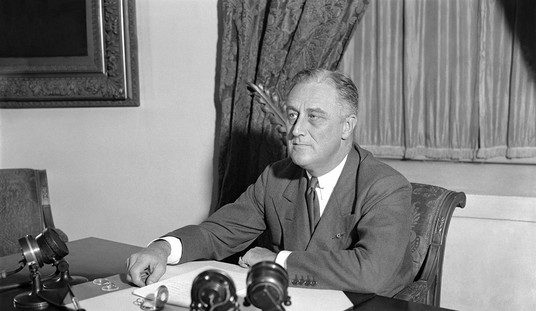
The issue back then was the Constitutionality of the newly minted tax known as the Social Security system. Was it not just a fancy mechanism for the government to raid your pocket in order to line its coffers?
Well, yes. But that’s not how Justice Cardozo saw it. “The discretion,” he said, “belongs to Congress” (“unless,” he added, jokester that he was, “the choice is clearly wrong, a display of arbitrary power, not an exercise of judgment.”)
Have you noticed how one man’s “arbitrary power” is another man’s legitimate “discretion”?
The really amusing thing about this whole charade of “sure-there-are-limits-on-Congress’s-power-to-obliterate-the distinction-between-meum-and-tuum” when it comes to your (“your”?) property is the venerableness of its historical precedent. Back in the late 1780s when Madison and Hamilton were trying to get the recalcitrant former colonists to line up and ratify the Constitution, they faced this issue squarely. At least Madison, who was far more concerned with placing limits of state power than his pal, faced it.
“Is the aggregate power of the general [we would say “federal”] government,” he asked in Federalist 41, “greater than ought to have been vested in it?”
It was a question Madison worried about. And he spent the balance of that number of the Federalist, and many others, trying to convince his readers (and, one suspects, sometimes even himself) that the answer was No: the government has to be vested with great powers but we have (famous word) “enumerated” them so as to limit them.
Part of Federalist 41 concerns the military and how much power the government ought to have to pay for it. But the second half deals with those bits of Article 1, Section 8 of the Constitution that bear upon Congress’s power to “levy and collect Taxes, Duties, Imposts and Excises, to pay the Debts and provide for the common Defense and general Welfare of the United States; . . .”
Seems pretty straightforward, doesn’t it? But exactly how far does said power reach? A lot of people worried about that. Was this not an “unlimited commission” to exercise power? No, no, said Madison. “No stronger proof could be given of the distress under which these writers labor for objections, than their stooping to such a misconstruction.”
Congress has power, including the power to tax. But, Madison says to the skeptics, those powers are enumerated. So not to worry. Sure, “Had no other enumeration or definition of the powers of the Congress been found in the Constitution, than the general expressions just cited, the authors of the objection might have had some color for it.” But the framers were careful to lay out the powers given to Congress. So:–
what color can the objection have, when a specification of the objects alluded to by these general terms immediately follows, and is not even separated by a longer pause than a semicolon?
Got that? Not even a full stop separates the investiture of Congress with power from the qualification and limitation of those powers. Madison’s logic is irresistible:
If the different parts of the same instrument ought to be so expounded, as to give meaning to every part which will bear it, shall one part of the same sentence be excluded altogether from a share in the meaning; and shall the more doubtful and indefinite terms be retained in their full extent, and the clear and precise expressions be denied any signification whatsoever? For what purpose could the enumeration of particular powers be inserted, if these and all others were meant to be included in the preceding general power?
You have to admire the clarity of his thought and the power of his expression:
Nothing is more natural nor common than first to use a general phrase, and then to explain and qualify it by a recital of particulars. But the idea of an enumeration of particulars which neither explain nor qualify the general meaning, and can have no other effect than to confound and mislead, is an absurdity . . .
I’m convinced. Unfortunately, the pressure of political expediency soon made mincemeat of Madison’s logic. We want to take more of your money. Does the Constitution limit our power to do that? Let’s have another look at that document and see what a little hermeneutical ingenuity, leavened by bad faith, fired by the desire to appropriate other people’s property, can do.
Turns out it can do a good deal. So the chief question is who gets to say what providing for the “general Welfare” means. You thought the general welfare involved maximizing individual liberty and securing a person’s private property? Too bad for you! We, who happen to control Congress, say the “general Welfare” means setting up expensive and ultimately unsustainable government programs that require us to take more and more money from you, the people who actually produce stuff, in the form of “Taxes, Duties, Imposts and Excises” — even, if you can believe it, in the form of health insurance for your lay-about neighbor down the street.
So this is where we are now. I don’t pretend to know what calculations Chief Justice Roberts made in formulating his surprising decision yesterday. Was he, as some assert, bullied? Doesn’t seem to me that he is a man to be bullied, but who knows? No one in the punditocracy does, that’s for sure. Was he cajoled and ultimately prevailed upon at the last minute to change his vote — if change it he did, as some are suggesting — by the Court’s left-wing in order to save the Court from being seen to “take sides” in an election? Maybe.
But maybe he pondered the case and decided that the issue of ObamaCare was really the province not of the Supreme Court but the voters. Obama and his minions consistently, indeed ostentatiously, insisted that the hilariously named “Affordable Care Act,” aka ObamaCare, was not a tax. When, in 2009, George Stephanopoulos said “[I]t’s still a tax increase,” Obama shot back “No. That’s not true, George.” Google it. The internet is full of transcripts and videos of Obama insisting that, whatever else it may be, the unaffordable “Affordable Care Act” is not a tax: no siree, never was a tax, never will be a tax. In short, it’s not a tax.
Except, of course, that the Supreme yesterday said that it is Constitutional only because it is a tax. In fact, it is the mother, grandmother, and great aunt of all taxes, the biggest, by far, in our country’s history (maybe the world). It’s not just one tax, either, but a veritable 21-tax salute.
So where are we now? The Democrats, who are not suicidal, will not be calling it a tax. (It all depends, don’t you know, on what the meaning of is is.) Mitt Romney, who wants to be president, certainly will be calling it a tax and will remind the middle class that, once this tax comes on-line, they will be a lot, lot poorer, thanks to Mr.-Hope-and-Change-just-count-me-Present-spread-the-wealth-around-Obama.
I like to think that this is one of those “teachable moments” we are supposed to applaud, a moment to revisit the breathtaking, if gradual, accretion of power by the federal government over the last 60 or 70 years. We are always being told by our masters in Washington that thus-and-such might be desirable but can’t be accomplished because it is politically inexpedient — that really reforming Social Security, say, is impossible because the voters wouldn’t stand for it, that any hint of an adumbration of changing Social Security would be political suicide, etc.
Maybe. Or maybe the chief justice just handed us an occasion to dramatize this debate in the biggest possible public forum: the general election for the presidency. I think Andy McCarthy has it exactly right when he observes that our pusillanimity with regard to programs like Social Security is a bi-paritsan liability.
[T]the country — very much including Republican leaders and many conservatives — has bought on to the wayward progressive premise that the General Welfare Clause of the Constitution empowers Congress to spend on anything it wants to spend on as long as their is some fig-leaf that ties the spending to the betterment of society. . . . Republicans are afraid to touch this because, if you follow the logic, you’d have to conclude that Congress has no constitutional authority to set up a Social Security system, a Medicare or Medicaid program, or most of the innumerable Big Government enterprises that Republicans support while, of course, decrying Big Government.
Personally, I’d like to turn the clock back to 1964 — to the early 1930s on Social Security — but people tell me I am being utopian. Think about it, though. Let’s agree with Samuel Johnson that “a decent provision for the poor is the true test of civilization.” Who says that the other Johnson, Lyndon Baines, was right when he instituted all those obscenely expensive programs and initiatives in order to be seen to “help the poor” — i.e., perpetuating their poverty — while assuring the hegemony of the Democratic Party as the dispenser of all those government goodies?
One pundit said that yesterday’s Supreme Court decision transformed the 2012 election from an ordinary election into a choice among fundamentally different visions. I thought it was pretty clear that that’s what it was all along, but yesterday’s decision certainly underscored the conflict. Here’s how I’d put it: do we want to be free citizens or wards of the state? We’ll see. Maybe John Roberts did the wrong thing yesterday. Or maybe those of us who are partisans of limited government and individual liberty will come to recognize that he just did us a big favor. Time will tell.





Join the conversation as a VIP Member